purple chokeberry
Aronia × prunifolia · Accepted scientific name
Scientific literature: Very Sparse (12 studies) · ★☆☆☆☆
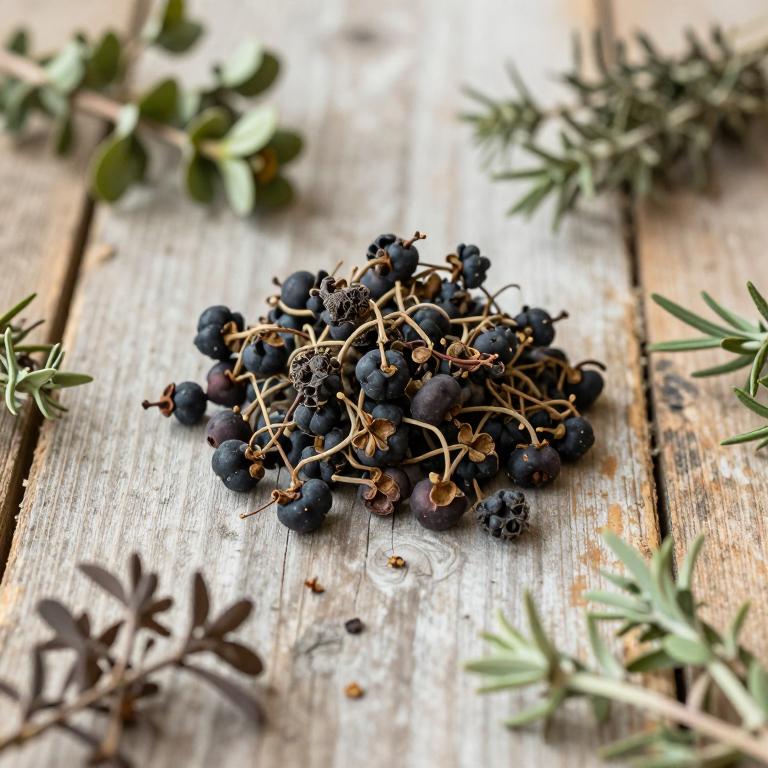
Purple chokeberry, scientifically known as Aronia × pruinifolia, is a resilient deciduous shrub celebrated for its potent antioxidant properties. Rich in anthocyanins and vitamins, its dark berries offer significant health benefits, including anti-inflammatory effects and cardiovascular support. This versatile plant is highly valued in both traditional medicine and nutrition.
- Family
- Rosaceae
- Native range
- Europe
- Parts used
- Not available
- Common names
- Purple Chokeberry · Purple Chokecherry
- Scientific synonyms
- Pyrus Melanocarpa Var. Atropurpurea · Aronia Arbutifolia Var. Atropurpurea · 22 more
Names and Synonyms
Common Names
- purple chokeberry
- purple chokecherry
Scientific Names
Accepted name
Aronia × prunifoliaSynonyms
- Pyrus melanocarpa var. atropurpurea
- Aronia arbutifolia var. atropurpurea
- Adenorachis atropurpurea
- Pyrus × hippomenes
- Aronia × glabrescens
- Pyrus atropurpurea
- Photinia × floribunda
- Malus domestica var. floribunda
- Mespilus × prunifolia
- Sorbus × floribunda
- Crataegus × prunifolia
- Sorbus × floribunda var. glabrescens
- Sorbus × floribunda var. typica
- Sorbus arbutifolia var. atropurpurea
- Aronia × floribunda
- Aronia atropurpurea
- Pyrus × parkmannii
- Pyrus × floribunda
- Aronia × floribunda var. glabrescens
- Pyrus arbutifolia f. pubescens
- Aronia × floribunda var. typica
- Pyrus arbutifolia var. atropurpurea
- Mespilus amelanchier var. prunifolia
- Crataegus × arbutifolia
Regional and Traditional Names
German:
- Apfelbeere
- Aronia
- schwarze Eberesche
French:
- arone noire
- aronie à feuilles de prunier
Sources: Catalogue of Life
Taxonomical Classification
This plant belongs to the kingdom Plantae and the phylum Streptophyta, falling under the class Equisetopsida and subclass Magnoliidae. Within the order Rosales and the family Rosaceae, it is classified under the genus Aronia. Specifically, Aronia × pruiniifolia represents a hybrid within this unique taxonomic lineage.
| Rank | Classification |
|---|---|
| Kingdom | Plantae |
| Phylum | Streptophyta |
| Class | Equisetopsida |
| Subclass | Magnoliidae |
| Order | Rosales |
| Family | Rosaceae |
| Genus | Aronia |
Sources: The World Checklist of Vascular Plants (WCVP)
Distribution
This plant exhibits a specific geographical distribution across several regions of Europe. In Northern Europe, its presence is noted within Great Britain. Moving into Middle Europe, the species can be found in Belgium. It is also widely distributed throughout Germany and the Netherlands. Finally, its range extends further into Middle Europe to include Poland.
| Region | Area |
|---|---|
| Northern Europe | Great Britain |
| Middle Europe | Belgium |
| Middle Europe | Germany |
| Middle Europe | Netherlands |
| Middle Europe | Poland |
| Southeastern Europe | Romania |
| Eastern Canada | Newfoundland |
| Eastern Canada | Ontario |
| Eastern Canada | Québec |
| North-Central U.S.A. | Wisconsin |
Sources: The World Checklist of Vascular Plants (WCVP)
Botanical Identification
Life history
The life history of Aronia × pruiniifolia is characterized by its status as a perennial plant, meaning it lives for more than two years and maintains its physiological functions through multiple growing seasons. As a long-lived woody species, it establishes a robust root system that allows it to persist in its environment, undergoing seasonal cycles of growth, flowering, and fruiting. During its active growing periods, the plant invests energy into developing leafy canopies and reproductive structures, often producing dark, nutrient-rich berries that facilitate its continued presence in the ecosystem. Because it follows a perennial lifecycle, it does not die after a single reproductive event but instead focuses on long-term survival and repeated seasonal productivity.
- Lifecycle :
- perennial
Morphology
The morphology of Aronia × pruiniifolia is characterized by a woody growth form, functioning as a self-supporting shrub. It is a terrestrial species, meaning it does not inhabit aquatic or semiaquatic environments, nor does it exist as an epiphyte. As an independent organism, it does not exhibit parasitic behavior, relying on its own structural integrity rather than acting as a climber, liana, or vine. Its physical structure is defined by its perennial woodiness, which supports its upright, shrubby habit.
- Aquatic :
- terrestrial
- Climber :
- self-supporting
- Epiphyte :
- terrestrial
- Growth form :
- shrub
- Parasite :
- independent
- Woodiness :
- woody
Physiology
The physiology of Aronia × pruiniifolia is characterized by a C3 photosynthetic pathway, a common metabolic strategy among temperate woody perennials that utilizes the enzyme RuBisCO for initial carbon fixation during the Calvin cycle. This metabolic framework supports the plant's growth in seasonal climates, allowing for efficient biomass production under moderate light and temperature conditions typical of its natural habitats. To complement this carbon assimilation process, the plant exhibits specialized physiological adaptations for nutrient uptake and water regulation, managing transpiration rates through controlled stomatal conductance to maintain turgor pressure. Furthermore, the physiological profile of this taxon includes the complex synthesis of secondary metabolites, particularly polyphenols and anthocyanins, which are integrated into its metabolic pathways to serve as antioxidant defense mechanisms against oxidative stress and environmental fluctuations.
- Photosynthetic pathway :
- C3
Sources: Global Inventory of Floras and Traits (GIFT)
Chemicals
Aronia × prunifolia has 11 reported phytochemicals identified across 0 scientific publications and several other databases. The most consistently reported chemicals include CHLOROGENIC ACID, CINNAMIC ACID, Cryptochlorogenic acid, Neochlorogenic acid, SYRINGIC ACID.
| Chemical | Supporting sources | Consensus |
|---|---|---|
| CHLOROGENIC ACID | 1 supporting sources | ★☆☆☆☆ |
| CINNAMIC ACID | 1 supporting sources | ★☆☆☆☆ |
| Cryptochlorogenic acid | 1 supporting sources | ★☆☆☆☆ |
| Neochlorogenic acid | 1 supporting sources | ★☆☆☆☆ |
| SYRINGIC ACID | 1 supporting sources | ★☆☆☆☆ |
| Vanillic acid | 1 supporting sources | ★☆☆☆☆ |
| benzoic acid | 1 supporting sources | ★☆☆☆☆ |
| caffeic acid | 1 supporting sources | ★☆☆☆☆ |
| phenylalanine | 1 supporting sources | ★☆☆☆☆ |
| protocatechuic acid | 1 supporting sources | ★☆☆☆☆ |
CHLOROGENIC ACID
- Molecules (Basel, Switzerland)
CINNAMIC ACID
- Molecules (Basel, Switzerland)
Cryptochlorogenic acid
- Molecules (Basel, Switzerland)
Neochlorogenic acid
- Molecules (Basel, Switzerland)
SYRINGIC ACID
- Molecules (Basel, Switzerland)
Vanillic acid
- Molecules (Basel, Switzerland)
benzoic acid
- Molecules (Basel, Switzerland)
caffeic acid
- Molecules (Basel, Switzerland)
phenylalanine
- Molecules (Basel, Switzerland)
protocatechuic acid
- Molecules (Basel, Switzerland)
Preparations
Aronia × prunifolia has 1 reported preparations identified across 0 scientific publications and several other databases. The most consistently reported preparations include agitated microshoot cultures.
| Preparation | Supporting sources | Consensus |
|---|---|---|
| Agitated microshoot cultures | 1 supporting sources | ★☆☆☆☆ |
Agitated microshoot cultures
- Molecules (Basel, Switzerland)