bog rosemary
Andromeda polifolia · Accepted scientific name
Scientific literature: Very Sparse (11 studies) · ★☆☆☆☆
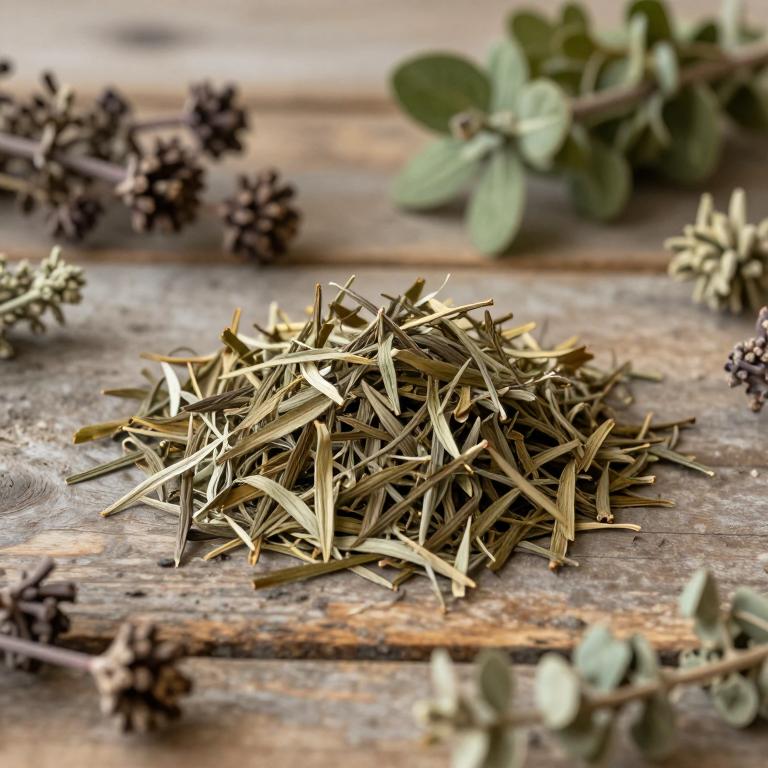
Bog rosemary, scientifically known as Andromeda poliifolia, is a resilient evergreen shrub native to acidic peatlands and coastal heaths. Characterized by its leathery leaves and bell-shaped flowers, this plant holds significant ethnobotanical importance. However, it contains toxic compounds, requiring careful handling and precise knowledge for medicinal applications.
- Family
- Ericaceae
- Native range
- Europe
- Parts used
- Not available
- Common names
- Bog Rosemary · Dwarf Bog Rosemary · 6 more
- Scientific synonyms
- Rhododendron Polifolium
Names and Synonyms
Common Names
- bog rosemary
- dwarf bog rosemary
- marsh holy rose
- northern bog rosemary
- Bog-Rosemary
- marsh holy-rose
- marsh holywort
- Wild Rosemary
Scientific Names
Accepted name
Andromeda polifoliaSynonyms
- Rhododendron polifolium
Regional and Traditional Names
Spanish:
- Andromeda
- romero de pantano
German:
- Rosmarinheide
- Gränke
- Poleirosmarinheide
- Polei-Gränke
- Andromeda rosmarinifolia
- Sumpfrosmarin
- Rosmarinheide
- Poleiblaettrige Andromeda Nom
French:
- andromède
- andromède
- andromède à feuilles de polium
- Andromede a feuilles de romarin
Sources: Wikidata, Catalogue of Life
Taxonomical Classification
This plant belongs to the kingdom Plantae and the phylum Streptophyta. Within the class Equisetopsida and subclass Magnoliidae, it is classified under the order Ericales and the family Ericaceae. Finally, it is identified by the genus Andromeda, specifically as the species Andromeda polifolia.
| Rank | Classification |
|---|---|
| Kingdom | Plantae |
| Phylum | Streptophyta |
| Class | Equisetopsida |
| Subclass | Magnoliidae |
| Order | Ericales |
| Family | Ericaceae |
| Genus | Andromeda |
Sources: The World Checklist of Vascular Plants (WCVP)
Distribution
This plant exhibits a specific geographical distribution concentrated within the regions of Northern Europe. It can be found growing naturally across the diverse landscapes of Denmark and Finland. Furthermore, its presence extends to the islands of Great Britain and Ireland. The species is also known to inhabit the northern territories of Norway. Overall, these five locations define the primary range for Andromeda poliifolia.
| Region | Area |
|---|---|
| Northern Europe | Denmark |
| Northern Europe | Finland |
| Northern Europe | Great Britain |
| Northern Europe | Ireland |
| Northern Europe | Norway |
| Northern Europe | Sweden |
| Middle Europe | Austria |
| Middle Europe | Belgium |
| Middle Europe | Czechia-Slovakia |
| Middle Europe | Germany |
Sources: The World Checklist of Vascular Plants (WCVP)
Botanical Identification
Ecology
The ecology of Andromeda polifolia is defined by its ability to thrive in diverse, moisture-rich environments across varying latitudes. This species is primarily found inhabiting forests, where it often occupies the understory, as well as near rivers and within swamps, where constant access to hydration is available. Additionally, its ecological range extends into the harsh, cold conditions of the tundra, demonstrating a significant adaptability to both temperate and arctic hydrological systems.
- Habitat :
- forest, rivers, swamps, tundra
Life history
The life history of Andromeda polifolia is characterized by its status as a perennial plant, ensuring its long-term persistence within its ecological niche. It exhibits a chamaephyte life form, maintaining its primary photosynthetic structures near the soil surface to withstand environmental stressors. This species is distinctly evergreen, retaining its foliage throughout the year to facilitate continuous metabolic processes. Its growth strategy is further defined by its classification as a chamaephety, allowing it to thrive through seasonal transitions while maintaining a stable, low-growing stature.
- Deciduousness :
- evergreen
- Life form :
- chamaephyte
- Lifecycle :
- perennial
Morphology
The morphology of Andromeda polifolia is characterized by its growth form as a woody shrub. It is a terrestrial, self-supporting plant that does not function as a climber or an epiphyte, nor does it exhibit parasitic behavior, remaining entirely independent. In terms of stature, the plant is relatively low-growing, with a height ranging from a minimum of 0.1 m to a maximum of 0.5 m, maintaining an average plant height of approximately 0.262 m.
- Aquatic :
- terrestrial
- Climber :
- self-supporting
- Epiphyte :
- terrestrial
- Growth form :
- shrub
- Parasite :
- independent
- Plant height max:
- 0.5 m
- Plant height mean:
- 0.262 m
- Plant height min:
- 0.1 m
- Woodiness :
- woody
Physiology
The physiology of Andromeda polifolia is characterized by a C3 photosynthetic pathway, indicating a standard carbon fixation process typical of many woody shrubs. The plant exhibits a non-carnivorous nutritional strategy, relying on traditional nutrient uptake through its root system rather than the digestion of prey. Morphologically, its leaf structure is relatively small, with a mean leaf size of 0.40375 cm², which contributes to its specific physiological profile. This leaf morphology is further defined by a mean Specific Leaf Area (SLA) of 77.21 cm²/g, a metric that reflects the relationship between the leaf's surface area and its dry mass, providing insight into its resource allocation and leaf thickness.
- Carnivory :
- non-carnivorous
- Leaf size mean:
- 0.40375 cm²
- Photosynthetic pathway :
- C3
- Specific Leaf Area (SLA) mean:
- 77.21 cm²/g
Reproduction
The reproduction of Andromeda polifolia is driven by a sexual process, as asexual reproduction is notably absent. The flowering period typically begins in April and concludes in June, during which the plant utilizes a biotic pollination syndrome. Specifically, the pollination process is mediated by insects, with bees playing a significant role in the transfer of pollen. Once fertilization occurs—a process supported by the presence of self-fertilization capabilities—the plant develops fruit in the form of a capsule. This capsule is characterized as being dehiscent, meaning it opens at maturity to release its seeds. The seeds are extremely lightweight, with a mean mass of approximately 0.00018967 g, ranging from a minimum of 0.000179 g to a maximum of 0.0002 g. Following dehiscence, the plant employs an anemochorous dispersal syndrome, utilizing wind to transport its small seeds to new locations.
- Dehiscence :
- dehiscent
- Dispersal syndrome :
- anemochorous
- Flowering time :
- Apr
- Flowering time :
- Jun
- Fruit type :
- capsule
- Pollination syndrome :
- insect
- Pollination syndrome :
- bee
- Pollination syndrome :
- biotic
- Reproduction asexual :
- absent
- Seed mass max:
- 2e-04 g
- Seed mass mean:
- 0.000189666666666667 g
- Seed mass min:
- 0.000179 g
- Self fertilization :
- present
Sources: Global Inventory of Floras and Traits (GIFT)
Chemicals
Andromeda polifolia has 11 reported phytochemicals identified across 0 scientific publications and several other databases. The most consistently reported chemicals include Avicularin, CD, CR, CU, FE.
| Chemical | Supporting sources | Consensus |
|---|---|---|
| Avicularin | 1 supporting sources | ★☆☆☆☆ |
| CD | 1 supporting sources | ★☆☆☆☆ |
| CR | 1 supporting sources | ★☆☆☆☆ |
| CU | 1 supporting sources | ★☆☆☆☆ |
| FE | 1 supporting sources | ★☆☆☆☆ |
| LI | 1 supporting sources | ★☆☆☆☆ |
| MN | 1 supporting sources | ★☆☆☆☆ |
| N- | 1 supporting sources | ★☆☆☆☆ |
| NI | 1 supporting sources | ★☆☆☆☆ |
| PB | 1 supporting sources | ★☆☆☆☆ |
Avicularin
- Planta medica
CD
- Journal of environmental science and health. Part A, Toxic/hazardous substances & environmental engineering
CR
- Journal of environmental science and health. Part A, Toxic/hazardous substances & environmental engineering
CU
- Journal of environmental science and health. Part A, Toxic/hazardous substances & environmental engineering
FE
- Journal of environmental science and health. Part A, Toxic/hazardous substances & environmental engineering
LI
- Journal of environmental science and health. Part A, Toxic/hazardous substances & environmental engineering
MN
- Journal of environmental science and health. Part A, Toxic/hazardous substances & environmental engineering
N-
- Journal of environmental science and health. Part A, Toxic/hazardous substances & environmental engineering
NI
- Journal of environmental science and health. Part A, Toxic/hazardous substances & environmental engineering
PB
- Journal of environmental science and health. Part A, Toxic/hazardous substances & environmental engineering