Lacy Ambrosia
Ambrosia tenuifolia · Accepted scientific name
Scientific literature: Very Sparse (6 studies) · ★☆☆☆☆
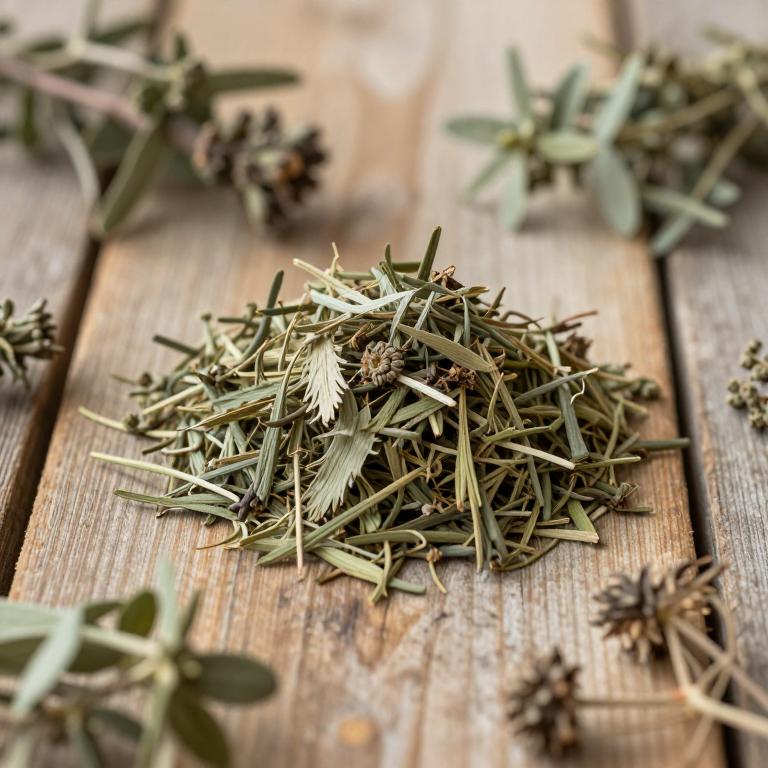
Lacy Ambrosia, scientifically known as Ambrosia tenuifolia, is a delicate, perennial herb cherished in traditional medicine. Characterized by its fine, fern-like foliage, this plant is valued for its diverse therapeutic properties. It is frequently utilized in herbal remedies to support digestive health and provide anti-inflammatory benefits in holistic wellness.
Names and Synonyms
Common Names
- Lacy Ambrosia
- bur ragweed
- lacy ragweed
- narrow-leaf ragweed
- slimleaf burr ragweed
Scientific Names
Accepted name
Ambrosia tenuifoliaSynonyms
- Gaertneria tenuifolia
- Ambrosia longistylis
- Ambrosia simulans
- Franseria tenuifolia
- Xanthidium tenuifolium
Regional and Traditional Names
Spanish:
- Altamisa
German:
- Schmalblättrige Ambrosie
French:
- Ambroise à petites feuilles
- Ambroisie à petites feuilles
Sources: Wikidata, Catalogue of Life
Taxonomical Classification
This plant belongs to the kingdom Plantae and the phylum Streptophyta, falling under the class Equisetopsida and subclass Magnoliidae. Within the order Asterales, it is classified under the family Asteraceae. It is further identified by the genus Ambrosia, specifically as the species Ambrosia tenuifolia.
| Rank | Classification |
|---|---|
| Kingdom | Plantae |
| Phylum | Streptophyta |
| Class | Equisetopsida |
| Subclass | Magnoliidae |
| Order | Asterales |
| Family | Asteraceae |
| Genus | Ambrosia |
Sources: The World Checklist of Vascular Plants (WCVP)
Distribution
This plant exhibits a diverse geographical distribution across several European regions. In Middle Europe, it can be found growing within Germany. Its presence extends to Southwestern Europe, specifically inhabiting the Balearic Islands, France, and Spain. Additionally, the species is located in Southeastern Europe, particularly in Italy. These varied locations highlight the wide range of habitats this medicinal plant occupies.
| Region | Area |
|---|---|
| Middle Europe | Germany |
| Southwestern Europe | Baleares |
| Southwestern Europe | France |
| Southwestern Europe | Spain |
| Southeastern Europe | Italy |
| Southeastern Europe | NW. Balkan Pen. |
| Southern Africa | Cape Provinces |
| Western Indian Ocean | Mauritius |
| Western Indian Ocean | Réunion |
| Western Asia | Palestine |
Sources: The World Checklist of Vascular Plants (WCVP)
Botanical Identification
Ecology
The ecology of Ambrosia tenuifolia is characterized by its adaptability to varied environments, ranging from sea level up to an elevation of 1000 m AMSL. This species is frequently found in anthropized areas (Área Antrópica), demonstrating a capacity to colonize landscapes modified by human activity, as well as within the specialized coastal ecosystems of Restinga. Its distribution across this elevational gradient and its presence in both disturbed and coastal habitats highlight its resilience within diverse ecological niches.
- Elevational range max:
- 1000 m AMSL
- Elevational range min:
- 0 m AMSL
- Habitat :
- Área Antrópica, Restinga
Life history
The life history of Ambrosia tenuifolia is characterized by its classification as a perennial plant, allowing it to persist across multiple growing seasons. In terms of its biological structure and survival strategy, it exhibits a complex life form profile, functioning as both a geophyte and a therophyte. As a geophyte, it relies on underground organs to survive unfavorable periods, while its therophyte nature indicates its capacity to complete its reproductive cycle via seeds, often leaving behind ephemeral aerial parts after the growing season.
- Life form :
- geophyte
- Life form :
- therophyte
- Lifecycle :
- perennial
Morphology
The morphology of Ambrosia tenuifolia is characterized by its growth form as a non-woody herb and specifically a forb. It is a self-supporting plant that does not function as a climber, liana, or vine, nor does it exhibit climbing behaviors. In terms of its ecological habit, the species is terrestrial rather than aquatic or semiaquatic, and it exists as an independent organism without parasitic tendencies. It does not function as an epiphyte, maintaining a strictly terrestrial existence. Regarding its physical dimensions, the plant is relatively small, reaching a maximum height of 1 meter.
- Aquatic :
- terrestrial
- Climber :
- self-supporting
- Epiphyte :
- terrestrial
- Growth form :
- herb
- Growth form :
- forb
- Parasite :
- independent
- Plant height max:
- 1 m
- Woodiness :
- non-woody
Physiology
The physiology of Ambrosia tenuifolia is characterized by a C3 photosynthetic pathway, which dictates its carbon fixation processes and metabolic efficiency in varying environmental conditions. The structural morphology of its foliage plays a critical role in its physiological performance, with leaf dimensions ranging from a minimum length of 2 cm to a maximum length of 8 cm. Furthermore, the leaf width varies between 4 cm and 5 cm, providing a specific surface area optimized for gas exchange and light interception consistent with its C3 metabolic framework.
- Leaf length max:
- 8 cm
- Leaf length min:
- 2 cm
- Leaf width max:
- 5 cm
- Leaf width min:
- 4 cm
- Photosynthetic pathway :
- C3
Reproduction
The reproduction of Ambrosia tenuifolia involves both sexual and asexual mechanisms to ensure its survival and dispersal within its habitat. Sexual reproduction is primarily facilitated through the production of small, inconspicuous flowers, which are typically wind-pollinated (anemophilous), leading to the development of seeds that serve as the main agent for long-distance colonization. In terms of its asexual reproduction, the presence of certain vegetative capabilities allows the plant to spread locally; however, the specific expression of these traits can vary, meaning that while asexual reproduction is present, its dominance or frequency may be absent or limited depending on environmental conditions and the specific life cycle stage of the individual.
- Reproduction asexual :
- present
Sources: Global Inventory of Floras and Traits (GIFT)
Chemicals
Ambrosia tenuifolia has 3 reported phytochemicals identified across 0 scientific publications and several other databases. The most consistently reported chemicals include Hispidulin, Peruvin, Psilostachyin.
| Chemical | Supporting sources | Consensus |
|---|---|---|
| Hispidulin | 1 supporting sources | ★☆☆☆☆ |
| Peruvin | 1 supporting sources | ★☆☆☆☆ |
| Psilostachyin | 1 supporting sources | ★☆☆☆☆ |
Hispidulin
- The American journal of tropical medicine and hygiene
Peruvin
- Antimicrobial agents and chemotherapy
Psilostachyin
- Antimicrobial agents and chemotherapy
Conditions
Ambrosia tenuifolia has 3 reported investigations on conditions identified across 0 scientific publications and several other databases. The most consistently reported conditions include Chagas' disease, Leishmania mexicana, leishmaniasis.
| Condition | Supporting sources | Consensus |
|---|---|---|
| Chagas' disease | 1 supporting sources | ★☆☆☆☆ |
| Leishmania mexicana | 1 supporting sources | ★☆☆☆☆ |
| Leishmaniasis | 1 supporting sources | ★☆☆☆☆ |
Chagas' disease
- Antimicrobial agents and chemotherapy
Leishmania mexicana
- The American journal of tropical medicine and hygiene
Leishmaniasis
- Antimicrobial agents and chemotherapy
Preparations
Ambrosia tenuifolia has 1 reported preparations identified across 0 scientific publications and several other databases. The most consistently reported preparations include organic extracts.
| Preparation | Supporting sources | Consensus |
|---|---|---|
| Organic extracts | 1 supporting sources | ★☆☆☆☆ |
Organic extracts
- Parasitology research