Aloe trigonantha
Aloe trigonantha · Accepted scientific name
Scientific literature: Very Sparse (3 studies) · ★☆☆☆☆
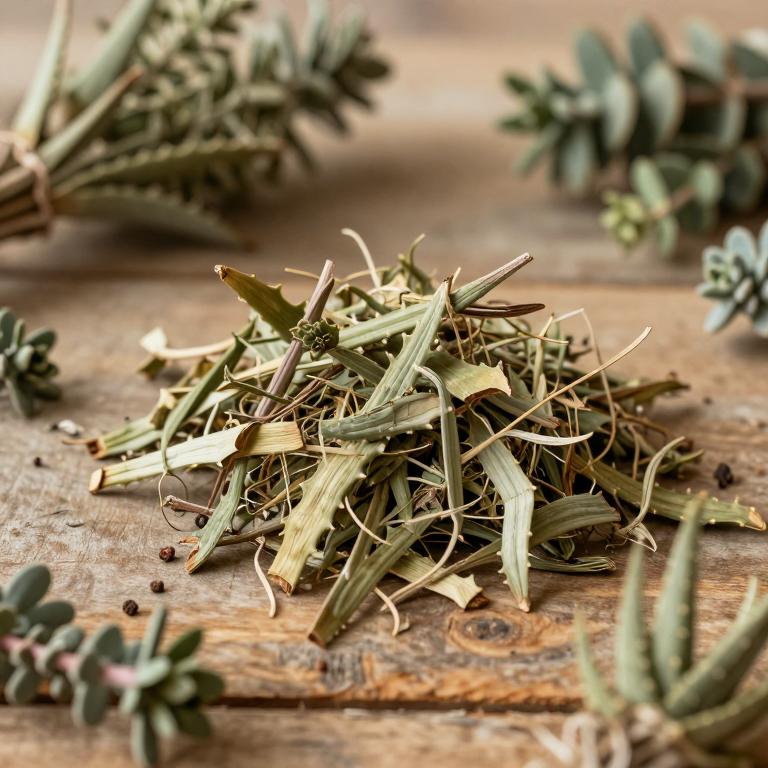
Aloe trigonantha, scientifically known as Aloe trigonantha, is a remarkable succulent native to the arid regions of Africa. Renowned for its unique geometric leaf structure, this medicinal plant offers significant therapeutic potential. It is traditionally utilized in various cultures to treat skin ailments, wounds, and various inflammatory conditions.
- Family
- Asphodelaceae
- Native range
- Africa
- Parts used
- Not available
- Common names
- Not available
- Scientific synonyms
- Not available
Names and Synonyms
Scientific Names
Accepted name
Aloe trigonanthaSources: Wikidata
Taxonomical Classification
This plant belongs to the kingdom Plantae and is classified under the phylum Streptophyta and the class Equisetopsida. Within the subclass Magnoliidae, it follows the order Asparagales and is a member of the family Asphodelaceae. Ultimately, it is categorized under the genus Aloe.
| Rank | Classification |
|---|---|
| Kingdom | Plantae |
| Phylum | Streptophyta |
| Class | Equisetopsida |
| Subclass | Magnoliidae |
| Order | Asparagales |
| Family | Asphodelaceae |
| Genus | Aloe |
Sources: The World Checklist of Vascular Plants (WCVP)
Distribution
This plant is characterized by a very specific and localized geographical distribution. It is primarily found within the region of Northeast Tropical Africa. Within this broader area, its occurrence is documented specifically in Ethiopia. Because of this limited range, the species remains confined to certain environmental niches in that country. Consequently, its natural habitat is restricted to these particular parts of the African continent.
| Region | Area |
|---|---|
| Northeast Tropical Africa | Ethiopia |
Sources: The World Checklist of Vascular Plants (WCVP)
Botanical Identification
Life history
The life history of Aloe trigonantha is characterized by its classification as a chamaephyte, a growth form that dictates its survival strategy in its native habitats. As a chamaephyte, the plant maintains its photosynthetic organs close to the ground, which serves as an evolutionary adaptation to manage environmental stressors such as high winds or intense solar radiation. This low-growing habit allows the species to utilize microclimates near the soil surface, protecting its core vegetative structures. Throughout its life cycle, the plant focuses on the development of succulent, fleshy leaves designed for efficient water storage, supporting its persistence during periods of drought. Its reproductive strategy involves the production of inflorescences that emerge from the basal rosette, facilitating pollination by specific fauna, while its life history is fundamentally shaped by its ability to endure fluctuating moisture levels through its specialized, low-profile architecture.
- Life form :
- chamaephyte
Morphology
The morphology of Aloe trigonantha is characterized by its growth form as a non-woody herb. It functions as an independent organism, exhibiting no parasitic behavior, and maintains a terrestrial lifestyle rather than an epiphytic one. Although it possesses structural characteristics that allow it to be classified as a self-supporting climber, it does not rely on external structures for its primary upward development.
- Climber :
- self-supporting
- Epiphyte :
- terrestrial
- Growth form :
- herb
- Parasite :
- independent
- Woodiness :
- non-woody
Sources: Global Inventory of Floras and Traits (GIFT)
Activities
Aloe trigonantha has 2 reported activities identified across 0 scientific publications and several other databases. The most consistently reported activities include Antibacterial, Antifungal.
| Activity | Supporting sources | Consensus |
|---|---|---|
| Antibacterial | 1 supporting sources | ★☆☆☆☆ |
| Antifungal | 1 supporting sources | ★☆☆☆☆ |
Antibacterial
- BMC complementary and alternative medicine
Antifungal
- BMC complementary and alternative medicine
Conditions
Aloe trigonantha has 1 reported investigations on conditions identified across 0 scientific publications and several other databases. The most consistently reported conditions include infectious diseases.
| Condition | Supporting sources | Consensus |
|---|---|---|
| Infectious diseases | 1 supporting sources | ★☆☆☆☆ |
Infectious diseases
- BMC complementary and alternative medicine