Aloe tormentorii
Aloe tormentorii · Accepted scientific name
Scientific literature: Very Sparse (7 studies) · ★☆☆☆☆
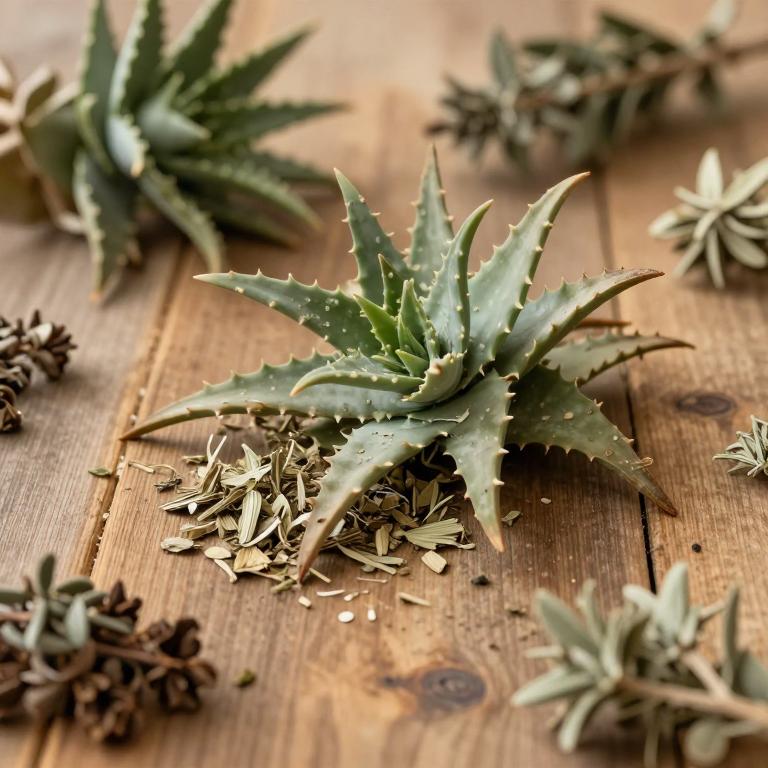
, scientifically known as Aloe tormentorii, is a resilient medicinal succulent distinguished by its unique healing properties. Thriving in specific arid environments, this plant is highly valued in traditional herbalism for its soothing capabilities. It serves as a potent natural remedy, offering therapeutic benefits for skin health and inflammation.
- Family
- Asphodelaceae
- Native range
- Africa
- Parts used
- Not available
- Common names
- Not available
- Scientific synonyms
- Lomatophyllum Tormentorii
Names and Synonyms
Scientific Names
Accepted name
Aloe tormentoriiSynonyms
- Lomatophyllum tormentorii
Sources: Wikidata, Catalogue of Life
Taxonomical Classification
This plant belongs to the kingdom Plantae and the phylum Streptophyta, falling within the class Equisetopsida and the subclass Magnoliidae. As a member of the order Asparagales and the family Asphodelaceae, it is classified under the genus Aloe.
| Rank | Classification |
|---|---|
| Kingdom | Plantae |
| Phylum | Streptophyta |
| Class | Equisetopsida |
| Subclass | Magnoliidae |
| Order | Asparagales |
| Family | Asphodelaceae |
| Genus | Aloe |
Sources: The World Checklist of Vascular Plants (WCVP)
Distribution
This plant, known as Aloe tormentorii, possesses a very specific and limited geographical range. It is native to the Western Indian Ocean region, where it thrives in unique island ecosystems. Specifically, its natural distribution is confined to the island of Mauritius. Within this tropical setting, the species occupies localized habitats that support its growth. Consequently, this narrow endemicity makes the plant a significant feature of the Mauritian landscape.
| Region | Area |
|---|---|
| Western Indian Ocean | Mauritius |
Sources: The World Checklist of Vascular Plants (WCVP)
Botanical Identification
Life history
The life history of Aloe tormentorii is characterized by its specialized growth habit and survival strategies within its natural habitat. As a perennial succulent, its life form is classified as a chamaephyte, a designation that reflects its tendency to maintain its photosynthetic structures close to the ground level to mitigate environmental stressors. This life strategy allows the plant to persist through varying seasonal conditions, often utilizing its fleshy leaves to store moisture and nutrients, which facilitates survival in arid or semi-arid environments. By maintaining a low-profile stature, the plant effectively manages heat exposure and wind desiccation while ensuring that its reproductive efforts are supported by a stable, perennial vegetative base.
- Life form :
- chamaephyte
Morphology
The morphology of Aloe tormentorii is characterized by a growth form classified as a herb, exhibiting a structural habit typical of many succulent species within its genus. It functions as an independent organism, showing no parasitic tendencies toward other plants, and maintains a terrestrial existence, growing in soil rather than as an epiphyte. Regarding its physical support, the plant is self-supporting, requiring no external structures for vertical stability as it follows its own upright or rosette-based developmental pattern.
- Climber :
- self-supporting
- Epiphyte :
- terrestrial
- Growth form :
- herb
- Parasite :
- independent
Physiology
The physiology of Aloe tormentorii is characterized by a specialized metabolic framework designed to manage water efficiency and carbon fixation. This species utilizes the C3 photosynthetic pathway, a process where the first stable product of carbon fixation is a three-carbon molecule produced via the enzyme RuBisCO during the Calvin cycle. Unlike many other members of the genus Aloe that have evolved Crassulacean Acid Metabolism (CAM) to facilitate nocturnal CO2 uptake and minimize transpiration in arid environments, the physiological profile of this specific plant relies on the standard C3 mechanism for converting light energy into chemical energy. This pathway involves the absorption of sunlight by chlorophyll within the chloroplasts to drive the conversion of water and carbon dioxide into glucose, necessitating a physiological balance between gas exchange through stomata and the prevention of excessive moisture loss.
- Photosynthetic pathway :
- C3
Sources: Global Inventory of Floras and Traits (GIFT)
Chemicals
Aloe tormentorii has 7 reported phytochemicals identified across 0 scientific publications and several other databases. The most consistently reported chemicals include Anthraquinones, Chromones, arabinose, fucose, galactose.
| Chemical | Supporting sources | Consensus |
|---|---|---|
| Anthraquinones | 1 supporting sources | ★☆☆☆☆ |
| Chromones | 1 supporting sources | ★☆☆☆☆ |
| arabinose | 1 supporting sources | ★☆☆☆☆ |
| fucose | 1 supporting sources | ★☆☆☆☆ |
| galactose | 1 supporting sources | ★☆☆☆☆ |
| mannose | 1 supporting sources | ★☆☆☆☆ |
| xylose | 1 supporting sources | ★☆☆☆☆ |
Anthraquinones
- Fitoterapia
Chromones
- Fitoterapia
arabinose
- Fitoterapia
fucose
- Fitoterapia
galactose
- Fitoterapia
mannose
- Fitoterapia
xylose
- Fitoterapia