Aloe nyeriensis
Aloe nyeriensis · Accepted scientific name
Scientific literature: Very Sparse (2 studies) · ★☆☆☆☆
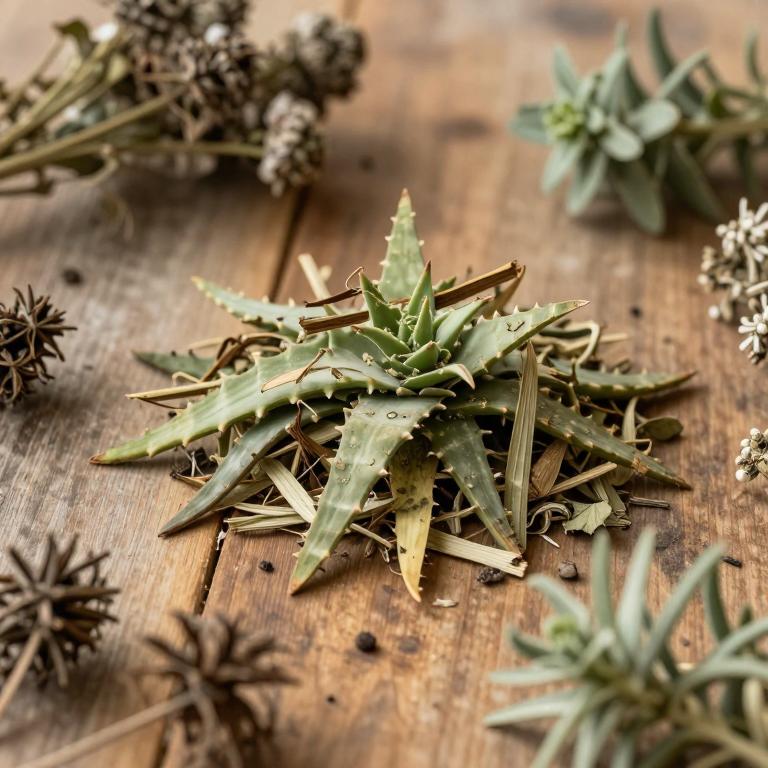
, scientifically known as Aloe nyeriensis, is a remarkable succulent native to the tropical regions of Africa. Characterized by its robust, fleshy leaves and striking architectural form, this species is prized in traditional medicine for its healing properties, offering potent antioxidant and anti-inflammatory benefits for diverse skin conditions.
- Family
- Asphodelaceae
- Native range
- Africa
- Parts used
- Not available
- Common names
- Not available
- Scientific synonyms
- Not available
Names and Synonyms
Scientific Names
Accepted name
Aloe nyeriensisRegional and Traditional Names
French:
- Aloe ngobitensis
Sources: Wikidata
Taxonomical Classification
This plant belongs to the kingdom Plantae and is classified under the phylum Streptophyta within the class Equisetopsida. As a member of the subclass Magnoliidae and the order Asparagales, it is situated in the family Asphodelaceae. It is specifically identified under the genus Aloe.
| Rank | Classification |
|---|---|
| Kingdom | Plantae |
| Phylum | Streptophyta |
| Class | Equisetopsida |
| Subclass | Magnoliidae |
| Order | Asparagales |
| Family | Asphodelaceae |
| Genus | Aloe |
Sources: The World Checklist of Vascular Plants (WCVP)
Distribution
This plant, known scientifically as Aloe nyeriensis, exhibits a very specific and limited range of occurrence. Its primary geographical presence is concentrated within the region of East Tropical Africa. Specifically, this medicinal species can be found growing in the country of Kenya. Because its habitat is so localized, it is considered a characteristic element of that particular African landscape. Understanding this narrow distribution is essential for the conservation and study of the species.
| Region | Area |
|---|---|
| East Tropical Africa | Kenya |
Sources: The World Checklist of Vascular Plants (WCVP)
Botanical Identification
Life history
The life history of Aloe nyeriensis is characterized by its status as a perennial plant, allowing it to persist through multiple growing seasons. It exhibits a dual classification in terms of growth architecture, functioning as both a phanerophyte and a nanophanerophyte, which reflects its structural development and height relative to the ground surface. Throughout its existence, the plant maintains an evergreen deciduousness, ensuring that its foliage remains functional and green regardless of seasonal shifts.
- Deciduousness :
- evergreen
- Life form :
- nanophanerophyte
- Life form :
- phanerophyte
- Lifecycle :
- perennial
Morphology
The morphology of Aloe nyeriensis is characterized by a shrub-like growth form with a predominantly woody structure. This plant reaches a mean height of approximately 2 meters and functions as a self-supporting organism rather than a climber. It is an independent species that does not exhibit parasitic behavior, maintaining a terrestrial existence rather than growing as an epiphyte.
- Climber :
- self-supporting
- Epiphyte :
- terrestrial
- Growth form :
- shrub
- Parasite :
- independent
- Plant height mean:
- 2 m
- Woodiness :
- woody
Physiology
The physiology of Aloe nyeriensis is characterized by its specialized Crassulacean Acid Metabolism (CAM), a photosynthetic adaptation that allows the plant to conserve water by fixing carbon dioxide at night and performing the Calvin cycle during the day. This metabolic pathway is essential for survival in arid environments, as it minimizes transpirational water loss through stomatal closure during peak heat. The plant's internal structures are optimized for succulent water storage within large, parenchymatous cells that maintain turgor pressure and facilitate nutrient transport. Regarding its nutrient cycling capabilities, Aloe nyeriensis does not function as a nitrogen fixer; it lacks the symbiotic relationship with diazotrophic bacteria, such as Rhizobium, necessary to convert atmospheric nitrogen into bioavailable forms, meaning it must rely on organic matter and soil minerals for its nitrogen requirements.
- Nitrogen fixer :
- no
Sources: Global Inventory of Floras and Traits (GIFT)
Chemicals
Aloe nyeriensis has 2 reported phytochemicals identified across 0 scientific publications and several other databases. The most consistently reported chemicals include methanol, water.
| Chemical | Supporting sources | Consensus |
|---|---|---|
| methanol | 1 supporting sources | ★☆☆☆☆ |
| water | 1 supporting sources | ★☆☆☆☆ |
methanol
- Journal of ethnopharmacology
water
- Journal of ethnopharmacology
Preparations
Aloe nyeriensis has 3 reported preparations identified across 0 scientific publications and several other databases. The most consistently reported preparations include Aqueous extracts, methanol, water.
| Preparation | Supporting sources | Consensus |
|---|---|---|
| Aqueous extracts | 1 supporting sources | ★☆☆☆☆ |
| Methanol | 1 supporting sources | ★☆☆☆☆ |
| Water | 1 supporting sources | ★☆☆☆☆ |
Aqueous extracts
- Journal of ethnopharmacology
Methanol
- Journal of ethnopharmacology
Water
- Journal of ethnopharmacology