Cape speckled aloe
Aloe microstigma · Accepted scientific name
Scientific literature: Very Sparse (1 studies) · ★☆☆☆☆
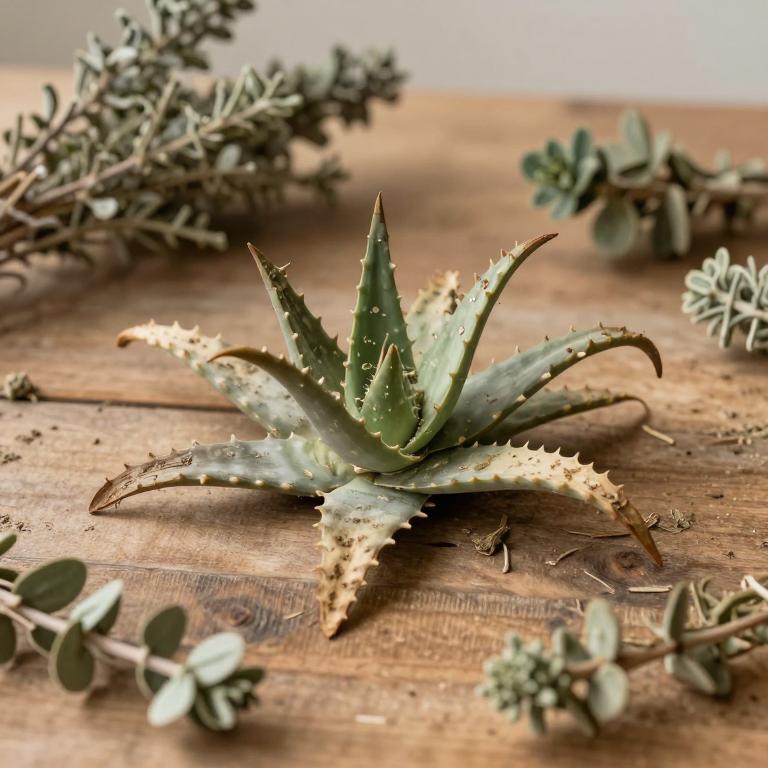
Cape speckled aloe, scientifically known as Aloe microstigma, is a charming, small-statured succulent native to South Africa. Characterized by its compact rosette and distinctive tiny white spots, this hardy species thrives in rocky habitats. It is highly valued by collectors for its striking aesthetics and ability to bloom beautifully.
- Family
- Asphodelaceae
- Native range
- Africa
- Parts used
- Not available
- Common names
- Not available
- Scientific synonyms
- Aloe Perfoliata
Names and Synonyms
Scientific Names
Accepted name
Aloe microstigmaSynonyms
- Aloe perfoliata
Sources: Wikidata
Taxonomical Classification
This plant belongs to the kingdom Plantae and the phylum Streptophyta, falling under the class Equisetopsida and subclass Magnoliidae. Within the order Asparagales, it is classified under the family Asphodelaceae. Finally, its specific taxonomic identity is established within the genus Aloe.
| Rank | Classification |
|---|---|
| Kingdom | Plantae |
| Phylum | Streptophyta |
| Class | Equisetopsida |
| Subclass | Magnoliidae |
| Order | Asparagales |
| Family | Asphodelaceae |
| Genus | Aloe |
Sources: The World Checklist of Vascular Plants (WCVP)
Distribution
This plant is primarily distributed across the southern portion of the African continent. Specifically, its natural habitat includes various regions within the Cape Provinces of Southern Africa. In addition to these areas, the species can also be found extending into Namibia. This localized range highlights the specific environmental conditions required for its growth. Consequently, its geographical footprint is concentrated within these distinct southern African territories.
| Region | Area |
|---|---|
| Southern Africa | Cape Provinces |
| Southern Africa | Namibia |
Sources: The World Checklist of Vascular Plants (WCVP)
Botanical Identification
Ecology
The ecology of Aloe microsstigma is characterized by its preference for coastal habitats, where it thrives within a specific altitudinal gradient. This species is found distributed from sea level up to a maximum elevation of 1450 m AMSL. Its presence in these coastal environments suggests an adaptation to the unique environmental pressures associated with maritime proximity and varying topographical elevations.
- Elevational range max:
- 1450 m AMSL
- Elevational range min:
- 0 m AMSL
- Habitat :
- Coastal
Life history
The life history of Aloe microsstigma is characterized by a perennial lifecycle, allowing the plant to persist through multiple growing seasons rather than completing its cycle within a single year. In terms of its structural growth patterns and ecological positioning, the species exhibits a complex life form classification, manifesting as both a nanophanerophyte and a phanerophyte. This dual classification indicates a growth habit where the stems or reproductive structures may remain relatively low to the ground or elevated, providing a resilient physiological framework that supports its long-term survival in its native environment.
- Life form :
- nanophanerophyte
- Life form :
- phanerophyte
- Lifecycle :
- perennial
Morphology
The morphology of Aloe microsstigma is characterized by a woody growth form that functions as both a herb and a shrub. This terrestrial plant is self-supporting rather than being a climber or an epiphyte, and it grows independently as a non-parasitic organism. In terms of stature, it exhibits significant height variation, with individual plants typically reaching a minimum height of 0.5 m and a maximum height of 2 m, maintaining an average plant height of approximately 0.7 m.
- Aquatic :
- terrestrial
- Climber :
- self-supporting
- Epiphyte :
- terrestrial
- Growth form :
- herb
- Growth form :
- shrub
- Parasite :
- independent
- Plant height max:
- 2 m
- Plant height mean:
- 0.7 m
- Plant height min:
- 0.5 m
- Woodiness :
- woody
Physiology
The physiology of Aloe microsstigma is characterized by highly specialized morphological and metabolic adaptations designed for efficiency in arid environments. Centrally, the plant utilizes the Crassulacean Acid Metabolism (CAM) photosynthetic pathway, a vital physiological mechanism that allows for nocturnal carbon dioxide uptake to minimize transpirational water loss during the heat of the day. Structurally, the plant's foliage is defined by robust, succulent leaves that serve as primary water storage organs. These leaves exhibit a consistent width of 8.5 cm, with both the mean and minimum measurements remaining stable at this value. In terms of longitudinal growth, the leaf length reaches a maximum of 22.5 cm, providing a significant surface area for light interception while maintaining the structural integrity necessary for its specialized metabolic processes.
- Leaf length max:
- 22.5 cm
- Leaf width mean:
- 8.5 cm
- Photosynthetic pathway :
- CAM
Reproduction
The reproduction of Aloe microsstigma is characterized by specific morphological dimensions of its reproductive structures, particularly regarding its fruit and seed development. The plant produces fruit that reach an average length of 3.3 cm. Within these fruits, the seeds exhibit significant variability in mass, ranging from a minimum of 0.00091 g to a maximum of 0.00279 g. On average, the seed mass for this species is recorded at 0.0017183335 g, reflecting the fine-scale biological investment required for its propagule production.
- Fruit length mean:
- 3.3 cm
- Seed mass max:
- 0.00279 g
- Seed mass mean:
- 0.0017183335 g
- Seed mass min:
- 0.00091 g
Sources: Global Inventory of Floras and Traits (GIFT)
Chemicals
Aloe microstigma has 1 reported phytochemicals identified across 0 scientific publications and several other databases. The most consistently reported chemicals include MANGANESE.
| Chemical | Supporting sources | Consensus |
|---|---|---|
| MANGANESE | 1 supporting sources | ★☆☆☆☆ |
MANGANESE
- Ancient science of life