Aloe megalacantha
Aloe megalacantha · Accepted scientific name
Scientific literature: Very Sparse (14 studies) · ★☆☆☆☆
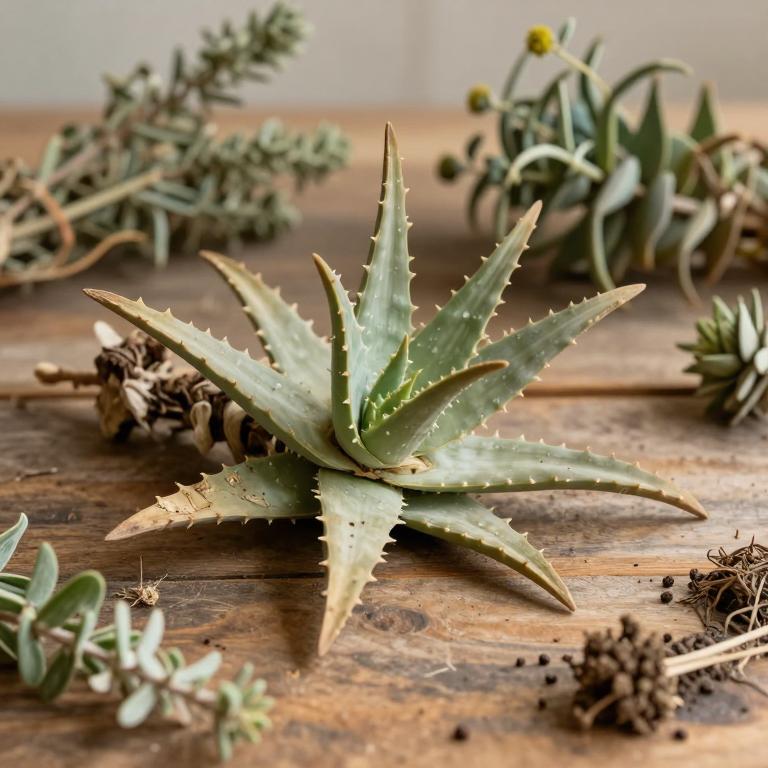
, scientifically known as Aloe megalacantha, is a distinctive succulent species native to the arid regions of Africa. Characterized by its robust, fleshy leaves and unique floral structure, this plant plays a vital role in its ecosystem and holds significant potential in traditional medicine for its soothing, healing properties.
- Family
- Asphodelaceae
- Native range
- Africa
- Parts used
- Leaf
- Common names
- Not available
- Scientific synonyms
- Not available
Names and Synonyms
Scientific Names
Accepted name
Aloe megalacanthaSources: Wikidata
Taxonomical Classification
This plant belongs to the kingdom Plantae and the phylum Streptophyta, falling under the class Equisetopsida and subclass Magnoliidae. Within the order Asparagales, it is classified under the family Asphodelaceae. Finally, its taxonomic placement concludes within the genus Aloe.
| Rank | Classification |
|---|---|
| Kingdom | Plantae |
| Phylum | Streptophyta |
| Class | Equisetopsida |
| Subclass | Magnoliidae |
| Order | Asparagales |
| Family | Asphodelaceae |
| Genus | Aloe |
Sources: The World Checklist of Vascular Plants (WCVP)
Distribution
This plant is characterized by a specific geographical distribution within the Northeast Tropical Africa region. It is primarily found inhabiting the landscapes of Ethiopia. Additionally, its natural range extends into the territory of Somalia. These two countries represent the core areas where the species can be located in the wild. Therefore, its presence is concentrated within these specific East African nations.
| Region | Area |
|---|---|
| Northeast Tropical Africa | Ethiopia |
| Northeast Tropical Africa | Somalia |
Sources: The World Checklist of Vascular Plants (WCVP)
Botanical Identification
Life history
The life history of Aloe megalacantha is characterized by its specific growth strategies and structural adaptations to its environment, classified under two distinct life form categories. Primarily, it functions as a phanerophyte, meaning its perennating buds are located well above the ground, allowing it to maintain a visible presence and sustain its growth through seasonal changes. Additionally, it exhibits traits of a nanophanerophyte, indicating that while it maintains its perennial structure, its height is relatively low and compact compared to larger woody species. This dual classification highlights a robust survival mechanism where the plant maintains elevated buds to protect its reproductive and vegetative potential while staying within a specialized stature suited for its ecological niche.
- Life form :
- nanophanerophyte
- Life form :
- phanerophyte
Morphology
The morphology of Aloe megalacantha is characterized by its growth form as a herb, which lacks any woody structure and is classified as non-woody. It functions as an independent organism, neither acting as a parasite nor as an epiphyte, as it maintains a strictly terrestrial existence. Furthermore, the plant is not a climber; it does not possess the structural capacity for climbing behavior, whether obligatory, facultative, or self-supporting.
- Climber :
- self-supporting
- Epiphyte :
- terrestrial
- Growth form :
- herb
- Parasite :
- independent
- Woodiness :
- non-woody
Sources: Global Inventory of Floras and Traits (GIFT)
Plant Parts
Aloe megalacantha has 1 reported plant parts identified across 1 scientific publications and several other databases that are studied for medicinal purposes. The most consistently reported plant part include leaf.
| Plant part | Supporting sources | Consensus |
|---|---|---|
| Leaf | 1 supporting sources | ★☆☆☆☆ |
Leaf
- International journal of microbiology
Activities
Aloe megalacantha has 3 reported activities identified across 1 scientific publications and several other databases. The most consistently reported activities include Antibacterial, Antifungal, Antihyperglycemic.
| Activity | Supporting sources | Consensus |
|---|---|---|
| Antibacterial | 1 supporting sources | ★☆☆☆☆ |
| Antifungal | 1 supporting sources | ★☆☆☆☆ |
| Antihyperglycemic | 1 supporting sources | ★☆☆☆☆ |
Antibacterial
- International journal of microbiology
Antifungal
- International journal of microbiology
Antihyperglycemic
- Diabetes, metabolic syndrome and obesity : targets and therapy
Conditions
Aloe megalacantha has 9 reported investigations on conditions identified across 1 scientific publications and several other databases. The most consistently reported conditions include malaria, abdominal pain, amoeba, ascariasis, dandruff.
| Condition | Supporting sources | Consensus |
|---|---|---|
| Malaria | 2 supporting sources | ★☆☆☆☆ |
| Abdominal pain | 1 supporting sources | ★☆☆☆☆ |
| Amoeba | 1 supporting sources | ★☆☆☆☆ |
| Ascariasis | 1 supporting sources | ★☆☆☆☆ |
| Dandruff | 1 supporting sources | ★☆☆☆☆ |
| Diabetes mellitus | 1 supporting sources | ★☆☆☆☆ |
| Impotence | 1 supporting sources | ★☆☆☆☆ |
| Snake bite | 1 supporting sources | ★☆☆☆☆ |
| Wound | 1 supporting sources | ★☆☆☆☆ |
Malaria
- Journal of ethnobiology and ethnomedicine
- International journal of microbiology
Abdominal pain
- International journal of microbiology
Amoeba
- International journal of microbiology
Ascariasis
- International journal of microbiology
Dandruff
- International journal of microbiology
Diabetes mellitus
- Metabolism open
Impotence
- International journal of microbiology
Snake bite
- International journal of microbiology
Wound
- International journal of microbiology
Preparations
Aloe megalacantha has 2 reported preparations identified across 1 scientific publications and several other databases. The most consistently reported preparations include exudate, leaf exudate.
| Preparation | Supporting sources | Consensus |
|---|---|---|
| Exudate | 1 supporting sources | ★☆☆☆☆ |
| Leaf exudate | 1 supporting sources | ★☆☆☆☆ |
Exudate
- Diabetes, metabolic syndrome and obesity : targets and therapy
Leaf exudate
- International journal of microbiology