Mountain aloe
Aloe marlothii · Accepted scientific name
Scientific literature: Very Sparse (8 studies) · ★☆☆☆☆
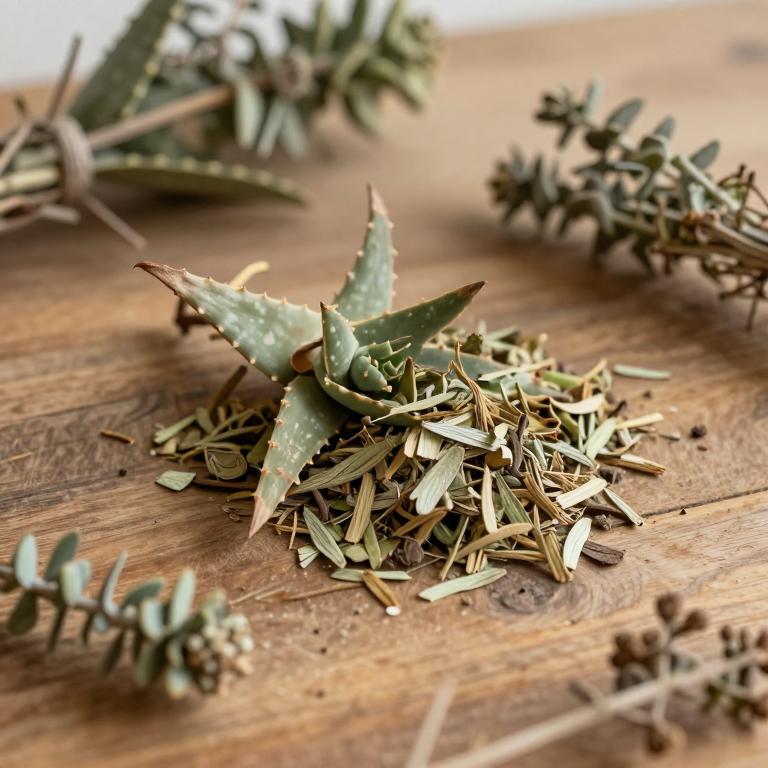
Mountain aloe, scientifically known as Aloe marlothii, is a striking succulent native to the rocky slopes of Southern Africa. Characterized by its robust, fleshy leaves and vibrant orange-red flowers, this resilient species is highly valued in traditional medicine for its soothing, anti-inflammatory, and wound-healing properties in diverse herbal remedies.
- Family
- Asphodelaceae
- Native range
- Africa
- Parts used
- Leaf
- Common names
- Flat-Flowered Aloe · Mountain Aloe
- Scientific synonyms
- Not available
Names and Synonyms
Common Names
- Flat-flowered Aloe
- Mountain Aloe
Scientific Names
Accepted name
Aloe marlothiiRegional and Traditional Names
French:
- Aloès de montagne
- Aloès de montagne
Sources: Wikidata, Catalogue of Life
Taxonomical Classification
This plant belongs to the kingdom Plantae and is classified under the phylum Streptophyta and the class Equisetopsida. Within the subclass Magnoliidae, it is further categorized under the order Asparagales and the family Asphodelaceae. Finally, it is placed within the genus Aloe.
| Rank | Classification |
|---|---|
| Kingdom | Plantae |
| Phylum | Streptophyta |
| Class | Equisetopsida |
| Subclass | Magnoliidae |
| Order | Asparagales |
| Family | Asphodelaceae |
| Genus | Aloe |
Sources: The World Checklist of Vascular Plants (WCVP)
Distribution
This plant exhibits a diverse geographical distribution across several key regions in Africa. Within South Tropical Africa, it can be specifically found in Mozambique. Its presence extends further into Southern Africa, where it inhabits the country of Botswana. In the South African region, the species is located in both KwaZulu-Natal and the Free State. Finally, the plant is also documented as growing within Eswatini.
| Region | Area |
|---|---|
| South Tropical Africa | Mozambique |
| Southern Africa | Botswana |
| Southern Africa | KwaZulu-Natal |
| Southern Africa | Free State |
| Southern Africa | Eswatini |
| Southern Africa | Northern Provinces |
Sources: The World Checklist of Vascular Plants (WCVP)
Botanical Identification
Ecology
The ecology of Aloe marlothii is characterized by its ability to inhabit a broad altitudinal gradient, allowing it to thrive across diverse topographical landscapes. This species is found at elevations ranging from 0 m AMSL to a maximum of 1600 m AMSL, demonstrating significant adaptability to varying environmental pressures and temperature regimes. This wide elevational range suggests that the plant can persist in both lowland coastal or valley environments and higher-altitude montane habitats, provided the specific edaphic and moisture requirements of its niche are met. Such ecological plasticity enables the species to occupy various microclimates within its geographic distribution, spanning from sea level to sub-montane zones.
- Elevational range max:
- 1600 m AMSL
- Elevational range min:
- 0 m AMSL
Life history
The life history of Aloe marlothii is characterized by its status as a perennial plant, allowing it to persist through multiple growing seasons. It functions biologically as a chamaephyte, maintaining its growth points close to the soil surface, which aids in its survival within its specific ecological niche. Throughout its existence, the plant exhibits an evergreen deciduousness, ensuring that its foliage remains functional and green across varying seasonal cycles rather than shedding all its leaves annually.
- Deciduousness :
- evergreen
- Life form :
- chamaephyte
- Lifecycle :
- perennial
Morphology
The morphology of Aloe marlothii is characterized by a robust growth form that can manifest as both a tree and a shrub. This plant is a woody, terrestrial species that functions as an independent organism rather than a parasite or epiphyte. It is a self-supporting plant that does not exhibit climbing habits. In terms of stature, its height is quite variable, ranging from a minimum of 1.5 meters to a maximum of 10 meters, with a mean plant height of approximately 3 meters.
- Aquatic :
- terrestrial
- Climber :
- self-supporting
- Epiphyte :
- terrestrial
- Growth form :
- tree
- Growth form :
- shrub
- Parasite :
- independent
- Plant height max:
- 10 m
- Plant height mean:
- 3 m
- Plant height min:
- 1.5 m
- Woodiness :
- woody
Physiology
The physiology of Aloe marlothii is characterized by specific metabolic adaptations suited to its environmental niche. The plant utilizes the C3 photosynthetic pathway to facilitate carbon fixation, relying on the direct carboxylation of ribulose-1,5-bisphosphate by the enzyme RuBisCO. Additionally, in terms of nutrient cycling and symbiotic relationships, Aloe marlothii does not function as a nitrogen fixer, lacking the specialized biological mechanisms or symbiotic associations required to convert atmospheric nitrogen into a usable form for plant growth.
- Nitrogen fixer :
- no
- Photosynthetic pathway :
- C3
Reproduction
The reproduction of Aloe marlothii is driven by a biotic pollination syndrome, specifically relying on bees to facilitate the transfer of pollen between flowers. The reproductive output of the species is characterized by the production of relatively small seeds, which exhibit a specific mass distribution. The individual seed mass ranges from a minimum of 0.00144 g to a maximum of 0.00182 g, with a calculated mean seed mass of 0.00163 g.
- Pollination syndrome :
- bee
- Pollination syndrome :
- biotic
- Seed mass max:
- 0.00182 g
- Seed mass mean:
- 0.00163 g
- Seed mass min:
- 0.00144 g
Sources: Global Inventory of Floras and Traits (GIFT)
Plant Parts
Aloe marlothii has 1 reported plant parts identified across 2 scientific publications and several other databases that are studied for medicinal purposes. The most consistently reported plant part include leaf.
| Plant part | Supporting sources | Consensus |
|---|---|---|
| Leaf | 2 supporting sources | ★☆☆☆☆ |
Leaf
- Phytochemistry
- Journal of ethnopharmacology
Chemicals
Aloe marlothii has 2 reported phytochemicals identified across 2 scientific publications and several other databases. The most consistently reported chemicals include 5-Hydroxyaloin A 6'-O-acetate, 7-O-Methylaloeresin A.
| Chemical | Supporting sources | Consensus |
|---|---|---|
| 5-Hydroxyaloin A 6'-O-acetate | 1 supporting sources | ★☆☆☆☆ |
| 7-O-Methylaloeresin A | 1 supporting sources | ★☆☆☆☆ |
5-Hydroxyaloin A 6'-O-acetate
- Phytochemistry
7-O-Methylaloeresin A
- Phytochemistry
Conditions
Aloe marlothii has 3 reported investigations on conditions identified across 2 scientific publications and several other databases. The most consistently reported conditions include Babesia, respiratory infections, wound healing.
| Condition | Supporting sources | Consensus |
|---|---|---|
| Babesia | 1 supporting sources | ★☆☆☆☆ |
| Respiratory infections | 1 supporting sources | ★☆☆☆☆ |
| Wound healing | 1 supporting sources | ★☆☆☆☆ |
Babesia
- Veterinary parasitology
Respiratory infections
- Journal of ethnopharmacology
Wound healing
- Journal of ethnopharmacology
Preparations
Aloe marlothii has 5 reported preparations identified across 2 scientific publications and several other databases. The most consistently reported preparations include A. marlothii gel, A. marlothii whole-leaf, gel, leaf exudate, whole-leaf materials.
| Preparation | Supporting sources | Consensus |
|---|---|---|
| A. marlothii gel | 1 supporting sources | ★☆☆☆☆ |
| A. marlothii whole-leaf | 1 supporting sources | ★☆☆☆☆ |
| Gel | 1 supporting sources | ★☆☆☆☆ |
| Leaf exudate | 1 supporting sources | ★☆☆☆☆ |
| Whole-leaf materials | 1 supporting sources | ★☆☆☆☆ |
A. marlothii gel
- Journal of ethnopharmacology
A. marlothii whole-leaf
- Journal of ethnopharmacology
Gel
- Journal of ethnopharmacology
Leaf exudate
- Phytochemistry
Whole-leaf materials
- Journal of ethnopharmacology