Aloe globuligemma
Aloe globuligemma · Accepted scientific name
Scientific literature: Very Sparse (4 studies) · ★☆☆☆☆
Aloe globuligemma, scientifically known as Aloe globuligemma, is a remarkable medicinal succulent prized for its therapeutic potential. Characterized by its unique globular growth and resilient nature, this plant offers diverse bioactive compounds. It is primarily utilized in traditional healing to soothe skin irritations and support holistic wellness through its properties.
- Family
- Asphodelaceae
- Native range
- Africa
- Parts used
- Not available
- Common names
- Not available
- Scientific synonyms
- Not available
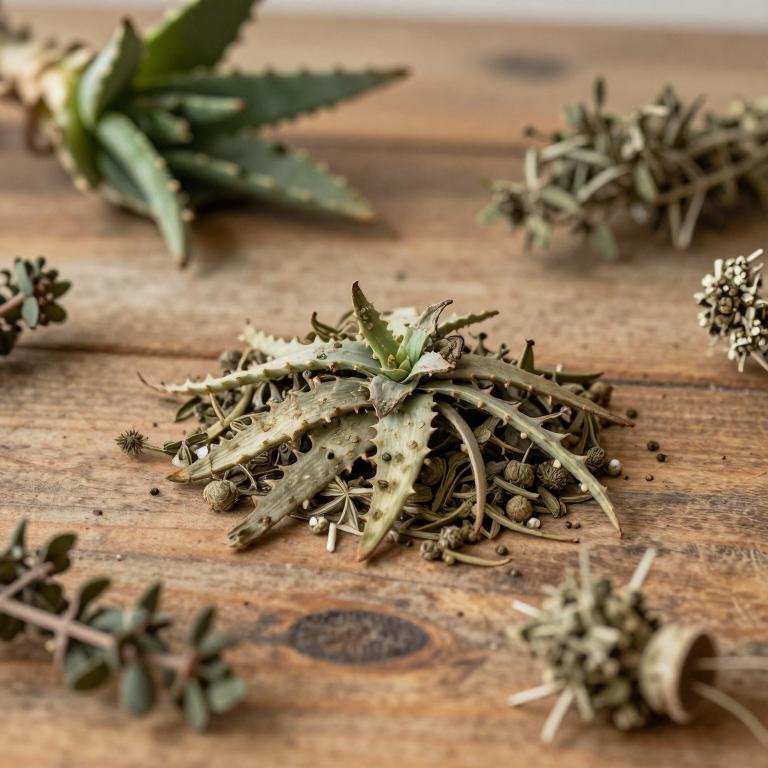
Names and Synonyms
Scientific Names
Accepted name
Aloe globuligemmaSources: Wikidata, Catalogue of Life
Taxonomical Classification
This plant belongs to the kingdom Plantae within the phylum Streptophyta and is classified under the class Equisetopsida. It further falls into the subclass Magnoliidae and the order Asparagales, specifically within the family Asphodelaceae. Finally, it is categorized under the genus Aloe.
| Rank | Classification |
|---|---|
| Kingdom | Plantae |
| Phylum | Streptophyta |
| Class | Equisetopsida |
| Subclass | Magnoliidae |
| Order | Asparagales |
| Family | Asphodelaceae |
| Genus | Aloe |
Sources: The World Checklist of Vascular Plants (WCVP)
Distribution
This plant is native to specific regions within the southern portion of the African continent. Its presence is notably recorded in Zimbabwe, located within South Tropical Africa. Furthermore, the species can be found in Botswana, which is situated in Southern Africa. The distribution also extends to the Northern Provinces of South Africa. These varied locations define the unique geographical range of Aloe globuligemma.
| Region | Area |
|---|---|
| South Tropical Africa | Zimbabwe |
| Southern Africa | Botswana |
| Southern Africa | Northern Provinces |
Sources: The World Checklist of Vascular Plants (WCVP)
Botanical Identification
Ecology
The ecology of Aloe globuligemma is defined by its specific altitudinal distribution within its native habitat, occupying a distinct vertical niche in the landscape. This species thrives within a specialized elevational range, establishing itself at altitudes starting from a minimum of 460 m AMSL and extending up to a maximum of 915 m AMSL. This relatively narrow altitudinal band suggests that the plant is adapted to specific environmental gradients, likely influenced by variations in temperature, moisture availability, and atmospheric pressure found within these mid-elevation zones.
- Elevational range max:
- 915 m AMSL
- Elevational range min:
- 460 m AMSL
Life history
The life history of Aloe globuligemma is characterized by its status as a perennial plant, allowing it to persist through multiple growing seasons rather than completing its cycle within a single year. As a chamaephyte, its growth habit is defined by keeping its buds close to the soil surface or just above it, which often serves as an adaptation to its specific environmental niche. Furthermore, the plant maintains an evergreen deciduousness, ensuring that its foliage remains functional and photosynthetic throughout the year without the need for a seasonal shedding period.
- Deciduousness :
- evergreen
- Life form :
- chamaephyte
- Lifecycle :
- perennial
Morphology
The morphology of Aloe globuligemma is characterized by a growth form that functions as both a herb and a subshrub, exhibiting a non-woody structure. This self-supporting species is strictly terrestrial, existing neither as an epiphyte nor an aquatic plant, and maintains an independent lifestyle without parasitic tendencies. In terms of stature, the plant displays significant variability in height, ranging from a minimum of 0.1 m to a maximum of 1.2 m, with an average plant height of approximately 0.6 m.
- Aquatic :
- terrestrial
- Climber :
- self-supporting
- Epiphyte :
- terrestrial
- Growth form :
- herb
- Growth form :
- subshrub
- Parasite :
- independent
- Plant height max:
- 1.2 m
- Plant height mean:
- 0.6 m
- Plant height min:
- 0.1 m
- Woodiness :
- non-woody
Physiology
The physiology of Aloe globuligemma is characterized by specialized metabolic pathways adapted for survival in arid environments, primarily focusing on efficient water retention and carbon assimilation. As a succulent, it utilizes Crassulacean Acid Metabolism (CAM), a physiological adaptation where stomata remain closed during the heat of the day to minimize transpiration and open at night to uptake carbon dioxide, which is then stored as malic acid. This process allows the plant to maintain high internal water potential despite external drought stress. In terms of nutrient acquisition and soil interaction, the plant does not exhibit the biochemical mechanisms required for symbiotic nitrogen fixation; therefore, it is not a nitrogen fixer, as indicated by its inability to convert atmospheric nitrogen into usable forms through specialized root nodules or microbial associations. Instead, its physiological nutrient uptake relies heavily on the absorption of nitrates and ammonium present in the soil through its specialized root system.
- Nitrogen fixer :
- no
Reproduction
The reproduction of Aloe globuligemma is characterized by the production of highly uniform seeds, which play a critical role in the propagation and dispersal of the species. Detailed morphological analysis of the reproductive output reveals a remarkably consistent seed mass across the population. The seed mass exhibits no variance, with a recorded mean, maximum, and minimum value all strictly measured at 0.00145 g. This precise consistency in seed mass suggests a highly stabilized reproductive strategy, ensuring that each individual seed carries a standardized nutrient reserve to support early germination and seedling establishment.
- Seed mass mean:
- 0.00145 g
Sources: Global Inventory of Floras and Traits (GIFT)
Chemicals
Aloe globuligemma has 1 reported phytochemicals identified across 0 scientific publications and several other databases. The most consistently reported chemicals include CONIINE.
| Chemical | Supporting sources | Consensus |
|---|---|---|
| CONIINE | 1 supporting sources | ★☆☆☆☆ |
CONIINE
- Dr. Duke
Activities
Aloe globuligemma has 3 reported activities identified across 0 scientific publications and several other databases. The most consistently reported activities include Abortifacient, Emetic, Paralytic.
| Activity | Supporting sources | Consensus |
|---|---|---|
| Abortifacient | 1 supporting sources | ★☆☆☆☆ |
| Emetic | 1 supporting sources | ★☆☆☆☆ |
| Paralytic | 1 supporting sources | ★☆☆☆☆ |
Abortifacient
- The Central African journal of medicine
Emetic
- Dr. Duke
Paralytic
- Dr. Duke