Djiboutian Aloe
Aloe djiboutiensis · Accepted scientific name
Scientific literature: Very Sparse (7 studies) · ★☆☆☆☆
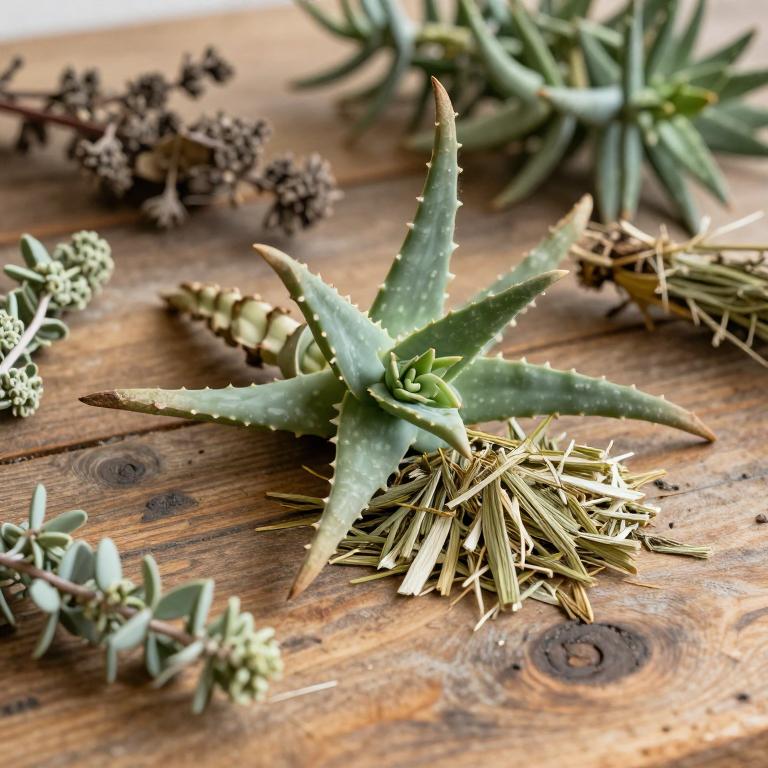
Djiboutian Aloe, scientifically known as Aloe djiboutiensis, is a resilient succulent endemic to the rugged landscapes of Djibouti. Renowned for its striking architectural form and medicinal potential, this species thrives in arid environments. It is highly valued in traditional practices for its soothing properties and unique botanical characteristics.
- Family
- Asphodelaceae
- Native range
- Africa
- Parts used
- Leaf
- Common names
- Djiboutian Aloe
- Scientific synonyms
- Not available
Names and Synonyms
Common Names
- Djiboutian Aloe
Scientific Names
Accepted name
Aloe djiboutiensisSources: Wikidata, Catalogue of Life
Taxonomical Classification
This plant belongs to the kingdom Plantae and the phylum Streptophyta, falling under the class Equisetopsida and subclass Magnoliidae. Within the order Asparagales, it is classified under the family Asphodelaceae and the genus Aloe.
| Rank | Classification |
|---|---|
| Kingdom | Plantae |
| Phylum | Streptophyta |
| Class | Equisetopsida |
| Subclass | Magnoliidae |
| Order | Asparagales |
| Family | Asphodelaceae |
| Genus | Aloe |
Sources: The World Checklist of Vascular Plants (WCVP)
Distribution
This plant is native to the specific landscapes of Northeast Tropical Africa. Its geographical presence is primarily concentrated within the borders of Djibouti. Additionally, the species can be found growing in the regions of Eritrea. These two countries represent the core areas where the plant's natural habitat exists. Therefore, its distribution is highly localized to these specific East African territories.
| Region | Area |
|---|---|
| Northeast Tropical Africa | Djibouti |
| Northeast Tropical Africa | Eritrea |
Sources: The World Checklist of Vascular Plants (WCVP)
Plant Parts
Aloe djiboutiensis has 1 reported plant parts identified across 1 scientific publications and several other databases that are studied for medicinal purposes. The most consistently reported plant part include leaf.
| Plant part | Supporting sources | Consensus |
|---|---|---|
| Leaf | 1 supporting sources | ★☆☆☆☆ |
Leaf
- Journal of ethnopharmacology
Chemicals
Aloe djiboutiensis has 2 reported phytochemicals identified across 1 scientific publications and several other databases. The most consistently reported chemicals include Flavonoid, Polyphenol.
| Chemical | Supporting sources | Consensus |
|---|---|---|
| Flavonoid | 1 supporting sources | ★☆☆☆☆ |
| Polyphenol | 1 supporting sources | ★☆☆☆☆ |
Flavonoid
- Molecules (Basel, Switzerland)
Polyphenol
- Molecules (Basel, Switzerland)
Conditions
Aloe djiboutiensis has 1 reported investigations on conditions identified across 1 scientific publications and several other databases. The most consistently reported conditions include malaria.
| Condition | Supporting sources | Consensus |
|---|---|---|
| Malaria | 1 supporting sources | ★☆☆☆☆ |
Malaria
- Journal of ethnopharmacology
Preparations
Aloe djiboutiensis has 2 reported preparations identified across 1 scientific publications and several other databases. The most consistently reported preparations include latex, leave.
| Preparation | Supporting sources | Consensus |
|---|---|---|
| Latex | 1 supporting sources | ★☆☆☆☆ |
| Leave | 1 supporting sources | ★☆☆☆☆ |
Latex
- Molecules (Basel, Switzerland)
Leave
- Molecules (Basel, Switzerland)