Dhofar Aloe
Aloe dhufarensis · Accepted scientific name
Scientific literature: Very Sparse (2 studies) · ★☆☆☆☆
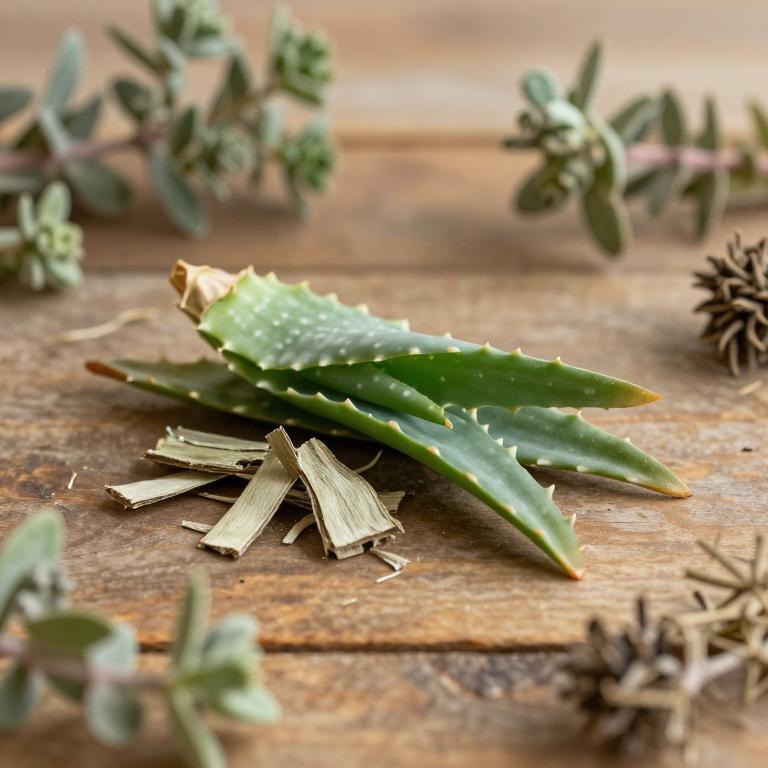
Dhofar Aloe, scientifically known as Aloe dhufarensis, is a resilient succulent endemic to the unique landscapes of southern Oman. Renowned for its medicinal properties, this plant is highly valued for its soothing gel, which offers potent anti-inflammatory and healing benefits, making it a cornerstone of traditional regional healing.
- Family
- Asphodelaceae
- Native range
- Asia-Temperate
- Parts used
- Not available
- Common names
- Dhofar Aloe
- Scientific synonyms
- Not available
Names and Synonyms
Common Names
- Dhofar Aloe
Scientific Names
Accepted name
Aloe dhufarensisSources: Wikidata, Catalogue of Life
Taxonomical Classification
This plant belongs to the kingdom Plantae within the phylum Streptophyta and the class Equisetopsida. As a member of the subclass Magnoliidae and the order Asparagales, it is classified under the family Asphodelaceae. Specifically, it is identified by the genus Aloe.
| Rank | Classification |
|---|---|
| Kingdom | Plantae |
| Phylum | Streptophyta |
| Class | Equisetopsida |
| Subclass | Magnoliidae |
| Order | Asparagales |
| Family | Asphodelaceae |
| Genus | Aloe |
Sources: The World Checklist of Vascular Plants (WCVP)
Distribution
This plant is specifically native to the unique landscapes of the Arabian Peninsula. Within this region, its natural range is primarily concentrated in the country of Oman. It can also be found growing across various terrains in Yemen. These specific territories define the limited geographical boundaries where the species thrives in the wild. Consequently, its distribution is closely tied to the distinct environmental conditions of these two nations.
| Region | Area |
|---|---|
| Arabian Peninsula | Oman |
| Arabian Peninsula | Yemen |
Sources: The World Checklist of Vascular Plants (WCVP)
Botanical Identification
Life history
The life history of Aloe dhufarensis is characterized by its classification as a chamaephyte, a growth form that allows it to thrive in specific ecological niches by maintaining its regenerative buds near or just above the soil surface. As a perennial succulent, its life cycle involves the gradual development of fleshy, rosette-forming leaves that serve as vital water storage organs, enabling the plant to endure periods of aridity. The ontogeny of the species begins with seed germination, typically following seasonal rainfall, leading to the establishment of a slow-growing individual that prioritizes structural resilience and moisture retention. Throughout its lifespan, the plant undergoes periodic reproductive phases, producing erect inflorescences that bloom to attract specific pollinators, thereby facilitating genetic exchange. The survival strategy of this chamaephyte relies on its ability to withstand environmental stressors through its low-growing stature and specialized physiological adaptations, ensuring long-term persistence in its natural habitat.
- Life form :
- chamaephyte
Morphology
The morphology of Aloe dhufarensis is characterized by its growth habit as a self-supporting plant, lacking any climbing mechanisms such as tendrils or twining stems, which classifies it as a non-climber. It functions as an independent organism, exhibiting no parasitic behavior toward other vegetation, and maintains a strictly terrestrial existence rather than an epiphytic one. Its structural form is defined by succulent, fleshy leaves arranged in a rosette pattern, which grow directly from the soil as part of its ground-based, independent life cycle.
- Climber :
- self-supporting
- Epiphyte :
- terrestrial
- Parasite :
- independent
Sources: Global Inventory of Floras and Traits (GIFT)
Chemicals
Aloe dhufarensis has 2 reported phytochemicals identified across 0 scientific publications and several other databases. The most consistently reported chemicals include Cellulase, Esterase.
| Chemical | Supporting sources | Consensus |
|---|---|---|
| Cellulase | 1 supporting sources | ★☆☆☆☆ |
| Esterase | 1 supporting sources | ★☆☆☆☆ |
Cellulase
- Microorganisms
Esterase
- Microorganisms