Aloe debrana
Aloe debrana · Accepted scientific name
Scientific literature: Very Sparse (8 studies) · ★☆☆☆☆
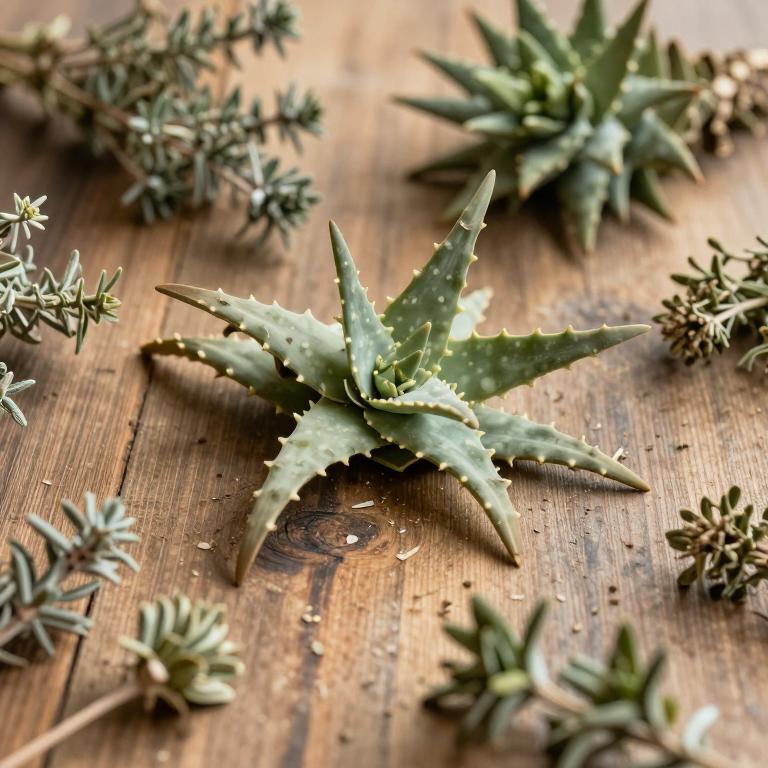
Aloe debrana, scientifically known as Aloe debrana, is a remarkable succulent native to specific arid regions. Renowned for its impressive medicinal properties, this plant features thick, moisture-rich leaves containing potent bioactive compounds. It is widely utilized in traditional healing to soothe skin irritations and promote rapid wound recovery.
- Family
- Asphodelaceae
- Native range
- Africa
- Parts used
- Root
- Common names
- Not available
- Scientific synonyms
- Aloe Berhana
Names and Synonyms
Scientific Names
Accepted name
Aloe debranaSynonyms
- Aloe berhana
Sources: Wikidata
Taxonomical Classification
This plant, Aloe debrana, belongs to the kingdom Plantae and the phylum Streptophyta. It is classified under the class Equisetopsida and the subclass Magnoliidae within the order Asparagales. Finally, it is a member of the family Asphodelaceae and falls under the genus Aloe.
| Rank | Classification |
|---|---|
| Kingdom | Plantae |
| Phylum | Streptophyta |
| Class | Equisetopsida |
| Subclass | Magnoliidae |
| Order | Asparagales |
| Family | Asphodelaceae |
| Genus | Aloe |
Sources: The World Checklist of Vascular Plants (WCVP)
Distribution
This plant, known as Aloe debrana, possesses a very specific and limited geographical range. Its natural habitat is primarily situated within the Northeast Tropical Africa region. Specifically, the species is documented to grow within the borders of Ethiopia. Due to this localized presence, it is considered an endemic element of the Ethiopian landscape. Understanding this narrow distribution is essential for the conservation of the species in its native environment.
| Region | Area |
|---|---|
| Northeast Tropical Africa | Ethiopia |
Sources: The World Checklist of Vascular Plants (WCVP)
Botanical Identification
Life history
The life history of Aloe debrana is characterized by its classification as a chamaephyte, a growth form where the permanent buds are located close to the ground, often protected by the plant's own succulent tissues or surrounding substrate. This life strategy allows the species to endure fluctuating environmental conditions by keeping its vital regenerative organs at a low profile. Throughout its life cycle, the plant develops thick, fleshy leaves designed for water storage, facilitating survival during periods of drought. As it matures, it transitions through various developmental stages, utilizing its low-lying architecture to optimize resource acquisition in its specific ecological niche, while its life history is fundamentally shaped by the ability to maintain perennial vitality through its specialized chamaephyte structure.
- Life form :
- chamaephyte
Morphology
The morphology of Aloe debrana is characterized by its growth form as a herb, which lacks a woody structure and is classified as non-woody. This plant functions as an independent organism, showing no parasitic tendencies, and maintains a terrestrial lifestyle rather than growing as an epiphyte. In terms of its structural support, it is a self-supporting plant that does not require a climbing mechanism or external host to maintain its upright posture.
- Climber :
- self-supporting
- Epiphyte :
- terrestrial
- Growth form :
- herb
- Parasite :
- independent
- Woodiness :
- non-woody
Sources: Global Inventory of Floras and Traits (GIFT)
Plant Parts
Aloe debrana has 1 reported plant parts identified across 1 scientific publications and several other databases that are studied for medicinal purposes. The most consistently reported plant part include root.
| Plant part | Supporting sources | Consensus |
|---|---|---|
| Root | 1 supporting sources | ★☆☆☆☆ |
Root
- Evidence-based complementary and alternative medicine : eCAM
Chemicals
Aloe debrana has 4 reported phytochemicals identified across 1 scientific publications and several other databases. The most consistently reported chemicals include 5-allyl-3-methoxybenzene-1,2-diol, Chrysophanol, aloesaponarin I, linoleic acid.
| Chemical | Supporting sources | Consensus |
|---|---|---|
| 5-allyl-3-methoxybenzene-1,2-diol | 1 supporting sources | ★☆☆☆☆ |
| Chrysophanol | 1 supporting sources | ★☆☆☆☆ |
| aloesaponarin I | 1 supporting sources | ★☆☆☆☆ |
| linoleic acid | 1 supporting sources | ★☆☆☆☆ |
5-allyl-3-methoxybenzene-1,2-diol
- Evidence-based complementary and alternative medicine : eCAM
Chrysophanol
- Evidence-based complementary and alternative medicine : eCAM
aloesaponarin I
- Evidence-based complementary and alternative medicine : eCAM
linoleic acid
- Evidence-based complementary and alternative medicine : eCAM
Activities
Aloe debrana has 2 reported activities identified across 1 scientific publications and several other databases. The most consistently reported activities include Antibacterial, Antioxidant.
| Activity | Supporting sources | Consensus |
|---|---|---|
| Antibacterial | 1 supporting sources | ★☆☆☆☆ |
| Antioxidant | 1 supporting sources | ★☆☆☆☆ |
Antibacterial
- Evidence-based complementary and alternative medicine : eCAM
Antioxidant
- Evidence-based complementary and alternative medicine : eCAM
Conditions
Aloe debrana has 1 reported investigations on conditions identified across 1 scientific publications and several other databases. The most consistently reported conditions include wounds.
| Condition | Supporting sources | Consensus |
|---|---|---|
| Wounds | 1 supporting sources | ★☆☆☆☆ |
Wounds
- Evidence-based complementary and alternative medicine : eCAM
Preparations
Aloe debrana has 1 reported preparations identified across 1 scientific publications and several other databases. The most consistently reported preparations include acetone (99.5%) extract of the roots.
| Preparation | Supporting sources | Consensus |
|---|---|---|
| Acetone (99.5%) extract of the roots | 1 supporting sources | ★☆☆☆☆ |
Acetone (99.5%) extract of the roots
- Evidence-based complementary and alternative medicine : eCAM