Dr Kirk's aloe
Aloe cryptopoda · Accepted scientific name
Scientific literature: Very Sparse (1 studies) · ★☆☆☆☆
Dr Kirk's aloe, scientifically known as Aloe cryptopoda, is a remarkable medicinal plant prized for its therapeutic potential. Renowned for its unique bioactive compounds, this succulent offers significant healing properties, particularly in skin care and inflammation management. Discover the natural power and traditional benefits of this extraordinary botanical treasure.
- Family
- Asphodelaceae
- Native range
- Europe
- Parts used
- Not available
- Common names
- Dr Kirk'S Aloe · Spire Aloe · 1 more
- Scientific synonyms
- Aloe Wickensii Var. Lutea
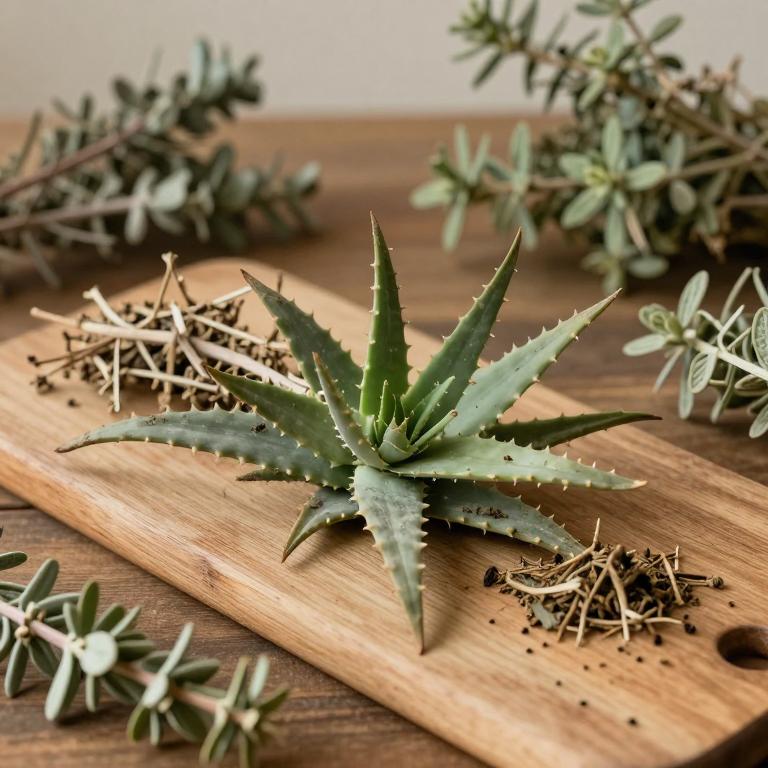
Names and Synonyms
Common Names
- Dr Kirk's aloe
- spire aloe
- yellow aloe
Scientific Names
Accepted name
Aloe cryptopodaSynonyms
- Aloe wickensii var. lutea
Regional and Traditional Names
Spanish:
- Aloe wickensii
Sources: Wikidata, Catalogue of Life
Taxonomical Classification
This plant belongs to the kingdom Plantae and is classified within the phylum Streptophyta and the class Equisetopsida. It is further organized under the subclass Magnoliidae and the order Asparagales. Finally, it is a member of the family Asphodelaceae and falls under the genus Aloe.
| Rank | Classification |
|---|---|
| Kingdom | Plantae |
| Phylum | Streptophyta |
| Class | Equisetopsida |
| Subclass | Magnoliidae |
| Order | Asparagales |
| Family | Asphodelaceae |
| Genus | Aloe |
Sources: The World Checklist of Vascular Plants (WCVP)
Distribution
This plant exhibits a diverse geographical range that spans across two major continents. In Southwestern Europe, its presence is specifically noted within the borders of Spain. Moving toward the East Tropical Africa region, it can be found in Tanzania. The species also maintains a significant distribution throughout South Tropical Africa. Specifically, it inhabits the territories of Malawi, Mozambique, and Zambia.
| Region | Area |
|---|---|
| Southwestern Europe | Spain |
| East Tropical Africa | Tanzania |
| South Tropical Africa | Malawi |
| South Tropical Africa | Mozambique |
| South Tropical Africa | Zambia |
| South Tropical Africa | Zimbabwe |
| Southern Africa | Botswana |
| Southern Africa | Eswatini |
| Southern Africa | Northern Provinces |
Sources: The World Checklist of Vascular Plants (WCVP)
Botanical Identification
Ecology
The ecology of Aloe cryptoppoda is defined by its specific altitudinal preferences, as it thrives within a distinct vertical niche in its native habitat. This species is primarily distributed across an elevational range that begins at a minimum of 460 m AMSL and extends to a maximum of 1220 m AMSL. This range suggests that the plant is adapted to various mid-altitude environmental conditions, likely occupying terrains that balance the warmer temperatures of lower elevations with the slightly cooler, more temperate climates found at its upper limits.
- Elevational range max:
- 1220 m AMSL
- Elevational range min:
- 460 m AMSL
Life history
The life history of Aloe cryptopoda is characterized by its status as a perennial plant, allowing it to persist through multiple growing seasons. As a chamaephyte, its life form is defined by its growth habit, where the majority of its vegetative structure remains close to the ground level, often protected by the soil surface or minimal woody tissue. Furthermore, the species maintains an evergreen deciduousness, ensuring that its foliage remains functional and green throughout the year without the need for a seasonal shedding period.
- Deciduousness :
- evergreen
- Life form :
- chamaephyte
- Lifecycle :
- perennial
Morphology
The morphology of Aloe cryptopoda is characterized by a growth form that transitions between a herb and a shrub, exhibiting a non-woody structure. This plant is a terrestrial species that functions as an independent organism, rather than a parasite or an epiphyte. It is a self-supporting plant, lacking the climbing characteristics of a vine or liana. In terms of stature, the plant varies in height, with a minimum measurement of 0.91 m, a mean height of approximately 1 m, and a maximum potential height of up to 2.74 m.
- Aquatic :
- terrestrial
- Climber :
- self-supporting
- Epiphyte :
- terrestrial
- Growth form :
- herb
- Growth form :
- shrub
- Parasite :
- independent
- Plant height max:
- 2.74 m
- Plant height mean:
- 1 m
- Plant height min:
- 0.91 m
- Woodiness :
- non-woody
Physiology
The physiology of Aloe cryptopodum is characterized by specialized metabolic pathways adapted to arid environments, primarily utilizing Crassulacean Acid Metabolism (CAM) to optimize water-use efficiency through nocturnal carbon dioxide uptake. Its internal mechanisms focus on the accumulation of mucilaginous polysaccharides and secondary metabolites within parenchymatous tissues to facilitate moisture retention and osmotic regulation. Regarding its nutrient cycling capabilities, the plant does not exhibit the ability to engage in symbiotic associations for atmospheric nitrogen conversion; specifically, it is not a nitrogen fixer, as indicated by its lack of specialized root nodules or biochemical pathways required for such nitrogen_fix_1 processes. Instead, its physiological processes are centered on efficient mineral uptake from the soil and the management of photosynthetic efficiency under high thermal stress.
- Nitrogen fixer :
- no
Reproduction
Reproduction in Aloe cryptopoda is characterized by the production of specialized seeds that exhibit a highly consistent and minute mass profile. The reproductive output of this species involves seeds with a mean mass of 0.001785 g, reflecting a precise biological investment in each individual propagule. This seed mass displays very little variance, ranging from a minimum value of 0.00172 g to a maximum value of 0.00185 g. Such uniformity in seed weight suggests a highly regulated developmental process during seed maturation, ensuring that each seed possesses a standardized amount of nutrient reserves essential for successful germination and early seedling establishment.
- Seed mass max:
- 0.00185 g
- Seed mass mean:
- 0.001785 g
- Seed mass min:
- 0.00172 g
Sources: Global Inventory of Floras and Traits (GIFT)
Activities
Aloe cryptopoda has 1 reported activities identified across 0 scientific publications and several other databases. The most consistently reported activities include Abortifacient.
| Activity | Supporting sources | Consensus |
|---|---|---|
| Abortifacient | 1 supporting sources | ★☆☆☆☆ |
Abortifacient
- The Central African journal of medicine