Krantz or Candelabra Aloe
Aloe arborescens subsp. arborescens · Accepted scientific name
Scientific literature: Very Sparse (6 studies) · ★☆☆☆☆
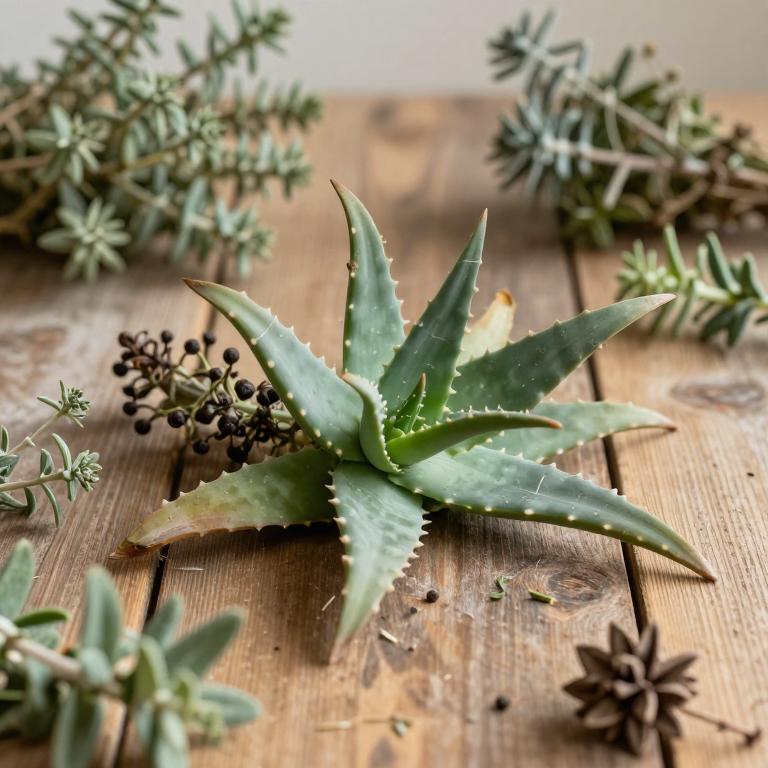
Krantz or Candelabra Aloe, scientifically known as Aloe arborescens subsp. arborescens, is a striking succulent native to Southern Africa. Characterized by its robust, branching structure and vibrant orange-to-red flowers, this resilient species thrives in rocky terrains, offering significant ornamental value and traditional medicinal properties within its natural habitat.
- Family
- Asphodelaceae
- Native range
- Europe
- Parts used
- Not available
- Common names
- Krantz Or Candelabra Aloe
- Scientific synonyms
- Aloe Arborescens Var. Frutescens · Aloe Arborescens Var. Natalensis · 11 more
Names and Synonyms
Common Names
- Krantz or Candelabra Aloe
Scientific Names
Accepted name
Aloe arborescens subsp. arborescensSynonyms
- Aloe arborescens var. frutescens
- Aloe arborescens var. natalensis
- Aloe perfoliata var. natalensis
- Aloe wilmsii
- Aloe natalensis
- Aloe perfoliatum
- Aloe frutescens
- Aloe fruticosa
- Aloe sigmoidea
- Aloe arborea
- Aloe arborescens var. milleri
- Aloe arborescens var. viridifolia
- Aloe arborescens var. pachystyrsa
Regional and Traditional Names
German:
- Tintenfisch-Aloe
Sources: Wikidata, Catalogue of Life
Taxonomical Classification
This plant belongs to the kingdom Plantae and the phylum Streptophyta, falling under the class Equisetopsida and subclass Magnoliidae. Within the order Asparagales, it is classified in the family Asphodelaceae and the genus Aloe. As a subspecies, Aloe arborescens subsp. arborescens represents a specific taxonomic rank within this botanical lineage.
| Rank | Classification |
|---|---|
| Kingdom | Plantae |
| Phylum | Streptophyta |
| Class | Equisetopsida |
| Subclass | Magnoliidae |
| Order | Asparagales |
| Family | Asphodelaceae |
| Genus | Aloe |
Sources: The World Checklist of Vascular Plants (WCVP)
Distribution
This plant exhibits a specific distribution pattern across several regions of Southern and Western Europe. It can be found inhabiting parts of Southwestern Europe, specifically within Spain and Portugal. Its presence extends to the Balearic Islands, which are also situated in Southwestern Europe. Furthermore, the species is located within the territory of France. Finally, its range reaches into Southeastern Europe, where it is documented in Italy.
| Region | Area |
|---|---|
| Southwestern Europe | Baleares |
| Southwestern Europe | France |
| Southwestern Europe | Portugal |
| Southwestern Europe | Spain |
| Southeastern Europe | Italy |
| Southeastern Europe | Sicilia |
| Northern Africa | Algeria |
| Northern Africa | Morocco |
| Northern Africa | Tunisia |
| Macaronesia | Azores |
Sources: The World Checklist of Vascular Plants (WCVP)
Chemicals
Aloe arborescens subsp. arborescens has 6 reported phytochemicals identified across 0 scientific publications and several other databases. The most consistently reported chemicals include Aloe emodin, Aloenin, Barbaloin, GLYCOPROTEIN, Magnesium lactate.
| Chemical | Supporting sources | Consensus |
|---|---|---|
| Aloe emodin | 1 supporting sources | ★☆☆☆☆ |
| Aloenin | 1 supporting sources | ★☆☆☆☆ |
| Barbaloin | 1 supporting sources | ★☆☆☆☆ |
| GLYCOPROTEIN | 1 supporting sources | ★☆☆☆☆ |
| Magnesium lactate | 1 supporting sources | ★☆☆☆☆ |
| succinic acid | 1 supporting sources | ★☆☆☆☆ |
Aloe emodin
- Zeitschrift fur Naturforschung. Section C, Biosciences
Aloenin
- Zeitschrift fur Naturforschung. Section C, Biosciences
Barbaloin
- Zeitschrift fur Naturforschung. Section C, Biosciences
GLYCOPROTEIN
- Experientia
Magnesium lactate
- Zeitschrift fur Naturforschung. Section C, Biosciences
succinic acid
- Zeitschrift fur Naturforschung. Section C, Biosciences