Summer Grass, bug-seed grass, cockatoo grass
Alloteropsis cimicina · Accepted scientific name
Scientific literature: Very Sparse (2 studies) · ★☆☆☆☆
Summer Grass, bug-seed grass, cockatoo grass, scientifically known as Alloteropsis cimicina, is a resilient perennial grass native to tropical regions. While primarily recognized as a common forage crop for livestock, it holds significant ethnobotanical value, often utilized in traditional medicine for its purported antimicrobial and healing properties.
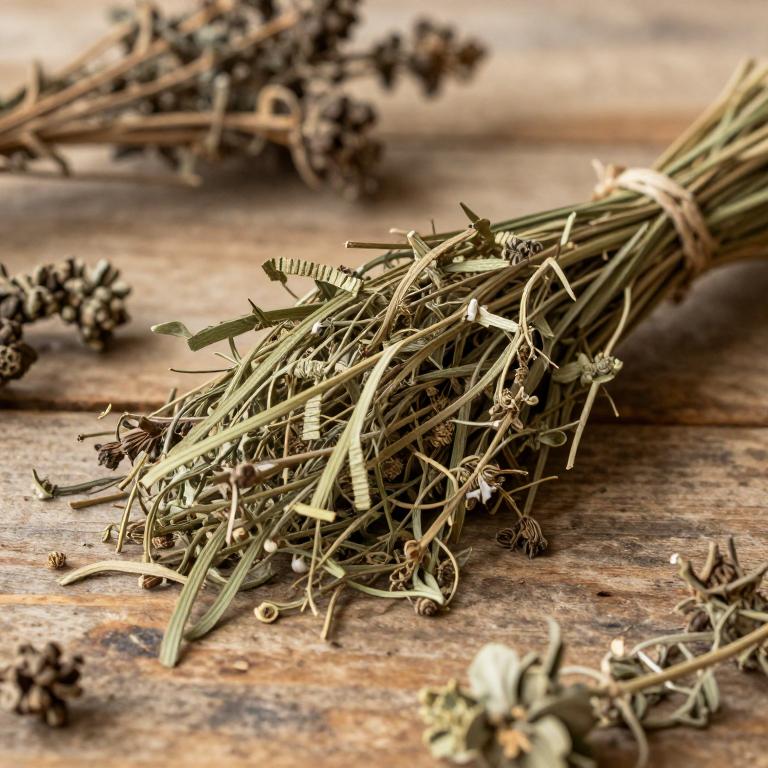
Names and Synonyms
Common Names
- bug-seed grass
- cockatoo grass
- Bugseed Grass
- Summergrass
Scientific Names
Accepted name
Alloteropsis cimicinaSynonyms
- Alloteropsis latifolia
- Alloteropsis quintasii
- Coridochloa cimicina
- Milium cimicinum
- Eriachne melicacea var. fragrans
- Oplismenus fasciculatus
- Melica cimicina
- Urochloa quintasii
- Agrostis cimicina
- Panicum cimicinum
- Urochloa cimicina
- Panicum fasciculiflorum
- Axonopus cimicinus
- Axonopus latifolius
Sources: Wikidata, Catalogue of Life
Taxonomical Classification
This plant belongs to the kingdom Plantae within the phylum Streptophyta and the class Equisetopsida. It is further classified under the subclass Magnoliidae and the order Poales. Finally, it is a member of the family Poaceae and is identified by the genus Alloteropsis.
| Rank | Classification |
|---|---|
| Kingdom | Plantae |
| Phylum | Streptophyta |
| Class | Equisetopsida |
| Subclass | Magnoliidae |
| Order | Poales |
| Family | Poaceae |
| Genus | Alloteropsis |
Sources: The World Checklist of Vascular Plants (WCVP)
Distribution
This plant exhibits a specific distribution pattern across several regions of the African continent. In West Tropical Africa, its presence is documented in Benin, Liberia, and Nigeria. Moving toward the central regions, its range extends into West-Central Tropical Africa. Within this central zone, the species can be found in both Burundi and Cameroon. Collectively, these locations highlight the plant's spread across diverse tropical environments.
| Region | Area |
|---|---|
| West Tropical Africa | Benin |
| West Tropical Africa | Liberia |
| West Tropical Africa | Nigeria |
| West-Central Tropical Africa | Burundi |
| West-Central Tropical Africa | Cameroon |
| West-Central Tropical Africa | DR Congo |
| Northeast Tropical Africa | Chad |
| Northeast Tropical Africa | Ethiopia |
| Northeast Tropical Africa | Somalia |
| Northeast Tropical Africa | Sudan-South Sudan |
Sources: The World Checklist of Vascular Plants (WCVP)
Botanical Identification
Ecology
The ecology of Alloteropsis cimicina is characterized by its ability to thrive in diverse environmental settings, ranging from naturally occurring ecosystems to human-modified landscapes. It is primarily found within the Amazonian savanna and in anthropic areas, demonstrating a certain level of adaptability to disturbed habitats. This species occupies a broad altitudinal gradient, establishing itself at elevations as low as 30 m AMSL and extending its distribution up to a maximum height of 1000 m AMSL.
- Elevational range max:
- 1000 m AMSL
- Elevational range min:
- 30 m AMSL
- Habitat :
- Área Antrópica, Savana Amazônica
Life history
The life history of Alloteroopsis cimicina is characterized by a perennial lifecycle, allowing the plant to persist through multiple growing seasons. In terms of its structural growth strategy, it is classified as a hemicryptophyte, meaning its perennating buds are located at the soil surface, protected by the litter or soil layer during unfavorable environmental conditions.
- Life form :
- hemicryptophyte
- Lifecycle :
- annual
Morphology
The morphology of Alloteropsis cimicina is characterized by its growth form as a non-woody herb with a graminoid habit. The plant is primarily terrestrial in its ecological niche, existing across aquactic, semiaquatic, and terrestrial habitats, but it does not function as an epiphyte, remaining strictly terrestrial. As an independent organism, it does not exhibit parasitic behavior. Structurally, the plant is self-supporting rather than acting as a climber, liana, or vine. In terms of stature, it maintains a relatively low profile, with a plant height ranging from a minimum of 0.6 m to a maximum of 1.2 m.
- Aquatic :
- terrestrial
- Climber :
- self-supporting
- Epiphyte :
- terrestrial
- Growth form :
- herb
- Growth form :
- graminoid
- Parasite :
- independent
- Plant height max:
- 1.2 m
- Plant height min:
- 0.6 m
- Woodiness :
- non-woody
Physiology
The physiology of Alloteropsis cimicina is characterized by a highly specialized metabolic framework, most notably defined by its utilization of the C4 photosynthetic pathway. Unlike plants that rely on the standard C3 cycle, this species employs a carbon fixation mechanism that spatially separates the initial capture of CO2 from the Calvin cycle, typically utilizing specialized bundle sheath cells to concentrate carbon dioxide around the enzyme RuBisCO. This C4 physiological adaptation enhances the plant's efficiency in carbon assimilation by significantly reducing photorespiration, thereby allowing for continued productivity even under conditions of high light intensity, elevated temperatures, and limited water availability. Through this specialized pathway, the plant optimizes its water-use efficiency and maintains a high rate of biomass production in competitive or stressful environmental niches.
- Photosynthetic pathway :
- C4
Reproduction
The reproduction of Alloteropsis cimicina is characterized by the production of a specialized fruit type classified as a nut. This fruit is indehiscent, meaning it does not split open at maturity to release its contents, thereby protecting the seeds within its structure until dispersal. The seeds produced by this species are notably minute, exhibiting a highly consistent seed mass with a mean, maximum, and minimum value of 0.00062 g. This uniformity in seed weight suggests a highly specific reproductive strategy involving very small, lightweight seeds.
- Dehiscence :
- indehiscent
- Fruit type :
- nut
- Seed mass mean:
- 0.00062 g
Sources: Global Inventory of Floras and Traits (GIFT)
Activities
Alloteropsis cimicina has 2 reported activities identified across 0 scientific publications and several other databases. The most consistently reported activities include Antimicrobial, Antioxidant.
| Activity | Supporting sources | Consensus |
|---|---|---|
| Antimicrobial | 1 supporting sources | ★☆☆☆☆ |
| Antioxidant | 1 supporting sources | ★☆☆☆☆ |
Antimicrobial
- Molecular biology reports
Antioxidant
- Molecular biology reports
Preparations
Alloteropsis cimicina has 1 reported preparations identified across 0 scientific publications and several other databases. The most consistently reported preparations include A. cimicina extract.
| Preparation | Supporting sources | Consensus |
|---|---|---|
| A. cimicina extract | 1 supporting sources | ★☆☆☆☆ |
A. cimicina extract
- Molecular biology reports