Garden Leek
Allium porrum · Accepted scientific name
Scientific literature: Very Sparse (42 studies) · ★☆☆☆☆
Garden Leek, scientifically known as Allium porrum, is a versatile perennial herb belonging to the Amaryllidaceae family. Renowned for its mild, onion-like flavor, it serves as a nutritional powerhouse. Rich in vitamins and antioxidants, this culinary staple offers significant medicinal benefits, supporting digestive health and boosting immune function.
- Family
- Amaryllidaceae
- Native range
- Europe
- Parts used
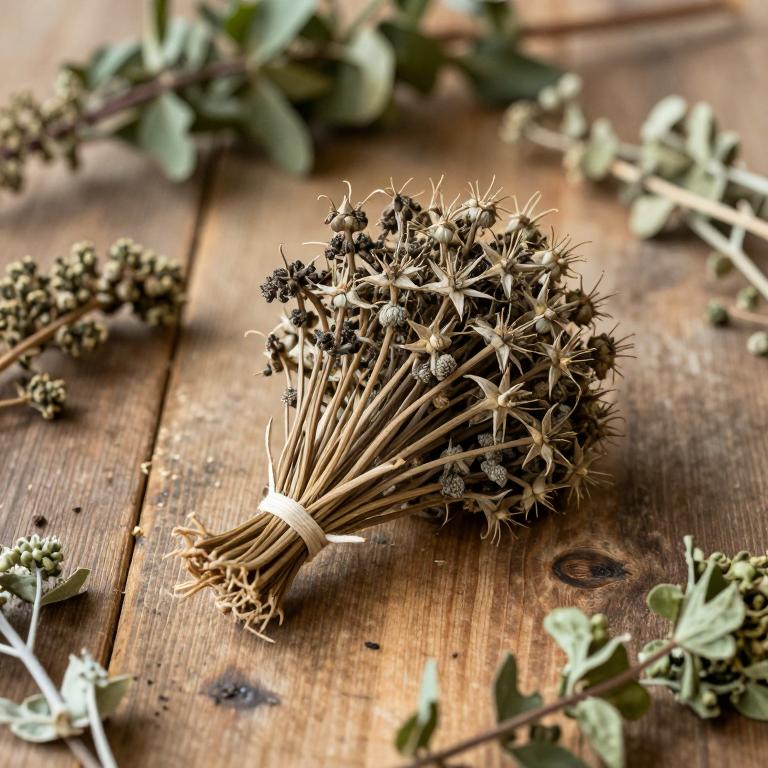
- Leaf · Seed
- Common names
- Garden Leek · Leek
- Scientific synonyms
- Porrum Commune · Allium Porrum Var. Latum · 5 more
Names and Synonyms
Common Names
- Garden Leek
- Leek
Scientific Names
Accepted name
Allium porrumSynonyms
- Porrum commune
- Allium porrum var. latum
- Porrum sativum
- Allium porrum var. breve
- Allium ampeloprasum subsp. porrum
- Allium ampeloprasum var. porrum
- Allium porrum var. viviparum
Regional and Traditional Names
Spanish:
- ajo porro
- poro
- puerro
German:
- Lauch
- Porree
- Winter-Lauch
- Gemeiner Lauch
- Gemuese-Lauch
- Suppen-Lauch
French:
- poireau
- Porreau
Sources: Wikidata, Catalogue of Life
Taxonomical Classification
This plant, Allium porrum, belongs to the kingdom Plantae and the phylum Streptophyta. It is classified under the class Equisetopsida and the subclass Magnoliidae within the order Asparagales. Finally, it is a member of the Amaryllidaceae family and falls under the genus Allium.
| Rank | Classification |
|---|---|
| Kingdom | Plantae |
| Phylum | Streptophyta |
| Class | Equisetopsida |
| Subclass | Magnoliidae |
| Order | Asparagales |
| Family | Amaryllidaceae |
| Genus | Allium |
Sources: The World Checklist of Vascular Plants (WCVP)
Distribution
This plant exhibits a broad distribution across several key regions of the European continent. In Northern Europe, its presence is well-documented in both Great Britain and Ireland. Moving toward the center of the continent, it can be found growing throughout Germany in Middle Europe. Its range extends further south into Southwestern Europe, where it is commonly located in France. Finally, the distribution continues into the Mediterranean climate of Spain within the same southwestern region.
| Region | Area |
|---|---|
| Northern Europe | Great Britain |
| Northern Europe | Ireland |
| Middle Europe | Germany |
| Southwestern Europe | France |
| Southwestern Europe | Spain |
| Southeastern Europe | Greece |
| Southeastern Europe | Italy |
| Eastern Europe | Belarus |
| Eastern Europe | Baltic States |
| Eastern Europe | Central European Russia |
Sources: The World Checklist of Vascular Plants (WCVP)
Botanical Identification
Life history
The life history of Allium porrum is characterized by a versatile growth pattern that can be classified as annual, biennial, perennial, or variable depending on the environmental conditions and cultivation practices. While typically managed as an annual crop for culinary and medicinal harvesting, the plant possesses the biological capacity to complete its life cycle over multiple years. In its biennial phase, the plant focuses on vegetative development during the first year, building energy reserves within its bulbous base, before transitioning to reproductive flowering in the second year. Under certain stable conditions, it can also exhibit a perennial nature, persisting through successive growing seasons. This lifecycle flexibility allows the species to adapt to varying climatic stressors, transitioning from rapid vegetative biomass production to the eventual development of inflorescences to ensure seed dispersal and species continuity.
- Lifecycle :
- perennial
Morphology
The morphology of Allium porrum is characterized by a herbaceous growth form, manifesting as a non-woody, self-supporting plant. It is a terrestrial species that functions as an independent organism, neither acting as a parasite nor an epiphyte. The plant typically reaches an average height of approximately 0.325 m, maintaining a structural habit consistent with a typical herb.
- Aquatic :
- terrestrial
- Climber :
- self-supporting
- Epiphyte :
- terrestrial
- Growth form :
- herb
- Parasite :
- independent
- Plant height mean:
- 0.325 m
- Woodiness :
- non-woody
Physiology
The physiology of Allium porrum is characterized by a C3 photosynthetic pathway, meaning it utilizes the Calvin cycle to fix carbon dioxide through the enzyme RuBisCO during the light-independent reactions. As a C3 plant, its carbon fixation occurs primarily within the mesophyll cells, where atmospheric $CO_2$ is directly incorporated into a three-carbon molecule. This metabolic process is highly efficient under temperate conditions and moderate light intensities, though it necessitates careful regulation of stomatal conductance to balance $CO_2$ uptake with transpiration rates to prevent water loss. The plant's physiological vigor is further supported by a robust nutrient uptake system capable of absorbing nitrogen, sulfur, and essential minerals from the soil to facilitate the synthesis of sulfur-containing compounds and various metabolic enzymes. Furthermore, its metabolic activity is closely tied to its seasonal growth patterns, where temperature and photoperiod influence the rate of carbohydrate translocation from the photosynthetic leaf tissues to the developing bulbous base.
- Photosynthetic pathway :
- C3
Reproduction
The reproduction of Allium porrum is characterized by specific morphological and ecological strategies centered on seed production and distribution. The seeds produced by this species are notably small, with a recorded mean seed mass of approximately 0.003 g. In terms of seed dispersal, the plant utilizes multiple syndromes to ensure its progeny reach suitable habitats. It exhibits an autochorous dispersal syndrome, where seeds are released through internal mechanisms, but this is complemented by a broader range of dispersal methods. These include anemochorous (wind), zoochorous (animal), hydrochorous (water), and unspecialized modes, as well as anthropochorous (human-mediated) movement. This multifaceted approach to dispersal ensures that the species can colonize diverse environments through both natural and incidental vectors.
- Dispersal syndrome :
- autochorous
- Seed mass mean:
- 0.003 g
Sources: Global Inventory of Floras and Traits (GIFT)
Plant Parts
Allium porrum has 3 reported plant parts identified across 3 scientific publications and several other databases that are studied for medicinal purposes. The most consistently reported plant part include leaf, seed, stem.
| Plant part | Supporting sources | Consensus |
|---|---|---|
| Leaf | 1 supporting sources | ★☆☆☆☆ |
| Seed | 1 supporting sources | ★☆☆☆☆ |
| Stem | 1 supporting sources | ★☆☆☆☆ |
Leaf
- Saudi medical journal
Seed
- World journal of gastroenterology
Stem
- Foods (Basel, Switzerland)
Chemicals
Allium porrum has 14 reported phytochemicals identified across 3 scientific publications and several other databases. The most consistently reported chemicals include vitamin C, Condensed Tannins, Flavonoid, Flavonoids, H2O.
| Chemical | Supporting sources | Consensus |
|---|---|---|
| vitamin C | 2 supporting sources | ★☆☆☆☆ |
| Condensed Tannins | 1 supporting sources | ★☆☆☆☆ |
| Flavonoid | 1 supporting sources | ★☆☆☆☆ |
| Flavonoids | 1 supporting sources | ★☆☆☆☆ |
| H2O | 1 supporting sources | ★☆☆☆☆ |
| KAEMPFEROL 3-beta-D-GLUCOSIDE | 1 supporting sources | ★☆☆☆☆ |
| Proanthocyanidins | 1 supporting sources | ★☆☆☆☆ |
| Quercetin 3-glucoside | 1 supporting sources | ★☆☆☆☆ |
| ascorbate | 1 supporting sources | ★☆☆☆☆ |
| glucose | 1 supporting sources | ★☆☆☆☆ |
vitamin C
- Vavilovskii zhurnal genetiki i selektsii
- Pakistan journal of pharmaceutical sciences
Condensed Tannins
- Foods (Basel, Switzerland)
Flavonoid
- Journal of pharmacopuncture
Flavonoids
- Foods (Basel, Switzerland)
H2O
- The new microbiologica
KAEMPFEROL 3-beta-D-GLUCOSIDE
- Zeitschrift fur Lebensmittel-Untersuchung und -Forschung
Proanthocyanidins
- Foods (Basel, Switzerland)
Quercetin 3-glucoside
- Zeitschrift fur Lebensmittel-Untersuchung und -Forschung
ascorbate
- Vavilovskii zhurnal genetiki i selektsii
glucose
- Zeitschrift fur Lebensmittel-Untersuchung und -Forschung
Activities
Allium porrum has 3 reported activities identified across 3 scientific publications and several other databases. The most consistently reported activities include Antibacterial, Antioxidant, Antidiabetic.
| Activity | Supporting sources | Consensus |
|---|---|---|
| Antibacterial | 2 supporting sources | ★☆☆☆☆ |
| Antioxidant | 2 supporting sources | ★☆☆☆☆ |
| Antidiabetic | 1 supporting sources | ★☆☆☆☆ |
Antibacterial
- Acta scientiarum polonorum. Technologia alimentaria
- Journal of pharmacopuncture
Antioxidant
- Journal of ethnopharmacology
- Vavilovskii zhurnal genetiki i selektsii
Antidiabetic
- Journal of ethnopharmacology
Conditions
Allium porrum has 6 reported investigations on conditions identified across 3 scientific publications and several other databases. The most consistently reported conditions include antibiotic resistance, cancers, diuretic, hospital infections, iron overload.
| Condition | Supporting sources | Consensus |
|---|---|---|
| Antibiotic resistance | 1 supporting sources | ★☆☆☆☆ |
| Cancers | 1 supporting sources | ★☆☆☆☆ |
| Diuretic | 1 supporting sources | ★☆☆☆☆ |
| Hospital infections | 1 supporting sources | ★☆☆☆☆ |
| Iron overload | 1 supporting sources | ★☆☆☆☆ |
| Thalassemia | 1 supporting sources | ★☆☆☆☆ |
Antibiotic resistance
- Journal of pharmacopuncture
Cancers
- Phytotherapy research : PTR
Diuretic
- International journal of biological macromolecules
Hospital infections
- Journal of pharmacopuncture
Iron overload
- Global journal of health science
Thalassemia
- Global journal of health science
Preparations
Allium porrum has 3 reported preparations identified across 3 scientific publications and several other databases. The most consistently reported preparations include hydro-alcoholic extract, methanol extracts, seeds.
| Preparation | Supporting sources | Consensus |
|---|---|---|
| Hydro-alcoholic extract | 1 supporting sources | ★☆☆☆☆ |
| Methanol extracts | 1 supporting sources | ★☆☆☆☆ |
| Seeds | 1 supporting sources | ★☆☆☆☆ |
Hydro-alcoholic extract
- Global journal of health science
Methanol extracts
- Acta scientiarum polonorum. Technologia alimentaria
Seeds
- World journal of gastroenterology