Alkanna tinctoria subsp. tinctoria
Alkanna tinctoria subsp. tinctoria · Accepted scientific name
Scientific literature: Very Sparse (32 studies) · ★☆☆☆☆
, scientifically known as Alkannna tinctoria subsp. tinctoria, is a remarkable medicinal herb prized for its potent healing properties. Renowned for its deep pigment and anti-inflammatory qualities, this subspecies is frequently utilized in traditional remedies to soothe skin irritations and promote scalp health through its unique botanical compounds.
- Family
- Boraginaceae
- Native range
- Europe
- Parts used
- Root · Leaf
- Common names
- Not available
- Scientific synonyms
- Alkanna Matthioli · Alkanna Tuberculata · 20 more
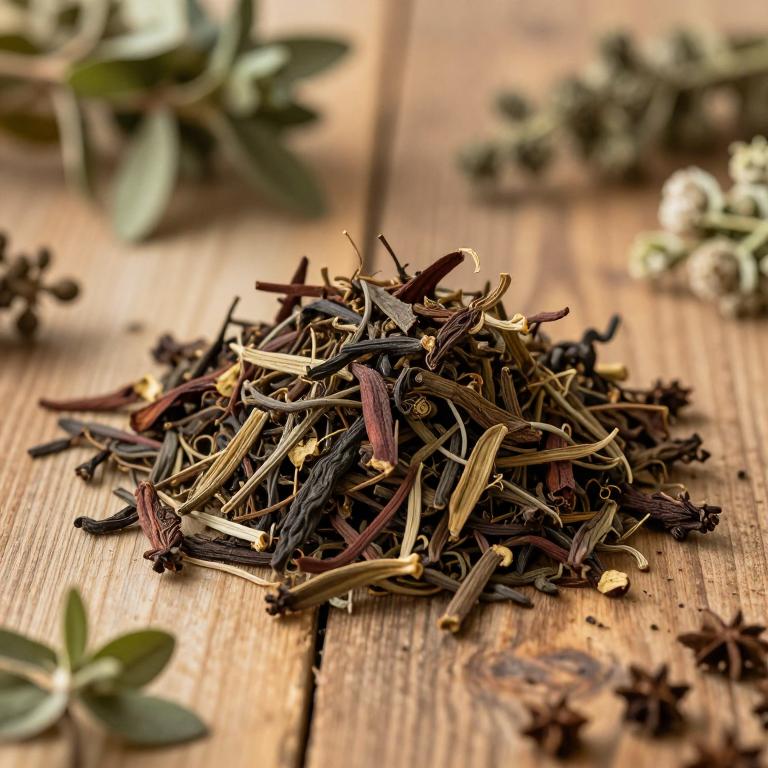
Names and Synonyms
Scientific Names
Accepted name
Alkanna tinctoria subsp. tinctoriaSynonyms
- Alkanna matthioli
- Alkanna tuberculata
- Anchusa tinctoria
- Alkanna tinctoria var. lehmannii
- Alkanna tinctoria var. baetica
- Alkanna lehmannii
- Onochilis tinctoria
- Alkanna tinctoria subsp. lehmannii
- Baphorhiza tinctoria
- Alkanna tinctoria var. marica
- Buglossum tinctorium
- Anchusa bracteolata
- Anchusa rhizochroa
- Anchusa tuberculata
- Alkanna arietinella
- Alkanna bracteolata
- Alkanna tinctoria subsp. glandulosa
- Rhytispermum tinctorium
- Lithospermum commutatum
- Lithospermum lehmannii
- Lithospermum obtusum
- Lycopsis cyrenaica
Regional and Traditional Names
French:
- Orcanette de Matthiole
- Orcanette des teinturiers
- Orcanette tinctoriale
Sources: Wikidata, Catalogue of Life
Taxonomical Classification
This plant, Alkanet tinctoria subsp. tinctoria, belongs to the kingdom Plantae and the phylum Streptophyta. It is classified under the class Equisetopsida and the subclass Magnoliidae, falling within the order Boraginales. Finally, it is a member of the family Boraginaceae and the genus Alkanna.
| Rank | Classification |
|---|---|
| Kingdom | Plantae |
| Phylum | Streptophyta |
| Class | Equisetopsida |
| Subclass | Magnoliidae |
| Order | Boraginales |
| Family | Boraginaceae |
| Genus | Alkanna |
Sources: The World Checklist of Vascular Plants (WCVP)
Distribution
This plant exhibits a diverse presence across several key regions within Europe. In Middle Europe, its distribution includes the territories of Germany, Hungary, and the area encompassing Czechia and Slovakia. Moving toward the western part of the continent, it is also found throughout Southwestern Europe. Specifically, this subspecies can be located within the borders of France. Additionally, its range extends further south to include the country of Portugal.
| Region | Area |
|---|---|
| Middle Europe | Czechia-Slovakia |
| Middle Europe | Germany |
| Middle Europe | Hungary |
| Southwestern Europe | France |
| Southwestern Europe | Portugal |
| Southwestern Europe | Sardegna |
| Southwestern Europe | Spain |
| Southeastern Europe | Albania |
| Southeastern Europe | Bulgaria |
| Southeastern Europe | Greece |
Sources: The World Checklist of Vascular Plants (WCVP)
Plant Parts
Alkanna tinctoria subsp. tinctoria has 2 reported plant parts identified across 5 scientific publications and several other databases that are studied for medicinal purposes. The most consistently reported plant part include root, leaf.
| Plant part | Supporting sources | Consensus |
|---|---|---|
| Root | 4 supporting sources | ★★☆☆☆ |
| Leaf | 1 supporting sources | ★☆☆☆☆ |
Root
- mSystems
- Experientia
- Plants (Basel, Switzerland)
- Frontiers in microbiology
Leaf
- BMC complementary and alternative medicine
Chemicals
Alkanna tinctoria subsp. tinctoria has 10 reported phytochemicals identified across 5 scientific publications and several other databases. The most consistently reported chemicals include Alkannin, shikonin, Angelic acid, Antioxidant, ISOVALERIC ACID.
| Chemical | Supporting sources | Consensus |
|---|---|---|
| Alkannin | 4 supporting sources | ★★☆☆☆ |
| shikonin | 3 supporting sources | ★★☆☆☆ |
| Angelic acid | 1 supporting sources | ★☆☆☆☆ |
| Antioxidant | 1 supporting sources | ★☆☆☆☆ |
| ISOVALERIC ACID | 1 supporting sources | ★☆☆☆☆ |
| Naphthoquinones | 1 supporting sources | ★☆☆☆☆ |
| Phenolic acid | 1 supporting sources | ★☆☆☆☆ |
| Phenols | 1 supporting sources | ★☆☆☆☆ |
| Tannins | 1 supporting sources | ★☆☆☆☆ |
| beta,beta-Dimethylacrylic acid | 1 supporting sources | ★☆☆☆☆ |
Alkannin
- mSystems
- Frontiers in plant science
- Plants (Basel, Switzerland)
- Frontiers in microbiology
shikonin
- mSystems
- Frontiers in plant science
- Frontiers in microbiology
Angelic acid
- Experientia
Antioxidant
- Pakistan journal of pharmaceutical sciences
ISOVALERIC ACID
- Experientia
Naphthoquinones
- mSystems
Phenolic acid
- Plants (Basel, Switzerland)
Phenols
- Foods (Basel, Switzerland)
Tannins
- Foods (Basel, Switzerland)
beta,beta-Dimethylacrylic acid
- Experientia
Activities
Alkanna tinctoria subsp. tinctoria has 2 reported activities identified across 5 scientific publications and several other databases. The most consistently reported activities include Antimicrobial, Antioxidant.
| Activity | Supporting sources | Consensus |
|---|---|---|
| Antimicrobial | 2 supporting sources | ★☆☆☆☆ |
| Antioxidant | 1 supporting sources | ★☆☆☆☆ |
Antimicrobial
- Pakistan journal of pharmaceutical sciences
- Plants (Basel, Switzerland)
Antioxidant
- Pakistan journal of pharmaceutical sciences
Preparations
Alkanna tinctoria subsp. tinctoria has 4 reported preparations identified across 5 scientific publications and several other databases. The most consistently reported preparations include Methanolic extracts, cell suspensions, extracts, hexane extracts of the lipid fraction of the roots.
| Preparation | Supporting sources | Consensus |
|---|---|---|
| Methanolic extracts | 1 supporting sources | ★☆☆☆☆ |
| Cell suspensions | 1 supporting sources | ★☆☆☆☆ |
| Extracts | 1 supporting sources | ★☆☆☆☆ |
| Hexane extracts of the lipid fraction of the roots | 1 supporting sources | ★☆☆☆☆ |
Methanolic extracts
- Plants (Basel, Switzerland)
Cell suspensions
- Microorganisms
Extracts
- Pharmaceutics
Hexane extracts of the lipid fraction of the roots
- Phytochemical analysis : PCA