Southern Bugle
Ajuga iva · Accepted scientific name
Scientific literature: Extensive (170 studies) · ★★★★☆
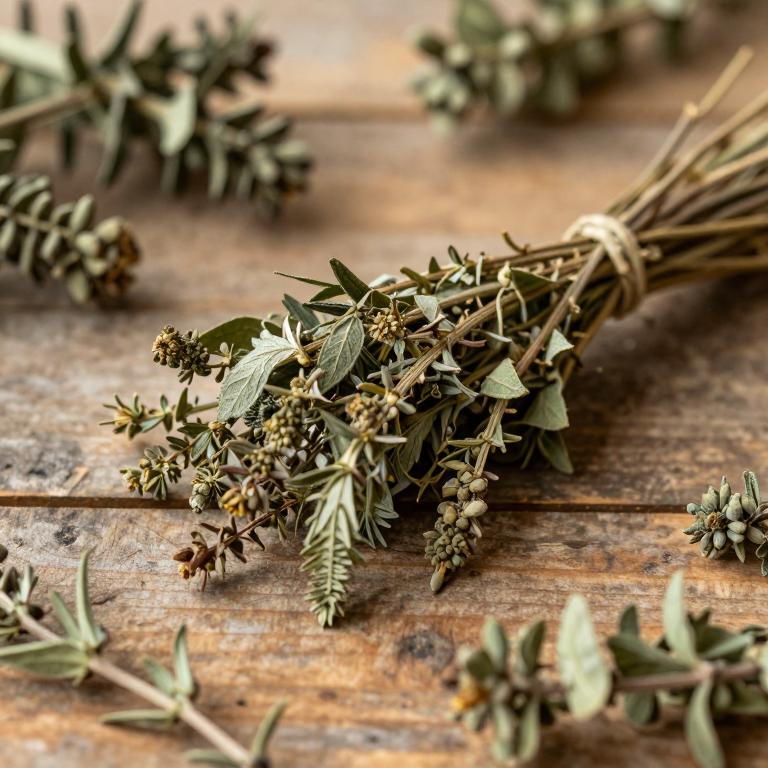
Southern Bugle, scientifically known as Ajuga iva, is a perennial herb native to North America. Characterized by its whorled leaves and spikes of small, tubular flowers, this plant belongs to the mint family. Traditionally used in folk medicine, it is valued for its various bioactive properties and medicinal potential.
- Family
- Lamiaceae
- Native range
- Europe
- Parts used
- Leaf
- Common names
- Southern Bugle
- Scientific synonyms
- Ajuga Iva F. Cleistogama · Ajuga Pseudoiva · 19 more
Names and Synonyms
Common Names
- Southern Bugle
Scientific Names
Accepted name
Ajuga ivaSynonyms
- Ajuga iva f. cleistogama
- Ajuga pseudoiva
- Bulga iva
- Ajuga moschata
- Ajuga iva var. cleistogama
- Chamaepitys iva
- Ajuga iva var. robertiana
- Ajuga iva subsp. pseudoiva
- Chamaepitys pseudoiva
- Ajuga iva var. pseudoiva
- Ajuga iva subsp. humilis
- Ajuga iva f. punctata
- Ajuga iva var. spathulifolia
- Bugula moschata
- Abiga cistifolia
- Moscharia arabica
- Ajuga iva proles pseudoiva
- Moscharia asperidifolia
- Ajuga iva var. linearifolia
- Teucrium iva
- Teucrium moschatum
Regional and Traditional Names
Spanish:
- Ajuga pseudoiva
- Bulga iva
- Pinillo amizclado
- Moscharia arabica
- Teucrium iva
- Chamaepitys pseudoiva
- Antilide segunda
- Chamaepitys moschata
- Moscharia asperidifolia
- Chamaepitys iva
- Bugula almizclada
- Moscharia forsskalii
- Iva común
- Hierba de vaca
- Ajuga moschata
- Abiga cistifolia
- Iva comun
German:
- Mittelmeer-Günsel
- Moschus-Günsel
- Moschus-Günsel
French:
- Bugle Ivette
Sources: Wikidata, Catalogue of Life
Taxonomical Classification
This plant belongs to the kingdom Plantae and the phylum Streptophyta, falling under the class Equisetopsida and subclass Magnoliidae. It is further classified within the order Lamiales and the family Lamiaceae. Finally, it is categorized under the genus Ajuga, specifically as the species Ajuga iva.
| Rank | Classification |
|---|---|
| Kingdom | Plantae |
| Phylum | Streptophyta |
| Class | Equisetopsida |
| Subclass | Magnoliidae |
| Order | Lamiales |
| Family | Lamiaceae |
| Genus | Ajuga |
Sources: The World Checklist of Vascular Plants (WCVP)
Distribution
This plant exhibits a specific geographical distribution concentrated within the Mediterranean region of Southwestern Europe. It can be found growing in the Balearic Islands, which are part of the Baleares archipelago. Additionally, its presence is documented across the island of Corsica and within the mainland territory of France. The species also extends its range to the coastal landscapes of Portugal. Finally, its habitat includes the island of Sardegna, completing its localized European distribution.
| Region | Area |
|---|---|
| Southwestern Europe | Baleares |
| Southwestern Europe | Corse |
| Southwestern Europe | France |
| Southwestern Europe | Portugal |
| Southwestern Europe | Sardegna |
| Southwestern Europe | Spain |
| Southeastern Europe | Albania |
| Southeastern Europe | Greece |
| Southeastern Europe | Italy |
| Southeastern Europe | Kriti |
Sources: The World Checklist of Vascular Plants (WCVP)
Botanical Identification
Ecology
The ecology of Ajuga iva is characterized by its ability to thrive across a broad altitudinal gradient, spanning from sea level up to an elevation of 1300 m AMSL. This wide elevational range indicates a high degree of adaptability to varying climatic conditions and atmospheric pressures. Typically found in diverse habitats, the species often colonizes open, sunny, or partially shaded areas such as grasslands, forest edges, and disturbed sites where soil moisture is sufficient to support its growth. Its distribution within these elevations suggests it can tolerate a variety of temperature regimes and moisture availability, allowing it to occupy different ecological niches ranging from lowland coastal or valley regions to mid-altitude montane environments.
- Elevational range max:
- 1300 m AMSL
- Elevational range min:
- 0 m AMSL
Life history
The life history of Ajuga iva is characterized by its status as a perennial plant, allowing it to persist through multiple growing seasons. In terms of its growth habit and structural classification, the species is identified as a chamaephyte, a life form where the terminal buds are located close to the soil surface, often protected by leaf litter or ground cover. This chamaephyte classification is consistent across its morphological descriptions, defining its strategy for surviving seasonal changes and maintaining its presence within its ecological niche.
- Life form :
- chamaephyte
- Lifecycle :
- perennial
Morphology
The morphology of Ajuga iva is characterized by a growth form that ranges from a herb to a subshrub, exhibiting a variable degree of woodiness. This plant is primarily terrestrial in its ecological habit, though it can exist in semi-aquatic or aquatic environments. It is a self-supporting species, lacking any climbing or vine-like tendencies, and functions as an independent organism rather than a parasite or epiphyte. In terms of stature, it is a relatively low-growing plant, with a height that typically ranges from a minimum of 0.05 m to a maximum of 0.25 m.
- Aquatic :
- terrestrial
- Climber :
- self-supporting
- Epiphyte :
- terrestrial
- Growth form :
- herb
- Growth form :
- subshrub
- Parasite :
- independent
- Plant height max:
- 0.25 m
- Plant height min:
- 0.05 m
- Woodiness :
- variable
Physiology
The physiological characteristics of the foliage in Ajuga iva are defined by specific morphological dimensions and structural forms. The leaves exhibit an elliptic form, displaying a significant range in size to accommodate varying developmental stages. In terms of length, the leaves measure a minimum of 1.5 cm and can reach a maximum of 4 cm. The width of the leaves also shows considerable variability, ranging from a minimum of 0.15 cm to a maximum of 0.7 cm, contributing to the overall specialized leaf architecture of the plant.
- Leaf form :
- elliptic
- Leaf length max:
- 4 cm
- Leaf length min:
- 1.5 cm
- Leaf width max:
- 0.7 cm
- Leaf width min:
- 0.15 cm
Reproduction
The reproduction of Ajuga iva is characterized by a prolonged flowering period that begins in April and extends through October, though the timing can be variable. During this reproductive phase, the plant produces distinct yellow flowers that typically range in length from a minimum of 1.2 cm to a maximum of 2 cm. Following successful pollination, the plant produces seeds with a highly consistent mass; both the mean, minimum, and maximum recorded seed mass are documented at 0.0014 g, indicating a uniform seed size for this species.
- Flower colour :
- yellow
- Flower length max:
- 2 cm
- Flower length min:
- 1.2 cm
- Flowering time :
- Apr
- Flowering time :
- Oct
- Seed mass mean:
- 0.0014 g
Sources: Global Inventory of Floras and Traits (GIFT)
Plant Parts
Ajuga iva has 1 reported plant parts identified across 4 scientific publications and several other databases that are studied for medicinal purposes. The most consistently reported plant part include leaf.
| Plant part | Supporting sources | Consensus |
|---|---|---|
| Leaf | 4 supporting sources | ★★☆☆☆ |
Leaf
- Heliyon
- Molecules (Basel, Switzerland)
- Journal of natural products
- Fitoterapia
Chemicals
Ajuga iva has 39 reported phytochemicals identified across 4 scientific publications and several other databases. The most consistently reported chemicals include Flavonoids, Cyasterone, Tannins, apigenin, ferulic acid.
| Chemical | Supporting sources | Consensus |
|---|---|---|
| Flavonoids | 3 supporting sources | ★★☆☆☆ |
| Cyasterone | 2 supporting sources | ★☆☆☆☆ |
| Tannins | 2 supporting sources | ★☆☆☆☆ |
| apigenin | 2 supporting sources | ★☆☆☆☆ |
| ferulic acid | 2 supporting sources | ★☆☆☆☆ |
| naringin | 2 supporting sources | ★☆☆☆☆ |
| polyphenols | 2 supporting sources | ★☆☆☆☆ |
| 20-HYDROXYECDYSONE | 1 supporting sources | ★☆☆☆☆ |
| 4-vinylguaiacol | 1 supporting sources | ★☆☆☆☆ |
| 8-O-Acetylharpagide | 1 supporting sources | ★☆☆☆☆ |
Flavonoids
- Molecules (Basel, Switzerland)
- Planta medica
- Life (Basel, Switzerland)
Cyasterone
- Dr. Duke
- Journal of ethnopharmacology
Tannins
- Life (Basel, Switzerland)
- Molecules (Basel, Switzerland)
apigenin
- Molecules (Basel, Switzerland)
- Journal of ethnopharmacology
ferulic acid
- Dr. Duke
- Life (Basel, Switzerland)
naringin
- Dr. Duke
- Planta medica
polyphenols
- Life (Basel, Switzerland)
- Molecules (Basel, Switzerland)
20-HYDROXYECDYSONE
- Journal of ethnopharmacology
4-vinylguaiacol
- Molecules (Basel, Switzerland)
8-O-Acetylharpagide
- Dr. Duke
Activities
Ajuga iva has 78 reported activities identified across 4 scientific publications and several other databases. The most consistently reported activities include Antioxidant, Analgesic, Antidiabetic, Antimicrobial, Antibacterial.
| Activity | Supporting sources | Consensus |
|---|---|---|
| Antioxidant | 5 supporting sources | ★★★☆☆ |
| Analgesic | 3 supporting sources | ★★☆☆☆ |
| Antidiabetic | 3 supporting sources | ★★☆☆☆ |
| Antimicrobial | 3 supporting sources | ★★☆☆☆ |
| Antibacterial | 2 supporting sources | ★☆☆☆☆ |
| (-)-Chronotropic | 1 supporting sources | ★☆☆☆☆ |
| (-)-Inotropic | 1 supporting sources | ★☆☆☆☆ |
| Aldose-Reductase-Inhibitor | 1 supporting sources | ★☆☆☆☆ |
| Allelopathic | 1 supporting sources | ★☆☆☆☆ |
| Anabolic | 1 supporting sources | ★☆☆☆☆ |
Antioxidant
- Dr. Duke
- Heliyon
- Molecules (Basel, Switzerland)
- Life (Basel, Switzerland)
- Journal of ethnopharmacology
Analgesic
- Dr. Duke
- Journal of ethnopharmacology
- Molecules (Basel, Switzerland)
Antidiabetic
- Planta medica
- Life (Basel, Switzerland)
- Journal of ethnopharmacology
Antimicrobial
- Molecules (Basel, Switzerland)
- Life (Basel, Switzerland)
- Journal of ethnopharmacology
Antibacterial
- Dr. Duke
- Molecules (Basel, Switzerland)
(-)-Chronotropic
- Dr. Duke
(-)-Inotropic
- Dr. Duke
Aldose-Reductase-Inhibitor
- Dr. Duke
Allelopathic
- Dr. Duke
Anabolic
- Dr. Duke
Conditions
Ajuga iva has 10 reported investigations on conditions identified across 4 scientific publications and several other databases. The most consistently reported conditions include cancer, allergy, diarrhea, fever, hypercholesterolemia.
| Condition | Supporting sources | Consensus |
|---|---|---|
| Cancer | 2 supporting sources | ★☆☆☆☆ |
| Allergy | 1 supporting sources | ★☆☆☆☆ |
| Diarrhea | 1 supporting sources | ★☆☆☆☆ |
| Fever | 1 supporting sources | ★☆☆☆☆ |
| Hypercholesterolemia | 1 supporting sources | ★☆☆☆☆ |
| Hypertension | 1 supporting sources | ★☆☆☆☆ |
| Immunological diseases | 1 supporting sources | ★☆☆☆☆ |
| Inflammation | 1 supporting sources | ★☆☆☆☆ |
| Pain | 1 supporting sources | ★☆☆☆☆ |
| Rheumatism | 1 supporting sources | ★☆☆☆☆ |
Cancer
- Pharmaceuticals (Basel, Switzerland)
- Journal of ethnopharmacology
Allergy
- Journal of ethnopharmacology
Diarrhea
- Heliyon
Fever
- Molecules (Basel, Switzerland)
Hypercholesterolemia
- Journal of ethnopharmacology
Hypertension
- Journal of ethnopharmacology
Immunological diseases
- Journal of ethnopharmacology
Inflammation
- Molecules (Basel, Switzerland)
Pain
- Molecules (Basel, Switzerland)
Rheumatism
- Journal of ethnopharmacology
Preparations
Ajuga iva has 3 reported preparations identified across 4 scientific publications and several other databases. The most consistently reported preparations include aqueous extract, hydroalcoholic extract, hydroethanolic extract.
| Preparation | Supporting sources | Consensus |
|---|---|---|
| Aqueous extract | 1 supporting sources | ★☆☆☆☆ |
| Hydroalcoholic extract | 1 supporting sources | ★☆☆☆☆ |
| Hydroethanolic extract | 1 supporting sources | ★☆☆☆☆ |
Aqueous extract
- Life (Basel, Switzerland)
Hydroalcoholic extract
- Molecules (Basel, Switzerland)
Hydroethanolic extract
- Life (Basel, Switzerland)