Utah Agave
Agave utahensis · Accepted scientific name
Scientific literature: Very Sparse (6 studies) · ★☆☆☆☆
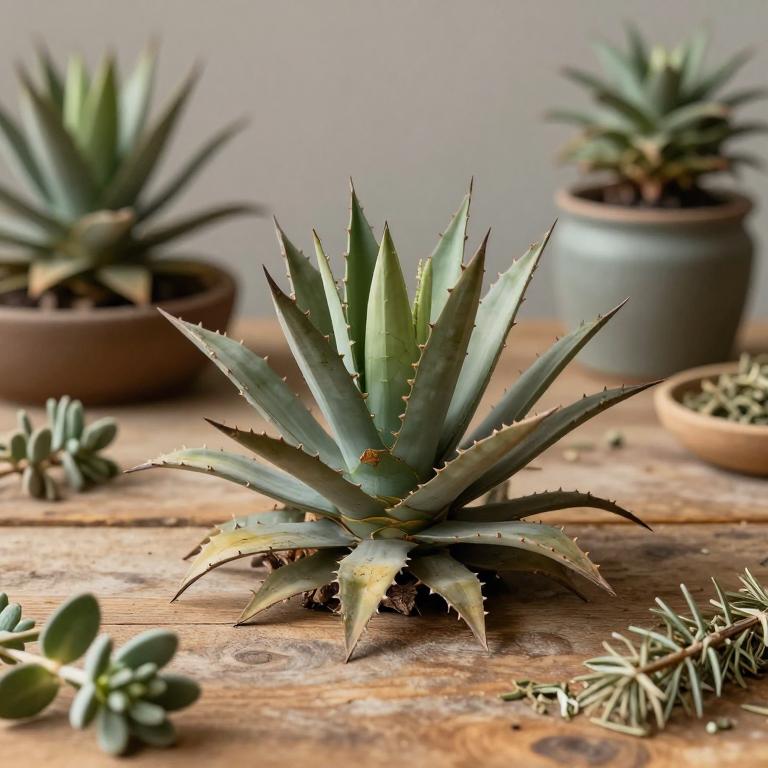
Utah Agave, scientifically known as Agave utahensis, is a resilient succulent native to the arid landscapes of the American Southwest. Renowned for its dramatic architectural form, this plant offers significant medicinal potential, traditionally utilized for its soothing mucilage and various bioactive compounds to support healing and wellness.
- Family
- Asparagaceae
- Native range
- Northern America
- Parts used
- Not available
- Common names
- Utah Agave
- Scientific synonyms
- Agave Haynaldii Var. Utahensis
Names and Synonyms
Common Names
- Utah Agave
Scientific Names
Accepted name
Agave utahensisSynonyms
- Agave haynaldii var. utahensis
Regional and Traditional Names
French:
- Agave de l'Utah
Sources: Wikidata, Catalogue of Life
Taxonomical Classification
This plant belongs to the kingdom Plantae within the phylum Streptophyta and is classified under the class Equisetopsida. Following the subclass Magnoliidae, it is organized into the order Asparagales and the family Asparagaceae. Ultimately, its taxonomic identity is defined by its placement within the genus Agave.
| Rank | Classification |
|---|---|
| Kingdom | Plantae |
| Phylum | Streptophyta |
| Class | Equisetopsida |
| Subclass | Magnoliidae |
| Order | Asparagales |
| Family | Asparagaceae |
| Genus | Agave |
Sources: The World Checklist of Vascular Plants (WCVP)
Distribution
This plant is primarily found within the arid regions of the Southwestern United States. Its natural habitat spans across the state of Arizona, where it thrives in dry environments. It also maintains a significant presence throughout the landscape of California. Additionally, the species can be located within the desert territories of Nevada. Finally, its geographical range extends into the rugged terrain of Utah.
| Region | Area |
|---|---|
| Southwestern U.S.A. | Arizona |
| Southwestern U.S.A. | California |
| Southwestern U.S.A. | Nevada |
| Southwestern U.S.A. | Utah |
Sources: The World Checklist of Vascular Plants (WCVP)
Botanical Identification
Life history
The life history of Agave utahensis is characterized by a perennial lifecycle, allowing the plant to persist in its environment over many years. In terms of its growth habit and structural classification, it is categorized as a hemicryptophyte, meaning its perennial buds are located at or just below the soil surface, protected by the leaf bases or organic matter. This life form enables the plant to endure seasonal environmental fluctuations while maintaining its physiological stability throughout its long existence.
- Life form :
- hemicryptophyte
- Lifecycle :
- perennial
Morphology
The morphology of Agave utahensis is characterized by a non-woody, herbaceous structure classified as a forb. This plant typically reaches an average height of approximately 0.3 m, growing as a self-supporting organism that does not require external support to maintain its posture. As a terrestrial species, it functions as an independent organism, neither acting as a parasite nor an epiphyte, and it establishes itself directly within the soil substrate.
- Climber :
- self-supporting
- Epiphyte :
- terrestrial
- Growth form :
- forb
- Parasite :
- independent
- Plant height mean:
- 0.3 m
- Woodiness :
- non-woody
Physiology
The physiology of Agave utahensis is defined by a highly specialized metabolic strategy designed for extreme water conservation and survival in arid environments. Central to its survival is its photosynthetic pathway, which utilizes Crassulacean Acid Metabolism (CAM). Unlike C3 or C4 plants, Agave utahensis temporally separates carbon fixation from the Calvin cycle to minimize transpirational water loss. During the nocturnal phase, the plant opens its stomata to absorb atmospheric carbon dioxide, which is then chemically converted and stored as malic acid within the vacuoles of its succulent mesophyll cells. As daylight progresses, the stomata remain tightly closed to prevent dehydration under intense solar radiation; during this period, the stored malic acid is decarboxylated to release carbon dioxide internally, allowing the photosynthetic process to proceed using the light energy captured by its chlorophyll. This CAM mechanism, combined with its succulent anatomy and thick cuticular layer, enables the plant to maintain high water-use efficiency and endure prolonged periods of drought.
- Photosynthetic pathway :
- CAM
Reproduction
The reproduction of Agave utahensis involves a complex lifecycle that typically transitions from vegetative growth to sexual reproduction through the development of a large, centralized inflorescence. Following the maturation of the plant, it produces numerous seeds that serve as the primary agents for genetic dispersal. These seeds are characterized by their minute size and specific weight profiles, with a recorded seed mass mean of 0.020775 g. Within the population, the individual seed mass exhibits a specific range, where both the maximum and minimum recorded values are documented at 0.00375 g, indicating a highly consistent and specialized mass for these reproductive units. This precise seed morphology is essential for the plant's ability to establish new colonies within its natural habitat.
- Seed mass max:
- 0.00375 g
- Seed mass mean:
- 0.020775 g
Sources: Global Inventory of Floras and Traits (GIFT)
Chemicals
Agave utahensis has 2 reported phytochemicals identified across 0 scientific publications and several other databases. The most consistently reported chemicals include AU-1, YG-1.
| Chemical | Supporting sources | Consensus |
|---|---|---|
| AU-1 | 1 supporting sources | ★☆☆☆☆ |
| YG-1 | 1 supporting sources | ★☆☆☆☆ |
AU-1
- Yakugaku zasshi : Journal of the Pharmaceutical Society of Japan
YG-1
- Yakugaku zasshi : Journal of the Pharmaceutical Society of Japan
Preparations
Agave utahensis has 1 reported preparations identified across 0 scientific publications and several other databases. The most consistently reported preparations include whole plants.
| Preparation | Supporting sources | Consensus |
|---|---|---|
| Whole plants | 4 supporting sources | ★★☆☆☆ |
Whole plants
- Journal of natural products
- Chemical & pharmaceutical bulletin
- Yakugaku zasshi : Journal of the Pharmaceutical Society of Japan
- Phytochemistry