Agave marmorata
Agave marmorata · Accepted scientific name
Scientific literature: Very Sparse (2 studies) · ★☆☆☆☆
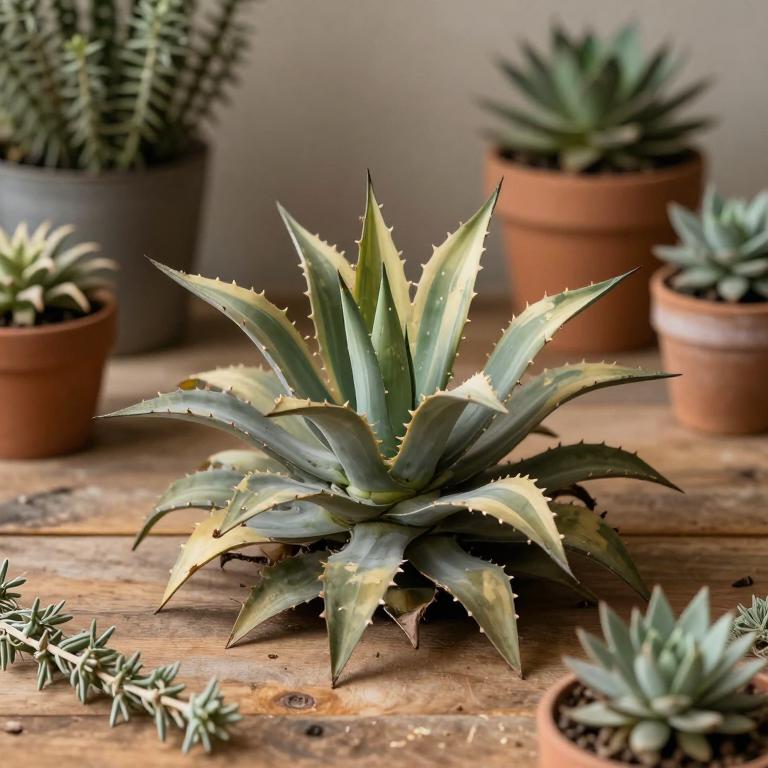
Agave marmorata, scientifically known as Agave marmorata, is a striking succulent prized for its unique, marbled foliage. Beyond its ornamental beauty, this species holds significant ethnobotanical value. Researchers continue to explore its chemical properties, investigating its potential medicinal applications and bioactive compounds within traditional healing practices and modern pharmacology.
- Family
- Asparagaceae
- Native range
- Northern America
- Parts used
- Not available
- Common names
- Not available
- Scientific synonyms
- Agave Todaroi
Names and Synonyms
Scientific Names
Accepted name
Agave marmorataSynonyms
- Agave todaroi
Regional and Traditional Names
Spanish:
- Huiscole
- Maguey Curandero
- Maguey de caballo
- Maguey pitzomel
- Maguey tepeztate
Sources: Wikidata, Catalogue of Life
Taxonomical Classification
This plant belongs to the kingdom Plantae and the phylum Streptophyta, falling under the class Equisetopsida and subclass Magnoliidae. Within the order Asparagales and the family Asparagaceae, it is classified under the genus Agave. Specifically, the species is known as Agave marmorata.
| Rank | Classification |
|---|---|
| Kingdom | Plantae |
| Phylum | Streptophyta |
| Class | Equisetopsida |
| Subclass | Magnoliidae |
| Order | Asparagales |
| Family | Asparagaceae |
| Genus | Agave |
Sources: The World Checklist of Vascular Plants (WCVP)
Distribution
This plant is native to specific regions within the country of Mexico. Its geographical range is primarily concentrated in the central part of the nation. Additionally, it can be found growing throughout the southwest portion of Mexico. These distinct areas define the natural habitat where the species thrives. Therefore, the distribution of Agave marmorata is limited to these specific Mexican territories.
| Region | Area |
|---|---|
| Mexico | Mexico Central |
| Mexico | Mexico Southwest |
Sources: The World Checklist of Vascular Plants (WCVP)
Botanical Identification
Life history
The life history of Agave marmorata is characterized by a perennial growth pattern where the vital organs are protected at or just below the soil surface, classifying it specifically as a hemicryptophyte. Within this biological framework, its life form is defined by its status as a hemicryptophyte, a trait that allows it to endure seasonal environmental shifts by maintaining its regenerative buds near the substrate level. This life history strategy ensures stability in its native habitat, utilizing its specialized morphology to balance resource acquisition with survival through varying climatic cycles.
- Life form :
- hemicryptophyte
Morphology
The morphology of Agave marmorata is characterized by its growth form as a non-woody herb, functioning as a self-supporting organism rather than a climber or liana. As an independent species, it does not exhibit parasitic behavior and maintains a strictly terrestrial lifestyle, lacking any aquatic, semiaquatic, or epiphytic tendencies. The plant's structure is defined by its herbacious nature, lacking woody tissues, which distinguishes it from shrubs or trees.
- Aquatic :
- terrestrial
- Climber :
- self-supporting
- Epiphyte :
- terrestrial
- Growth form :
- herb
- Parasite :
- independent
- Woodiness :
- non-woody
Physiology
The physiology of Agave marmorata is primarily characterized by its specialized photosynthetic pathway, utilizing Crassulacean Acid Metabolism (CAM) to optimize water-use efficiency in arid environments. Unlike C3 or C4 plants, this species exhibits a temporal separation of carbon fixation; it opens its stomata during the cooler nocturnal hours to intake carbon dioxide, which is then chemically stored as malic acid within the vacuoles of its succulent tissues. During the daylight hours, the stomata remain tightly closed to minimize transpirational water loss, while the stored malate is decarboxylated to release CO2 internally for fixation by the enzyme RuBisCO via the Calvin cycle. This physiological adaptation allows the plant to maintain metabolic activity and carbon assimilation under high temperature and low moisture conditions, ensuring survival through efficient moisture conservation.
- Photosynthetic pathway :
- CAM
Reproduction
The reproduction of Agave marmorata is characterized by the production of specialized seeds that exhibit specific morphological weight variations. The seed mass within a population shows a measurable range, with a documented minimum mass of 0.00263 g and a maximum mass reaching up to 0.00407 g. On average, the seeds possess a mean mass of 0.00317 g, a metric that serves as a critical indicator of the plant's reproductive investment and potential seedling vigor.
- Seed mass max:
- 0.00407 g
- Seed mass mean:
- 0.00317 g
- Seed mass min:
- 0.00263 g
Sources: Global Inventory of Floras and Traits (GIFT)
Activities
Agave marmorata has 2 reported activities identified across 0 scientific publications and several other databases. The most consistently reported activities include Antibacterial, Anticancer.
| Activity | Supporting sources | Consensus |
|---|---|---|
| Antibacterial | 1 supporting sources | ★☆☆☆☆ |
| Anticancer | 1 supporting sources | ★☆☆☆☆ |
Antibacterial
- Natural product research
Anticancer
- Natural product research