Agave brittoniana
Agave brittoniana · Accepted scientific name
Scientific literature: Very Sparse (1 studies) · ★☆☆☆☆
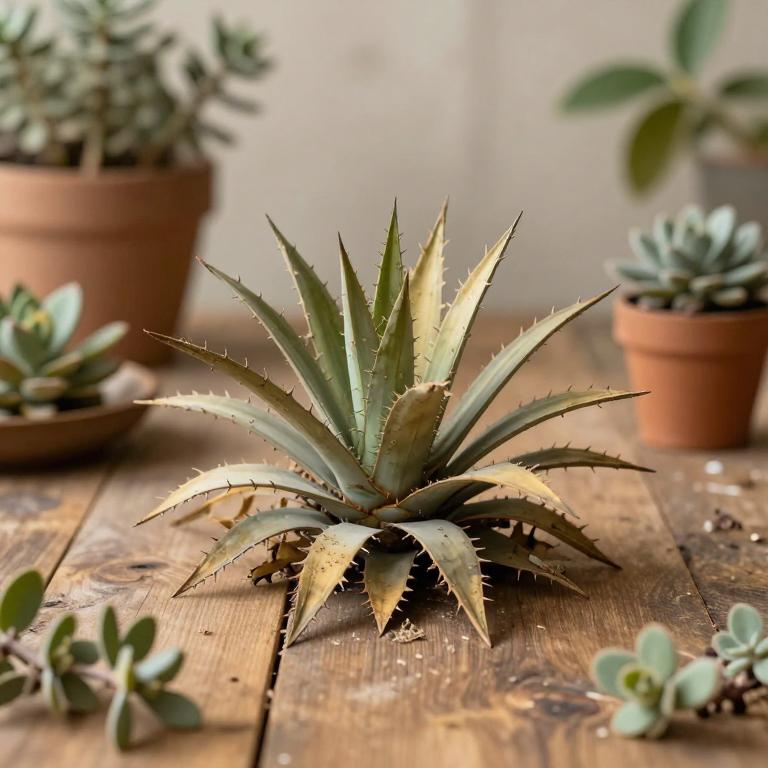
scientifically known as Agave brittoniana, is a striking succulent native to specific arid regions. Renowned for its architectural form and resilient nature, this plant holds significant ethnobotanical value. Beyond its ornamental appeal, various traditional practices utilize its fibrous leaves and sap, showcasing its unique medicinal and practical importance.
- Family
- Asparagaceae
- Native range
- Southern America
- Parts used
- Not available
- Common names
- Not available
- Scientific synonyms
- Agave Brittoniana Var. Brachypus · Agave Brittoniana Subsp. Brachypus · 1 more
Names and Synonyms
Scientific Names
Accepted name
Agave brittonianaSynonyms
- Agave brittoniana var. brachypus
- Agave brittoniana subsp. brachypus
- Agave brittoniana subsp. sancti-spirituensis
Sources: Wikidata
Taxonomical Classification
This plant, Agave brittonianana, belongs to the kingdom Plantae and the phylum Streptophyta. It is classified under the class Equisetopsida and the subclass Magnoliidae within the order Asparagales. Finally, it is a member of the family Asparagaceae and the genus Agave.
| Rank | Classification |
|---|---|
| Kingdom | Plantae |
| Phylum | Streptophyta |
| Class | Equisetopsida |
| Subclass | Magnoliidae |
| Order | Asparagales |
| Family | Asparagaceae |
| Genus | Agave |
Sources: The World Checklist of Vascular Plants (WCVP)
Distribution
This plant, known scientifically as Agave brittoniana, possesses a very specific and limited geographical range. Its natural distribution is confined entirely to the Caribbean region. Within this tropical area, the species is found exclusively on the island of Cuba. Because it is endemic to this single location, it represents a unique part of the island's local flora. Understanding this narrow habitat is essential for the conservation of the species.
| Region | Area |
|---|---|
| Caribbean | Cuba |
Sources: The World Checklist of Vascular Plants (WCVP)
Botanical Identification
Life history
The life history of Agave brittoniana is characterized by its distinct classification as a hemicryptophyte, a growth form where the perennating buds are located at or just below the soil surface, often protected by organic debris or the plant's own succulent base. As a hemicryptophyte, it navigates its environmental challenges by maintaining its vital reproductive and vegetative structures in a protected subterranean or near-surface position, allowing it to survive periods of dormancy or environmental stress. This life strategy facilitates its persistence in its specific ecological niche, utilizing its perennial nature to establish a stable presence within its habitat.
- Life form :
- hemicryptophyte
Morphology
The morphology of Agave brittoniana is characterized by its growth habit as a self-supporting climber, meaning it possesses the structural integrity to maintain its position without the need for external support through obligate or facultative mechanisms. It functions as an independent organism rather than a parasite, maintaining its own metabolic processes without relying on a host plant for nutrients. Furthermore, its ecological placement is strictly terrestrial, as it does not exhibit epiphyte characteristics and grows directly within the soil substrate rather than on other vegetation.
- Climber :
- self-supporting
- Epiphyte :
- terrestrial
- Parasite :
- independent
Sources: Global Inventory of Floras and Traits (GIFT)
Chemicals
Agave brittoniana has 1 reported phytochemicals identified across 0 scientific publications and several other databases. The most consistently reported chemicals include Karatavioside A.
| Chemical | Supporting sources | Consensus |
|---|---|---|
| Karatavioside A | 1 supporting sources | ★☆☆☆☆ |
Karatavioside A
- Magnetic resonance in chemistry : MRC