Umtundulu
Aganope stuhlmannii · Accepted scientific name
Scientific literature: Very Sparse (3 studies) · ★☆☆☆☆
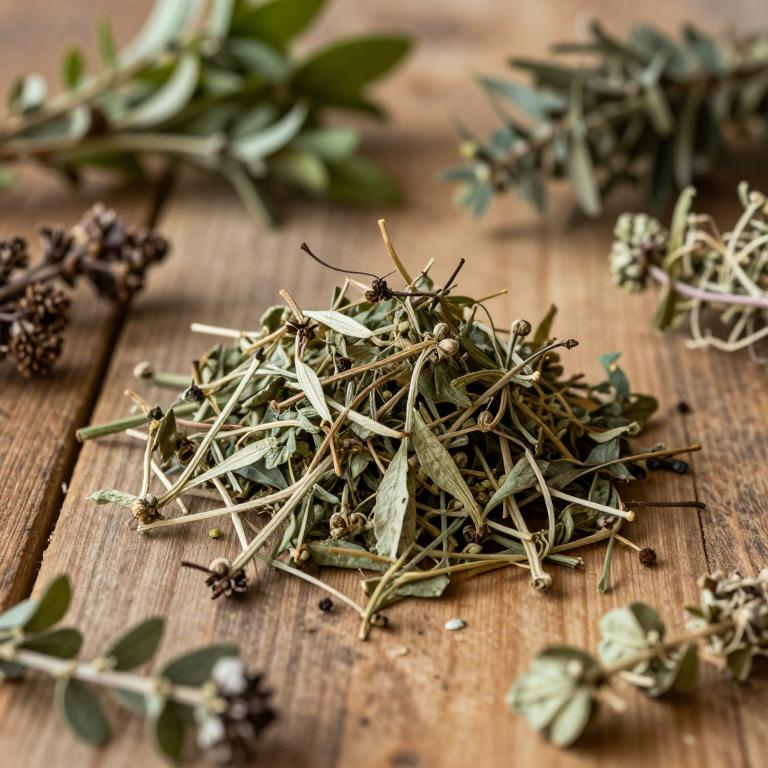
Umtundulu, scientifically known as Aganope stuhlmannii, is a remarkable medicinal plant native to African wetlands. Renowned for its potent therapeutic properties, it is traditionally utilized to treat various ailments, including skin infections and inflammatory conditions. This versatile botanical serves as a vital resource in many indigenous healing practices.
Names and Synonyms
Common Names
- Umtundulu
- Wing-Bean
- Wing-Pod
- Wingbean
- wingpod
Scientific Names
Accepted name
Aganope stuhlmanniiSynonyms
- Ostryoderris stuhlmannii
- Xeroderris chevalieri
- Xeroderris stuhlmannii
- Ostryoderris chevalieri
- Derris stuhlmannii
- Deguelia stuhlmannii
Sources: Wikidata, Catalogue of Life
Taxonomical Classification
This plant belongs to the kingdom Plantae and is classified within the phylum Streptophyta and the class Equisetopsida. Following its subclass Magnoliidae, it is organized under the order Fabales and the family Fabaceae. Finally, its taxonomic identity is completed by its classification under the genus Aganope.
| Rank | Classification |
|---|---|
| Kingdom | Plantae |
| Phylum | Streptophyta |
| Class | Equisetopsida |
| Subclass | Magnoliidae |
| Order | Fabales |
| Family | Fabaceae |
| Genus | Aganope |
Sources: The World Checklist of Vascular Plants (WCVP)
Distribution
This plant is primarily distributed across the West Tropical Africa region. Within this geographic zone, it can be found growing in the country of Benin. Its range also extends northward into the territory of Burkina. Additionally, the species is documented in the coastal nations of Gambia and Ghana. Finally, its presence is noted within the borders of Guinea-Bissau.
| Region | Area |
|---|---|
| West Tropical Africa | Benin |
| West Tropical Africa | Burkina |
| West Tropical Africa | Gambia |
| West Tropical Africa | Ghana |
| West Tropical Africa | Guinea-Bissau |
| West Tropical Africa | Guinea |
| West Tropical Africa | Ivory Coast |
| West Tropical Africa | Mali |
| West Tropical Africa | Nigeria |
| West Tropical Africa | Senegal |
Sources: The World Checklist of Vascular Plants (WCVP)
Botanical Identification
Ecology
The ecology of Aganope stuhlmannii is characterized by its preference for deciduous woodland and bush environments, where it thrives within these specific vegetative structures. This species occupies a distinct altitudinal gradient, establishing itself at elevations ranging from a minimum of 200 m AMSL to a maximum of 1000 m AMSL.
- Elevational range max:
- 1000 m AMSL
- Elevational range min:
- 200 m AMSL
- Habitat :
- deciduous woodland and bush
Life history
The life history of Agapanthus stuhlmannii is characterized by a perennial lifecycle, allowing the plant to persist through multiple growing seasons. As a phanerophyte, its regenerative buds are located on elevated stems well above the ground level, a structural trait that defines its primary life form. The plant exhibits a deciduous nature, shedding its foliage in response to seasonal environmental changes or periods of dormancy.
- Deciduousness :
- deciduous
- Life form :
- phanerophyte
- Lifecycle :
- perennial
Morphology
The morphology of Agapanthus stuhlmannii is characterized by its stature as a large, woody tree that functions as a self-supporting structure. As a terrestrial species, it does not exhibit epiphytic or aquatic tendencies and grows independently without parasitic requirements. The plant's height varies significantly depending on environmental conditions, ranging from a minimum of 5 meters to a maximum of 18 meters, with an average height of approximately 12 meters.
- Aquatic :
- terrestrial
- Climber :
- self-supporting
- Epiphyte :
- terrestrial
- Growth form :
- tree
- Parasite :
- independent
- Plant height max:
- 18 m
- Plant height mean:
- 12 m
- Plant height min:
- 5 m
- Woodiness :
- woody
Physiology
The physiology of Agapanthus stuhlmannii is characterized by a specialized metabolic framework and nutrient acquisition strategy. This species utilizes a C3 photosynthetic pathway, a common mechanism in many temperate and subtropical plants where carbon fixation occurs directly through the Calvin cycle without the spatial or temporal separation seen in C4 or CAM plants. In terms of nutrient cycling, the plant functions as a nitrogen fixer, possessing the physiological capability to convert atmospheric nitrogen into a bioavailable form, which enhances its ability to thrive in nitrogen-limited environments and contributes to the overall fertility of its immediate ecosystem.
- Nitrogen fixer :
- yes
- Photosynthetic pathway :
- C3
Reproduction
The reproduction of Aganope stuhlmannii is characterized by a biotic pollination syndrome, relying primarily on insect vectors to facilitate the transfer of pollen. This biological interaction ensures the successful fertilization required for seed production. Once fertilization occurs, the plant produces seeds that exhibit notable variation in size; the individual seed mass ranges from a minimum of 0.249 g to a maximum of 0.77249 g, with an average seed mass of approximately 0.4730225 g.
- Pollination syndrome :
- insect
- Pollination syndrome :
- biotic
- Seed mass max:
- 0.77249 g
- Seed mass mean:
- 0.4730225 g
- Seed mass min:
- 0.249 g
Sources: Global Inventory of Floras and Traits (GIFT)
Plant Parts
Aganope stuhlmannii has 1 reported plant parts identified across 1 scientific publications and several other databases that are studied for medicinal purposes. The most consistently reported plant part include stem.
| Plant part | Supporting sources | Consensus |
|---|---|---|
| Stem | 1 supporting sources | ★☆☆☆☆ |
Stem
- Pharmaceutical biology
Chemicals
Aganope stuhlmannii has 2 reported phytochemicals identified across 1 scientific publications and several other databases. The most consistently reported chemicals include Odoratin, phenol.
| Chemical | Supporting sources | Consensus |
|---|---|---|
| Odoratin | 1 supporting sources | ★☆☆☆☆ |
| phenol | 1 supporting sources | ★☆☆☆☆ |
Odoratin
- Pharmaceutical biology
phenol
- Pharmaceutical biology
Preparations
Aganope stuhlmannii has 1 reported preparations identified across 1 scientific publications and several other databases. The most consistently reported preparations include hydroalcoholic extract.
| Preparation | Supporting sources | Consensus |
|---|---|---|
| Hydroalcoholic extract | 1 supporting sources | ★☆☆☆☆ |
Hydroalcoholic extract
- Pharmaceutical biology