Adenaria floribunda H.B.K.
Adenaria floribunda · Accepted scientific name
Scientific literature: Very Sparse (3 studies) · ★☆☆☆☆
Adenaria floribunda H.B.K., scientifically known as Adenaria floribunda, is a distinctive deciduous shrub native to the arid regions of Southern Africa. Commonly referred to as the mucuna or mountain aloe, this resilient plant is valued for its medicinal properties, particularly in traditional treatments for respiratory and digestive ailments.
- Family
- Lythraceae
- Native range
- Northern America
- Parts used
- Leaf
- Common names
- Adenaria Floribunda H.B.K.
- Scientific synonyms
- Adenaria Floribunda Var. Grisleoides · Antherylium Floribundum · 12 more
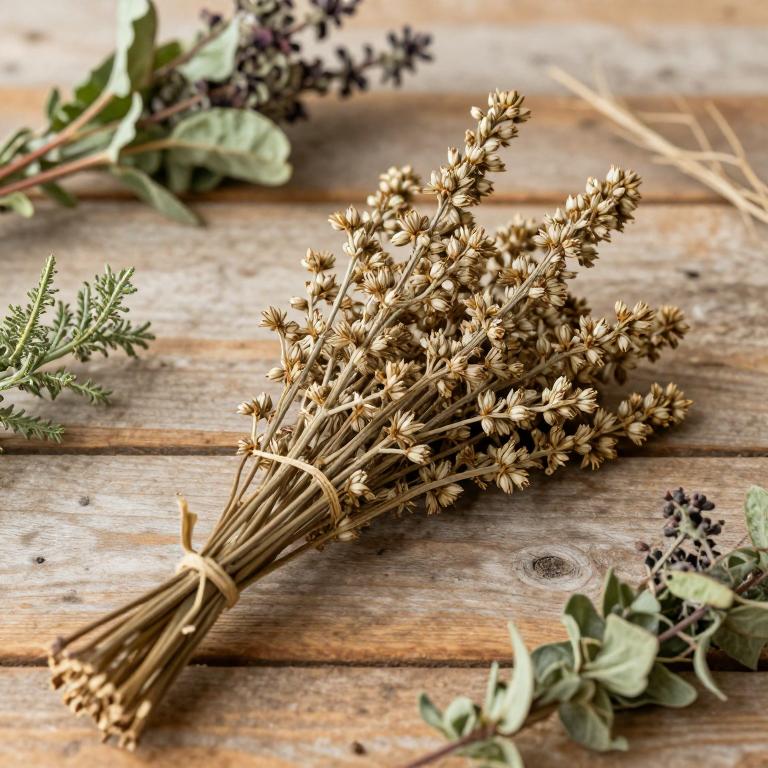
Names and Synonyms
Common Names
- Adenaria floribunda H.B.K.
Scientific Names
Accepted name
Adenaria floribundaSynonyms
- Adenaria floribunda var. grisleoides
- Antherylium floribundum
- Antherylium purpuratum
- Antherylium grisleoides
- Adenaria floribunda f. grisleoides
- Adenaria floribunda var. microphylla
- Adenaria floribunda var. parvifolia
- Adenaria floribunda var. purpurata
- Adenaria floribunda f. purpurata
- Adenaria grisleoides
- Adenaria lanceolata
- Adenaria parvifolia
- Adenaria purpurata
- Adenaria purpurata var. australis
Sources: Wikidata, Catalogue of Life
Taxonomical Classification
This plant, known scientifically as Adenaria floribunda, belongs to the kingdom Plantae and the phylum Streptophyta. It is classified under the class Equisetopsida and the subclass Magnoliidae within the order Myrtales. Finally, it is a member of the family Lythraceae and is situated within the genus Adenaria.
| Rank | Classification |
|---|---|
| Kingdom | Plantae |
| Phylum | Streptophyta |
| Class | Equisetopsida |
| Subclass | Magnoliidae |
| Order | Myrtales |
| Family | Lythraceae |
| Genus | Adenaria |
Sources: The World Checklist of Vascular Plants (WCVP)
Distribution
This plant exhibits a broad geographical range stretching from North to Central America. Within Mexico, its presence is noted across the Gulf region and throughout the Southwest. It can also be found extending into the Southeast portion of Mexico. Moving southward into Central America, the species inhabits the landscapes of Guatemala. Finally, its distribution reaches as far south as Costa Rica.
| Region | Area |
|---|---|
| Mexico | Mexico Gulf |
| Mexico | Mexico Southwest |
| Mexico | Mexico Southeast |
| Central America | Costa Rica |
| Central America | Guatemala |
| Central America | Honduras |
| Central America | Nicaragua |
| Central America | Panamá |
| Caribbean | Dominican Republic |
| Caribbean | Haiti |
Sources: The World Checklist of Vascular Plants (WCVP)
Botanical Identification
Ecology
The ecology of Adenaria floribunda is characterized by its presence in diverse and moisture-rich environments, ranging from perennial seasonal forests (Floresta Estacional Perenifólia) and ombrophilous or rainforest habitats (Floresta Ombrófila/Pluvial) to specialized aquatic vegetation zones (Vegetação Aquática). This species exhibits a broad altitudinal distribution, spanning from sea level (0 m AMSL) to high-altitude reaches of up to 2800 m AMSL. Across its entire range, the plant maintains an average elevation of approximately 1750 m AMSL, reflecting its ability to adapt to varying topographical and climatic gradients within these lush forest ecosystems.
- Elevational range max:
- 2800 m AMSL
- Elevational range mean:
- 1750 m AMSL
- Elevational range min:
- 0 m AMSL
- Habitat :
- Floresta Estacional Perenifólia, Floresta Ombrófila (= Floresta Pluvial), Vegetação Aquática
Life history
The life history of Adenaria floribunda is characterized by its status as a perennial species, allowing it to maintain a stable presence within its ecosystem over many years. As a long-lived woody plant, it bypasses the short developmental windows typical of annuals or biennials, instead establishing a robust structural framework that supports repeated reproductive cycles. This perennial nature enables the plant to endure seasonal fluctuations and environmental shifts, investing energy into sustained growth and the development of a persistent root system. Throughout its extended lifespan, the plant undergoes continuous physiological processes to support its vegetative expansion and periodic flowering, ensuring its long-term survival and ability to contribute to the local flora across multiple growing seasons.
- Lifecycle :
- perennial
Morphology
The morphology of Adenaria floribunda is characterized by its woody growth form, manifesting primarily as a shrub. It functions as a self-supporting plant, exhibiting neither climbing nor parasitic behaviors, and remains an independent organism. In its natural habitat, it is strictly terrestrial, lacking any epiphytic or aquatic characteristics. The plant reaches a moderate stature, with a mean height of approximately 2.5 m and a maximum potential height of up to 5 m.
- Aquatic :
- terrestrial
- Climber :
- self-supporting
- Epiphyte :
- terrestrial
- Growth form :
- shrub
- Parasite :
- independent
- Plant height max:
- 5 m
- Plant height mean:
- 2.5 m
- Woodiness :
- woody
Physiology
The physiology of Adenaria floribunda is characterized by specific structural and resource-allocation traits that define its vegetative efficiency. The plant exhibits a highly consistent stem specific density (SSD), with a mean, minimum, and maximum value all recorded at 480 mg/cm³, indicating a uniform structural composition in its woody tissues. In terms of foliar characteristics, the leaf dry matter content (LDMC) remains stable across its measured range, maintaining a mean, minimum, and maximum of 344.4 mg/g, which suggests a highly controlled investment in leaf tissue density and non-structural carbohydrates. Furthermore, the Specific Leaf Area (SLA) is characterized by a fixed value across all recorded observations, with a mean, minimum, and maximum of 168.9087 cm²/g, reflecting a specific strategy for balancing light interception and leaf thickness.
- Leaf dry matter content (LDMC) mean:
- 344.4 mg/g
- Specific Leaf Area (SLA) min:
- 168.9087 cm²/g
- Stem specific density (SSD) min:
- 480 mg/cm³
Reproduction
Reproduction in Adenaria floribunda involves a complex interplay of dispersal mechanisms designed to ensure the survival and spread of the species across its habitat. The plant exhibits a diverse range of dispersal syndromes, functioning through an unspecialized approach that incorporates multiple vectors to facilitate seed movement. Specifically, the species utilizes zoochorous dispersal, where animals play a critical role in transporting seeds to new locations. This is supplemented by anemochorous and hydrochorous strategies, allowing wind and water to act as secondary agents of movement. Additionally, the plant may engage in autochorous dispersal, where seeds are moved by internal mechanical forces. This multi-modal reproductive strategy ensures that Adenaria floribunda can effectively colonize varied environments through both biotic and abiotic means.
- Dispersal syndrome :
- zoochorous
Sources: Global Inventory of Floras and Traits (GIFT)
Plant Parts
Adenaria floribunda has 1 reported plant parts identified across 1 scientific publications and several other databases that are studied for medicinal purposes. The most consistently reported plant part include leaf.
| Plant part | Supporting sources | Consensus |
|---|---|---|
| Leaf | 1 supporting sources | ★☆☆☆☆ |
Leaf
- Journal of natural products
Chemicals
Adenaria floribunda has 1 reported phytochemicals identified across 1 scientific publications and several other databases. The most consistently reported chemicals include Adenaflorin A.
| Chemical | Supporting sources | Consensus |
|---|---|---|
| Adenaflorin A | 1 supporting sources | ★☆☆☆☆ |
Adenaflorin A
- Journal of natural products
Activities
Adenaria floribunda has 1 reported activities identified across 1 scientific publications and several other databases. The most consistently reported activities include Cytotoxic.
| Activity | Supporting sources | Consensus |
|---|---|---|
| Cytotoxic | 1 supporting sources | ★☆☆☆☆ |
Cytotoxic
- Journal of natural products