yarrow
Achillea · Accepted scientific name
Scientific literature: Very Sparse (26 studies) · ★☆☆☆☆
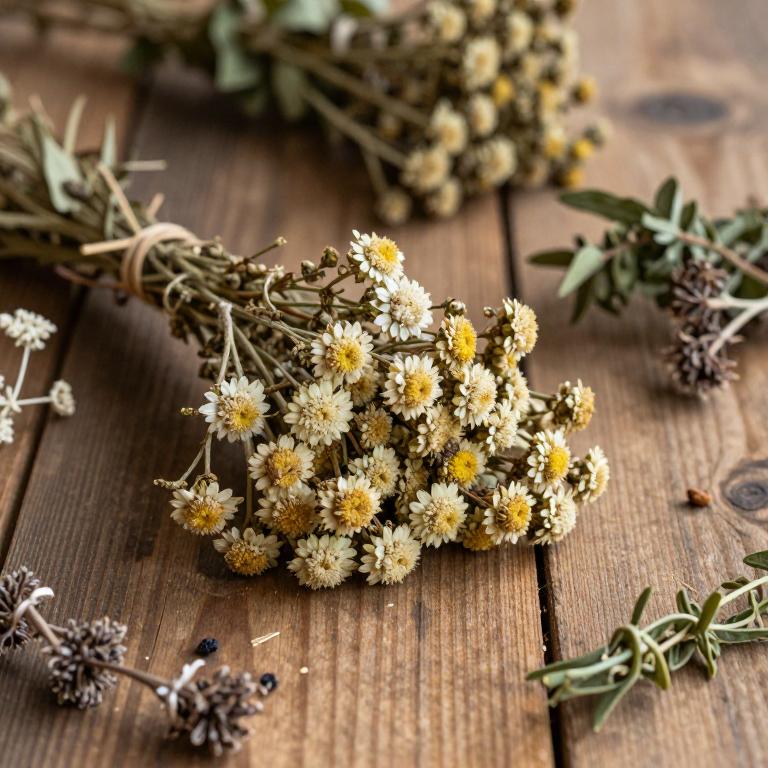
Yarrow, scientifically known as Achillea, is a versatile perennial herb celebrated for its remarkable healing properties. Renowned since antiquity, this hardy plant features feathery foliage and delicate flower clusters. Traditionally used to staunch bleeding and soothe inflammation, it remains a cornerstone in herbal medicine for supporting skin and digestive health.
- Family
- Asteraceae
- Native range
- Europe
- Parts used
- Flower · Leaf
- Common names
- Yarrow · Yarrows
- Scientific synonyms
- Leucocyclus · Conforata · 7 more
Names and Synonyms
Common Names
- yarrow
- yarrows
Scientific Names
Accepted name
AchilleaSynonyms
- Leucocyclus
- Conforata
- Arthrolepis
- Ptarmica
- Neesia
- Millefolium
- Chrysopelta
- Otanthus
- Alitubus
Regional and Traditional Names
Spanish:
- Conforata
- Diotis
- Arthrolepis
- Leucocyclus
- Millefolium
- Achillios
- milenrama y parientes
German:
- Schafgarben
- Schafgarbe
- Schafgarbe
- Schafgarben
French:
- Achillée
- Achillee
- Achillées
- Achillée
Sources: Wikidata, Catalogue of Life
Taxonomical Classification
This plant belongs to the kingdom Plantae and the phylum Streptophyta, falling under the class Equisetopsida and subclass Magnoliidae. Within the order Asterales, it is classified under the family Asteraceae and the genus Achillea.
| Rank | Classification |
|---|---|
| Kingdom | Plantae |
| Phylum | Streptophyta |
| Class | Equisetopsida |
| Subclass | Magnoliidae |
| Order | Asterales |
| Family | Asteraceae |
| Genus | Achillea |
Sources: The World Checklist of Vascular Plants (WCVP)
Distribution
This plant exhibits a widespread presence across several regions within Northern Europe. It can be found growing naturally in the landscapes of Denmark and Finland. The species also extends its reach to the remote islands of Føroyar and Iceland. Additionally, its geographical range encompasses the diverse terrains of Great Britain. Together, these locations highlight the plant's significant distribution throughout the northern latitudes.
| Region | Area |
|---|---|
| Northern Europe | Denmark |
| Northern Europe | Finland |
| Northern Europe | Føroyar |
| Northern Europe | Great Britain |
| Northern Europe | Iceland |
| Northern Europe | Ireland |
| Northern Europe | Norway |
| Northern Europe | Sweden |
| Middle Europe | Austria |
| Middle Europe | Belgium |
Sources: The World Checklist of Vascular Plants (WCVP)
Plant Parts
Achillea has 2 reported plant parts identified across 2 scientific publications and several other databases that are studied for medicinal purposes. The most consistently reported plant part include flower, leaf.
| Plant part | Supporting sources | Consensus |
|---|---|---|
| Flower | 1 supporting sources | ★☆☆☆☆ |
| Leaf | 1 supporting sources | ★☆☆☆☆ |
Flower
- Frontiers in microbiology
Leaf
- Frontiers in microbiology
Chemicals
Achillea has 7 reported phytochemicals identified across 2 scientific publications and several other databases. The most consistently reported chemicals include Coumarins, Flavonoids, Monoterpenes, Sesquiterpenes, Sterols.
| Chemical | Supporting sources | Consensus |
|---|---|---|
| Coumarins | 1 supporting sources | ★☆☆☆☆ |
| Flavonoids | 1 supporting sources | ★☆☆☆☆ |
| Monoterpenes | 1 supporting sources | ★☆☆☆☆ |
| Sesquiterpenes | 1 supporting sources | ★☆☆☆☆ |
| Sterols | 1 supporting sources | ★☆☆☆☆ |
| Terpenoids | 1 supporting sources | ★☆☆☆☆ |
| Triterpenes | 1 supporting sources | ★☆☆☆☆ |
Coumarins
- Daru : journal of Faculty of Pharmacy, Tehran University of Medical Sciences
Flavonoids
- Daru : journal of Faculty of Pharmacy, Tehran University of Medical Sciences
Monoterpenes
- Daru : journal of Faculty of Pharmacy, Tehran University of Medical Sciences
Sesquiterpenes
- Daru : journal of Faculty of Pharmacy, Tehran University of Medical Sciences
Sterols
- Daru : journal of Faculty of Pharmacy, Tehran University of Medical Sciences
Terpenoids
- Daru : journal of Faculty of Pharmacy, Tehran University of Medical Sciences
Triterpenes
- Daru : journal of Faculty of Pharmacy, Tehran University of Medical Sciences
Activities
Achillea has 4 reported activities identified across 2 scientific publications and several other databases. The most consistently reported activities include Diuretic, Emmenagogue, Sedative, Tonic.
| Activity | Supporting sources | Consensus |
|---|---|---|
| Diuretic | 2 supporting sources | ★☆☆☆☆ |
| Emmenagogue | 1 supporting sources | ★☆☆☆☆ |
| Sedative | 1 supporting sources | ★☆☆☆☆ |
| Tonic | 1 supporting sources | ★☆☆☆☆ |
Diuretic
- Plants (Basel, Switzerland)
- Journal of ethnopharmacology
Emmenagogue
- Plants (Basel, Switzerland)
Sedative
- Journal of ethnopharmacology
Tonic
- Journal of ethnopharmacology
Conditions
Achillea has 9 reported investigations on conditions identified across 2 scientific publications and several other databases. The most consistently reported conditions include inflammation, breast-feedings, dyspepsia, flatulence, hay fever.
| Condition | Supporting sources | Consensus |
|---|---|---|
| Inflammation | 2 supporting sources | ★☆☆☆☆ |
| Breast-feedings | 1 supporting sources | ★☆☆☆☆ |
| Dyspepsia | 1 supporting sources | ★☆☆☆☆ |
| Flatulence | 1 supporting sources | ★☆☆☆☆ |
| Hay fever | 1 supporting sources | ★☆☆☆☆ |
| Headache | 1 supporting sources | ★☆☆☆☆ |
| Hemorrhoid | 1 supporting sources | ★☆☆☆☆ |
| Wound healing | 1 supporting sources | ★☆☆☆☆ |
| Wounds | 1 supporting sources | ★☆☆☆☆ |
Inflammation
- Daru : journal of Faculty of Pharmacy, Tehran University of Medical Sciences
- Journal of ethnopharmacology
Breast-feedings
- Journal of ethnopharmacology
Dyspepsia
- Daru : journal of Faculty of Pharmacy, Tehran University of Medical Sciences
Flatulence
- Daru : journal of Faculty of Pharmacy, Tehran University of Medical Sciences
Hay fever
- Journal of ethnopharmacology
Headache
- Daru : journal of Faculty of Pharmacy, Tehran University of Medical Sciences
Hemorrhoid
- Journal of ethnopharmacology
Wound healing
- Journal of ethnopharmacology
Wounds
- Daru : journal of Faculty of Pharmacy, Tehran University of Medical Sciences
Preparations
Achillea has 11 reported preparations identified across 2 scientific publications and several other databases. The most consistently reported preparations include extracts, Achillea extracts, artisanal beers, chloroform extract, essential oils.
| Preparation | Supporting sources | Consensus |
|---|---|---|
| Extracts | 2 supporting sources | ★☆☆☆☆ |
| Achillea extracts | 1 supporting sources | ★☆☆☆☆ |
| Artisanal beers | 1 supporting sources | ★☆☆☆☆ |
| Chloroform extract | 1 supporting sources | ★☆☆☆☆ |
| Essential oils | 1 supporting sources | ★☆☆☆☆ |
| Herbal teas | 1 supporting sources | ★☆☆☆☆ |
| Ice creams | 1 supporting sources | ★☆☆☆☆ |
| Leftovers or mulch | 1 supporting sources | ★☆☆☆☆ |
| Liqueurs | 1 supporting sources | ★☆☆☆☆ |
| Seasoned food products | 1 supporting sources | ★☆☆☆☆ |
Extracts
- Avicenna journal of phytomedicine
- Journal of ethnopharmacology
Achillea extracts
- Molecules (Basel, Switzerland)
Artisanal beers
- Plants (Basel, Switzerland)
Chloroform extract
- Zeitschrift fur Naturforschung. C, Journal of biosciences
Essential oils
- Journal of ethnopharmacology
Herbal teas
- Plants (Basel, Switzerland)
Ice creams
- Plants (Basel, Switzerland)
Leftovers or mulch
- Heliyon
Liqueurs
- Plants (Basel, Switzerland)
Seasoned food products
- Plants (Basel, Switzerland)