Achillea wilhelmsii
Achillea wilhelmsii · Accepted scientific name
Scientific literature: Very Sparse (44 studies) · ★☆☆☆☆
, scientifically known as Achillea wilhelmsii, is a rare and distinctive medicinal plant belonging to the Asteraceae family. Renowned for its unique botanical characteristics, this species holds significant potential in traditional healing practices. Exploring its phytochemical properties offers fascinating insights into its therapeutic applications and its role in natural medicine.
- Family
- Asteraceae
- Native range
- Africa
- Parts used
- Not available
- Common names
- Not available
- Scientific synonyms
- Achillea Kermanica · Achillea Krascheninnikovii · 1 more
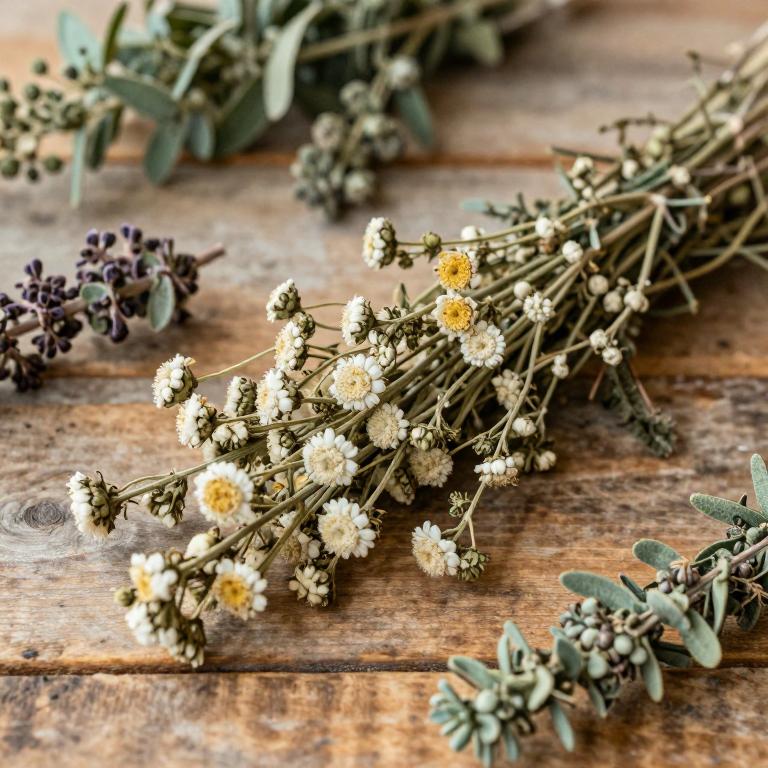
Names and Synonyms
Scientific Names
Accepted name
Achillea wilhelmsiiSynonyms
- Achillea kermanica
- Achillea krascheninnikovii
- Achillea santolinoides subsp. wilhelmsii
Sources: Wikidata, Catalogue of Life
Taxonomical Classification
This plant belongs to the kingdom Plantae and the phylum Streptophyta, falling under the class Equisetopsida and subclass Magnoliidae. Within the order Asterales, it is classified under the family Asteraceae and the genus Achillea. Specifically, the medicinal species is known as Achillea wilhelmsii.
| Rank | Classification |
|---|---|
| Kingdom | Plantae |
| Phylum | Streptophyta |
| Class | Equisetopsida |
| Subclass | Magnoliidae |
| Order | Asterales |
| Family | Asteraceae |
| Genus | Achillea |
Sources: The World Checklist of Vascular Plants (WCVP)
Distribution
This plant exhibits a specific geographical distribution spanning parts of Northern Africa and Central Asia. In the African continent, it can be found inhabiting the territories of Algeria, Egypt, Libya, and Tunisia. Beyond the African coastline, its range extends eastward into the mountainous regions of Central Asia. Specifically, it has been documented growing within the borders of Kirgizstan. Consequently, the species occupies a distinct ecological niche across these diverse geographical locations.
| Region | Area |
|---|---|
| Northern Africa | Algeria |
| Northern Africa | Egypt |
| Northern Africa | Libya |
| Northern Africa | Tunisia |
| Central Asia | Kirgizstan |
| Central Asia | Tadzhikistan |
| Central Asia | Uzbekistan |
| Caucasus | Transcaucasus |
| Western Asia | Afghanistan |
| Western Asia | Cyprus |
Sources: The World Checklist of Vascular Plants (WCVP)
Botanical Identification
Ecology
The ecology of Achillea wilhelmsii is characterized by its ability to thrive across diverse and often challenging landscapes, ranging from low-lying areas to high-altitude environments. It inhabits a broad elevational spectrum, beginning at altitudes as low as 300 m AMSL and extending up to a maximum of 3300 m AMSL. This species demonstrates significant ecological plasticity, colonizing a variety of distinct habitats including crop fields, deserts, and semi-deserts. Furthermore, it is well-adapted to specialized niches such as saline places and stony places, indicating a high tolerance for both osmotic stress and poor, rocky soil conditions.
- Elevational range max:
- 3300 m AMSL
- Elevational range min:
- 300 m AMSL
- Habitat :
- crop fields, desert, saline places, semidesert, stony places
Life history
The life history of Achillea wilhelmsii is characterized by a perennial lifecycle, allowing the plant to persist through multiple growing seasons rather than completing its cycle in a single year. In terms of its structural life form, the species is classified as a hemicryptophyte, meaning its perennable buds are located at or just below the soil surface, protected by leaf litter or other surface debris during unfavorable environmental conditions. This specific growth habit, consistent across its life form classifications, enables the plant to maintain stability and resilience within its ecological niche throughout its lifespan.
- Life form :
- hemicryptophyte
- Lifecycle :
- perennial
Morphology
The morphology of Achillea wilhelmsii is characterized by a growth form classified as a herb, specifically functioning as a non-woody forb. The plant is a self-supporting organism, lacking any climber or vine-like tendencies, and functions as an independent species without parasitic behavior. It is primarily a terrestrial plant, showing no aquatic or epiphytic characteristics. In terms of stature, it is a diminutive species with a plant height ranging from a minimum of 0.1 m to a maximum of 0.32 m.
- Aquatic :
- terrestrial
- Climber :
- self-supporting
- Epiphyte :
- terrestrial
- Growth form :
- herb
- Parasite :
- independent
- Plant height max:
- 0.32 m
- Plant height min:
- 0.1 m
- Woodiness :
- non-woody
Reproduction
The reproduction of Achillea wilmsii is characterized by a specific seasonal flowering window and the production of minute seeds. The flowering period typically commences in April and concludes in July, though the timing can be variable depending on environmental conditions. During this reproductive phase, the plant produces seeds that are remarkably consistent in size; the seed mass remains uniform with a mean, maximum, and minimum value of 0.00018 g, indicating a highly stabilized seed weight across the population.
- Flowering time :
- Apr
- Flowering time :
- Jul
- Seed mass mean:
- 0.00018 g
Sources: Global Inventory of Floras and Traits (GIFT)
Chemicals
Achillea wilhelmsii has 17 reported phytochemicals identified across 0 scientific publications and several other databases. The most consistently reported chemicals include camphor, 1,8-Cineol, 1,8-Cineole, ANETHOLE, BORNYL ACETATE.
| Chemical | Supporting sources | Consensus |
|---|---|---|
| camphor | 2 supporting sources | ★☆☆☆☆ |
| 1,8-Cineol | 1 supporting sources | ★☆☆☆☆ |
| 1,8-Cineole | 1 supporting sources | ★☆☆☆☆ |
| ANETHOLE | 1 supporting sources | ★☆☆☆☆ |
| BORNYL ACETATE | 1 supporting sources | ★☆☆☆☆ |
| CAMPHENE | 1 supporting sources | ★☆☆☆☆ |
| CARVACROL | 1 supporting sources | ★☆☆☆☆ |
| CU | 1 supporting sources | ★☆☆☆☆ |
| Dihydrocarvone | 1 supporting sources | ★☆☆☆☆ |
| FE | 1 supporting sources | ★☆☆☆☆ |
camphor
- 3 Biotech
- Scientific reports
1,8-Cineol
- 3 Biotech
1,8-Cineole
- Scientific reports
ANETHOLE
- Scientific reports
BORNYL ACETATE
- 3 Biotech
CAMPHENE
- 3 Biotech
CARVACROL
- 3 Biotech
CU
- BMC plant biology
Dihydrocarvone
- 3 Biotech
FE
- BMC plant biology
Activities
Achillea wilhelmsii has 9 reported activities identified across 0 scientific publications and several other databases. The most consistently reported activities include Antibacterial, Analgesic, Anticancer, Antihyperlipidemic, Antihypertensive.
| Activity | Supporting sources | Consensus |
|---|---|---|
| Antibacterial | 2 supporting sources | ★☆☆☆☆ |
| Analgesic | 1 supporting sources | ★☆☆☆☆ |
| Anticancer | 1 supporting sources | ★☆☆☆☆ |
| Antihyperlipidemic | 1 supporting sources | ★☆☆☆☆ |
| Antihypertensive | 1 supporting sources | ★☆☆☆☆ |
| Antiphlogistic | 1 supporting sources | ★☆☆☆☆ |
| Antiproliferative | 1 supporting sources | ★☆☆☆☆ |
| Antispasmodic | 1 supporting sources | ★☆☆☆☆ |
| Apoptotic | 1 supporting sources | ★☆☆☆☆ |
Antibacterial
- Complementary therapies in medicine
- Plant disease
Analgesic
- Plant disease
Anticancer
- Biomedical reports
Antihyperlipidemic
- Drugs under experimental and clinical research
Antihypertensive
- Drugs under experimental and clinical research
Antiphlogistic
- Plant disease
Antiproliferative
- Biomedical reports
Antispasmodic
- Plant disease
Apoptotic
- Biomedical reports
Conditions
Achillea wilhelmsii has 13 reported investigations on conditions identified across 0 scientific publications and several other databases. The most consistently reported conditions include prostate cancer, MRSA, PCa, acute lung injury, analgesic.
| Condition | Supporting sources | Consensus |
|---|---|---|
| Prostate cancer | 2 supporting sources | ★☆☆☆☆ |
| Mrsa | 1 supporting sources | ★☆☆☆☆ |
| Pca | 1 supporting sources | ★☆☆☆☆ |
| Acute lung injury | 1 supporting sources | ★☆☆☆☆ |
| Analgesic | 1 supporting sources | ★☆☆☆☆ |
| Antispasmodic | 1 supporting sources | ★☆☆☆☆ |
| Edema | 1 supporting sources | ★☆☆☆☆ |
| Epileptic seizures | 1 supporting sources | ★☆☆☆☆ |
| Gastrointestinal disorders | 1 supporting sources | ★☆☆☆☆ |
| Inflammation | 1 supporting sources | ★☆☆☆☆ |
Prostate cancer
- BioMedicine
- Biomedical reports
Mrsa
- 3 Biotech
Pca
- Biomedical reports
Acute lung injury
- Journal of complementary & integrative medicine
Analgesic
- Plant disease
Antispasmodic
- Plant disease
Edema
- Journal of complementary & integrative medicine
Epileptic seizures
- Indian journal of physiology and pharmacology
Gastrointestinal disorders
- Complementary therapies in medicine
Inflammation
- Journal of complementary & integrative medicine
Preparations
Achillea wilhelmsii has 8 reported preparations identified across 0 scientific publications and several other databases. The most consistently reported preparations include hydroalcoholic extract, EO, Ethanolic extract, essential oils, extract.
| Preparation | Supporting sources | Consensus |
|---|---|---|
| Hydroalcoholic extract | 2 supporting sources | ★☆☆☆☆ |
| Eo | 1 supporting sources | ★☆☆☆☆ |
| Ethanolic extract | 1 supporting sources | ★☆☆☆☆ |
| Essential oils | 1 supporting sources | ★☆☆☆☆ |
| Extract | 1 supporting sources | ★☆☆☆☆ |
| Extracts | 1 supporting sources | ★☆☆☆☆ |
| Methanolic extracts | 1 supporting sources | ★☆☆☆☆ |
| Plant extract | 1 supporting sources | ★☆☆☆☆ |
Hydroalcoholic extract
- Complementary therapies in medicine
- Biomedical reports
Eo
- 3 Biotech
Ethanolic extract
- Journal of complementary & integrative medicine
Essential oils
- Journal of arthropod-borne diseases
Extract
- Journal of traditional and complementary medicine
Extracts
- BioMedicine
Methanolic extracts
- Chemistry & biodiversity
Plant extract
- Indian journal of physiology and pharmacology