Achillea umbellata
Achillea umbellata · Accepted scientific name
Scientific literature: Very Sparse (10 studies) · ★☆☆☆☆
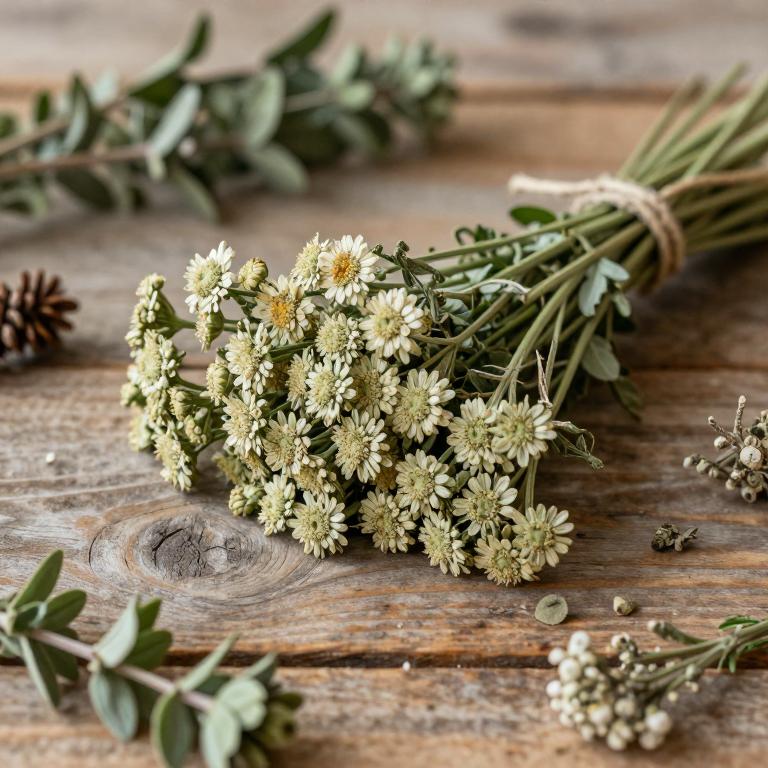
, scientifically known as Achillea umbellata, is a perennial herb belonging to the Asteraceae family. Native to specific regions, this plant is valued in traditional medicine for its diverse therapeutic properties. Often utilized for its anti-inflammatory and antimicrobial potential, it remains a significant subject in ethnobotanical and pharmacological studies.
- Family
- Asteraceae
- Native range
- Europe
- Parts used
- Not available
- Common names
- Not available
- Scientific synonyms
- Not available
Names and Synonyms
Scientific Names
Accepted name
Achillea umbellataSources: Wikidata, Catalogue of Life
Taxonomical Classification
This plant belongs to the kingdom Plantae and is classified under the phylum Streptophyta and class Equisetopsida. Within the subclass Magnoliidae and order Asterales, it is a member of the Asteraceae family. Finally, it is identified under the genus Achillea as Achillea umbellata.
| Rank | Classification |
|---|---|
| Kingdom | Plantae |
| Phylum | Streptophyta |
| Class | Equisetopsida |
| Subclass | Magnoliidae |
| Order | Asterales |
| Family | Asteraceae |
| Genus | Achillea |
Sources: The World Checklist of Vascular Plants (WCVP)
Distribution
This plant possesses a very specific and limited geographical range. According to botanical records, its presence is primarily concentrated within Southeastern Europe. Specifically, the species is known to inhabit the region of Greece. This restricted distribution suggests that it may be highly adapted to the local Mediterranean climate. Consequently, researchers focusing on its habitat must look toward these particular southern European landscapes.
| Region | Area |
|---|---|
| Southeastern Europe | Greece |
Sources: The World Checklist of Vascular Plants (WCVP)
Botanical Identification
Life history
The life history of Achillea umbellata is characterized by its classification as a chamaephyte, a life form that dictates its survival strategy and growth habit within its native habitats. As a chamaephyte, the plant's perennating buds are located close to the ground level, typically just above the soil surface, which allows it to withstand varying environmental stresses such as temperature fluctuations or grazing. This growth strategy places it within a spectrum of life forms, specifically identified as a chamaephyte in both its primary and secondary structural classifications. By maintaining its reproductive and vegetative buds near the substrate, Achillea umbellata can effectively navigate its ecological niche, utilizing this low-growing stature to optimize resource acquisition while remaining resilient to external pressures.
- Life form :
- chamaephyte
Morphology
The morphology of Achillea umbellaata is characterized by a perennial growth habit, typically manifesting as a low-growing, spreading herb. The plant exhibits a diverse range of habitat adaptations, functioning across various moisture levels including aquatic, semiaquatic, and terrestrial environments. Its stems are generally erect or ascending, often branching from the base to form a compact cluster. The leaves are finely divided, displaying a pinnatifid or bipinnatifid structure with narrow, linear segments that give the foliage a delicate, feathery appearance. The inflorescence is composed of numerous small, discoid flower heads arranged in dense, flat-topped terminal corymbs. These flower heads are typically yellowish to cream-colored, supported by involucral bracts that surround the base of the florets. The root system is typically fibrous or rhizomatous, allowing the plant to anchor effectively within its specific ecological niche, whether in moist soil or transitional water edges.
- Aquatic :
- terrestrial
Sources: Global Inventory of Floras and Traits (GIFT)
Chemicals
Achillea umbellata has 3 reported phytochemicals identified across 0 scientific publications and several other databases. The most consistently reported chemicals include Fragranol, Fragranyl acetate, benzoate.
| Chemical | Supporting sources | Consensus |
|---|---|---|
| Fragranol | 1 supporting sources | ★☆☆☆☆ |
| Fragranyl acetate | 1 supporting sources | ★☆☆☆☆ |
| benzoate | 1 supporting sources | ★☆☆☆☆ |
Fragranol
- Food and chemical toxicology : an international journal published for the British Industrial Biological Research Association
Fragranyl acetate
- Food and chemical toxicology : an international journal published for the British Industrial Biological Research Association
benzoate
- Food and chemical toxicology : an international journal published for the British Industrial Biological Research Association
Activities
Achillea umbellata has 5 reported activities identified across 0 scientific publications and several other databases. The most consistently reported activities include Analgesic, Antianxiety, Antimicrobial, Antinociceptive, Anxiolytic.
| Activity | Supporting sources | Consensus |
|---|---|---|
| Analgesic | 1 supporting sources | ★☆☆☆☆ |
| Antianxiety | 1 supporting sources | ★☆☆☆☆ |
| Antimicrobial | 1 supporting sources | ★☆☆☆☆ |
| Antinociceptive | 1 supporting sources | ★☆☆☆☆ |
| Anxiolytic | 1 supporting sources | ★☆☆☆☆ |
Analgesic
- Food and chemical toxicology : an international journal published for the British Industrial Biological Research Association
Antianxiety
- Food and chemical toxicology : an international journal published for the British Industrial Biological Research Association
Antimicrobial
- Food and chemical toxicology : an international journal published for the British Industrial Biological Research Association
Antinociceptive
- Food and chemical toxicology : an international journal published for the British Industrial Biological Research Association
Anxiolytic
- Food and chemical toxicology : an international journal published for the British Industrial Biological Research Association
Conditions
Achillea umbellata has 2 reported investigations on conditions identified across 0 scientific publications and several other databases. The most consistently reported conditions include analgesic, anxiety.
| Condition | Supporting sources | Consensus |
|---|---|---|
| Analgesic | 1 supporting sources | ★☆☆☆☆ |
| Anxiety | 1 supporting sources | ★☆☆☆☆ |
Analgesic
- Food and chemical toxicology : an international journal published for the British Industrial Biological Research Association
Anxiety
- Food and chemical toxicology : an international journal published for the British Industrial Biological Research Association