bristly yarrow
Achillea setacea · Accepted scientific name
Scientific literature: Very Sparse (10 studies) · ★☆☆☆☆
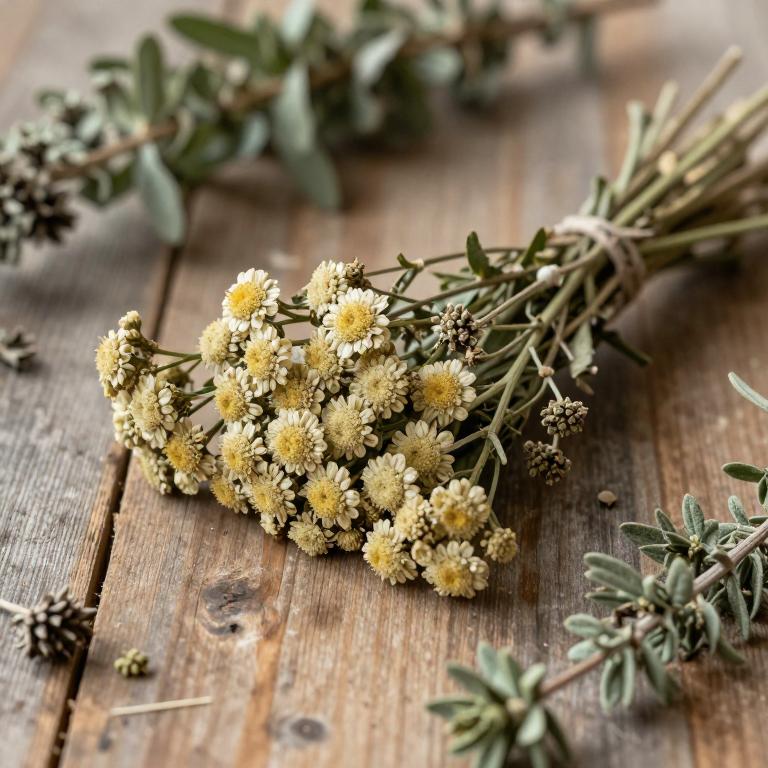
Bristly yarrow, scientifically known as Achillea setacea, is a perennial herb native to North America. Distinguished by its coarse, hairy foliage and clusters of white flowers, this resilient plant thrives in sunny, open habitats. Historically valued for its healing properties, it remains a fascinating subject in botanical studies.
- Family
- Asteraceae
- Native range
- Europe
- Parts used
- Not available
- Common names
- Bristly Yarrow
- Scientific synonyms
- Achillea Millefolium Var. Crustata · Achillea Setacea F. Ramosa · 11 more
Names and Synonyms
Common Names
- bristly yarrow
Scientific Names
Accepted name
Achillea setaceaSynonyms
- Achillea millefolium var. crustata
- Achillea setacea f. ramosa
- Millefolium setaceum
- Achillea capillaris
- Achillea setacea f. dolopica
- Achillea millefolium subsp. crustata
- Achillea fililoba
- Achillea millefolium var. setacea
- Achillea salina
- Achillea kummerleana
- Achillea crustata
- Achillea setacea var. filifolia
- Achillea setacea subsp. dolopica
Regional and Traditional Names
German:
- Feinblättrige Schafgarbe
- feinblättrige Schafgarbe
- Feinblättrige Wiesen-Schafgarbe
- Feinblaettrige Wiesen-Schafgarbe
French:
- achillée sétacée
- Achillee setacee
Sources: Wikidata, Catalogue of Life
Taxonomical Classification
This plant belongs to the kingdom Plantae and the phylum Streptophyta, falling under the class Equisetopsida and subclass Magnoliidae. Within the order Asterales, it is classified under the family Asteraceae and the genus Achillea.
| Rank | Classification |
|---|---|
| Kingdom | Plantae |
| Phylum | Streptophyta |
| Class | Equisetopsida |
| Subclass | Magnoliidae |
| Order | Asterales |
| Family | Asteraceae |
| Genus | Achillea |
Sources: The World Checklist of Vascular Plants (WCVP)
Distribution
This plant is distributed across several regions within Middle Europe. It can be found growing in the natural landscapes of Austria. Additionally, its presence extends to the territory of Belgium. The species also inhabits the areas of Czechia and Slovakia. Finally, this medicinal plant is documented in both Germany and Hungary.
| Region | Area |
|---|---|
| Middle Europe | Austria |
| Middle Europe | Belgium |
| Middle Europe | Czechia-Slovakia |
| Middle Europe | Germany |
| Middle Europe | Hungary |
| Middle Europe | Poland |
| Middle Europe | Switzerland |
| Southwestern Europe | France |
| Southwestern Europe | Spain |
| Southeastern Europe | Albania |
Sources: The World Checklist of Vascular Plants (WCVP)
Botanical Identification
Ecology
The ecology of Achillea setacea is characterized by its ability to thrive across a diverse array of landscapes, including cropfields, forests, forest edges, meadows, oldfields, and parks. It exhibits a significant adaptive capacity to varying altitudes, occupying an elevational range that spans from a minimum of 540 m AMSL to a maximum of 2400 m AMSL. Throughout its distribution, the species maintains a mean elevation of approximately 1470 m AMSL, reflecting its preference for mid-to-high altitude environments within its various habitat types.
- Elevational range max:
- 2400 m AMSL
- Elevational range mean:
- 1470 m AMSL
- Elevational range min:
- 540 m AMSL
- Habitat :
- cropfields,forest,forestedges,meadows,oldfields,parks
Life history
The life history of Achillea setacea is characterized by its existence as a perennial plant, allowing it to persist through multiple growing seasons. It adopts a hemicryptophyte life form, meaning its perennuating buds are located at or just below the soil surface, protected by leaf litter or soil during unfavorable conditions. Additionally, this species exhibits a deciduous nature, shedding its foliage as part of its seasonal cycle.
- Deciduousness :
- deciduous
- Life form :
- hemicryptophyte
- Lifecycle :
- perennial
Morphology
The morphology of Achillea setacea is characterized by its growth form as a non-woody herb, exhibiting a self-supporting structure rather than acting as a climber or vine. As a terrestrial plant, it functions as an independent organism and is not an epiphyte or a parasite. The plant maintains a relatively modest stature, with its height typically ranging from a minimum of 0.1 m to a maximum of 0.7 m, resulting in an average plant height of approximately 0.225 m.
- Aquatic :
- terrestrial
- Climber :
- self-supporting
- Epiphyte :
- terrestrial
- Growth form :
- herb
- Parasite :
- independent
- Plant height max:
- 0.7 m
- Plant height mean:
- 0.225 m
- Plant height min:
- 0.1 m
- Woodiness :
- non-woody
Physiology
The physiology of Achillea setacea is characterized by its specialized metabolic and structural adaptations, most notably its utilization of the C3 photosynthetic pathway. In this process, carbon dioxide is fixed directly by the enzyme RuBisCO through the Calvin cycle, a mechanism typical of most temperate herbaceous perennials which allows the plant to thrive in moderate climates. This C3 metabolism dictates the plant's water-use efficiency and stomatal conductance patterns, influencing how it manages gas exchange and transpiration during different diurnal cycles. Beyond its carbon fixation strategy, the plant's physiological framework involves complex secondary metabolic pathways that facilitate the synthesis of bioactive compounds, which are often regulated in response to environmental stressors such as light intensity and soil moisture availability. These physiological processes collectively support the plant's growth, reproductive cycles, and its ability to maintain homeostasis within its specific ecological niche.
- Photosynthetic pathway :
- C3
Reproduction
The reproduction of Achillea setacea is characterized by a specific seasonal flowering period and specialized mechanisms for pollination and seed dispersal. The plant enters its flowering stage in June and continues through August. Its pollination process is primarily biotic, specifically utilizing an insect-based pollination syndrome to ensure fertilization. Notably, self-fertilization is absent in this species, necessitating cross-pollination through its insect vectors. Following successful fertilization, the plant produces seeds with a mean mass of approximately 0.00017 g. These seeds are distributed via an anemochorous dispersal syndrome, meaning they are adapted to be dispersed by the wind.
- Dispersal syndrome :
- anemochorous
- Flowering time :
- Jun
- Flowering time :
- Aug
- Pollination syndrome :
- insect
- Pollination syndrome :
- biotic
- Seed mass mean:
- 0.00017 g
- Self fertilization :
- absent
Sources: Global Inventory of Floras and Traits (GIFT)
Chemicals
Achillea setacea has 8 reported phytochemicals identified across 0 scientific publications and several other databases. The most consistently reported chemicals include CD, CHLOROGENIC ACID, PB, SABINENE, alpha-Thujone.
| Chemical | Supporting sources | Consensus |
|---|---|---|
| CD | 1 supporting sources | ★☆☆☆☆ |
| CHLOROGENIC ACID | 1 supporting sources | ★☆☆☆☆ |
| PB | 1 supporting sources | ★☆☆☆☆ |
| SABINENE | 1 supporting sources | ★☆☆☆☆ |
| alpha-Thujone | 1 supporting sources | ★☆☆☆☆ |
| beta-Thujone | 1 supporting sources | ★☆☆☆☆ |
| camphor | 1 supporting sources | ★☆☆☆☆ |
| catechins | 1 supporting sources | ★☆☆☆☆ |
CD
- Environmental science and pollution research international
CHLOROGENIC ACID
- Chemistry & biodiversity
PB
- Environmental science and pollution research international
SABINENE
- Planta medica
alpha-Thujone
- Planta medica
beta-Thujone
- Planta medica
camphor
- Planta medica
catechins
- Chemistry & biodiversity
Preparations
Achillea setacea has 2 reported preparations identified across 0 scientific publications and several other databases. The most consistently reported preparations include AME, aerial parts.
| Preparation | Supporting sources | Consensus |
|---|---|---|
| Ame | 1 supporting sources | ★☆☆☆☆ |
| Aerial parts | 1 supporting sources | ★☆☆☆☆ |
Ame
- Chemistry & biodiversity
Aerial parts
- Zeitschrift fur Naturforschung. C, Journal of biosciences