Achillea pachycephala
Achillea pachycephala · Accepted scientific name
Scientific literature: Very Sparse (9 studies) · ★☆☆☆☆
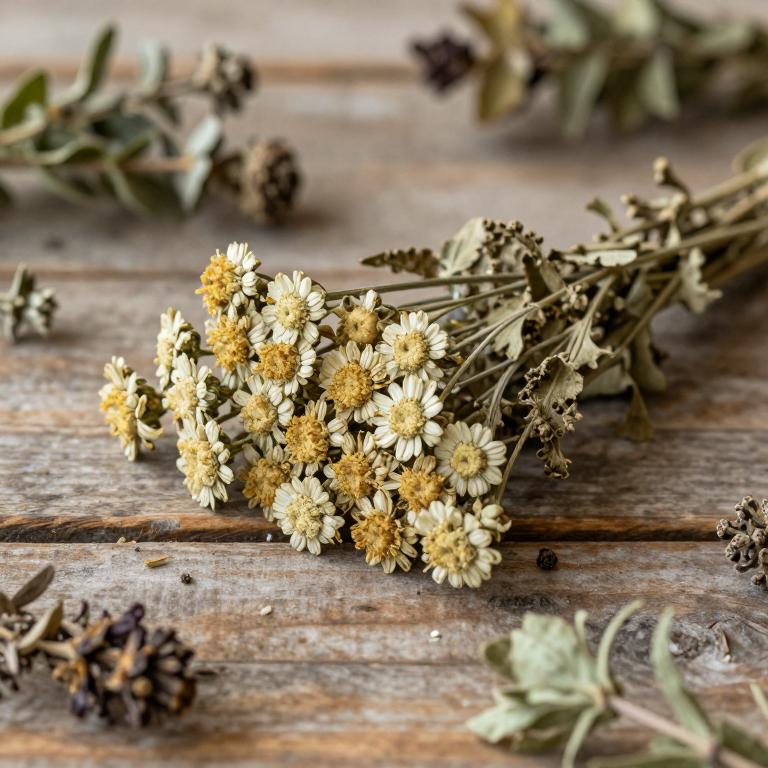
, scientifically known as Achillea pachycephala, is a resilient medicinal herb native to specific mountainous regions. Renowned for its dense, button-like flower heads, this species belongs to the Asteraceae family. It is traditionally valued for its therapeutic properties, offering potential applications in treating inflammation and supporting digestive health naturally.
- Family
- Asteraceae
- Native range
- Asia-Temperate
- Parts used
- Not available
- Common names
- Not available
- Scientific synonyms
- Not available
Names and Synonyms
Scientific Names
Accepted name
Achillea pachycephalaSources: Wikidata
Taxonomical Classification
This plant belongs to the kingdom Plantae and the phylum Streptophyta, falling under the class Equisetopsida and subclass Magnoliidae. Within the order Asterales, it is classified under the family Asteraceae and is specifically identified as part of the genus Achillea.
| Rank | Classification |
|---|---|
| Kingdom | Plantae |
| Phylum | Streptophyta |
| Class | Equisetopsida |
| Subclass | Magnoliidae |
| Order | Asterales |
| Family | Asteraceae |
| Genus | Achillea |
Sources: The World Checklist of Vascular Plants (WCVP)
Distribution
This plant, known scientifically as Achillea pachycephala, exhibits a very specific and limited range in its natural habitat. Its geographical distribution is primarily centered within the region of Western Asia. Specifically, the species can be found growing natively in the country of Iran. This localized occurrence suggests that the plant is adapted to the unique environmental conditions found in this part of the world. Consequently, its presence is a distinct characteristic of the Iranian landscape.
| Region | Area |
|---|---|
| Western Asia | Iran |
Sources: The World Checklist of Vascular Plants (WCVP)
Chemicals
Achillea pachycephala has 9 reported phytochemicals identified across 0 scientific publications and several other databases. The most consistently reported chemicals include 1,3-Dicaffeoylquinic acid, CHLOROGENIC ACID, RUTIN, apigenin, apigenin-7-O-glycoside.
| Chemical | Supporting sources | Consensus |
|---|---|---|
| 1,3-Dicaffeoylquinic acid | 1 supporting sources | ★☆☆☆☆ |
| CHLOROGENIC ACID | 1 supporting sources | ★☆☆☆☆ |
| RUTIN | 1 supporting sources | ★☆☆☆☆ |
| apigenin | 1 supporting sources | ★☆☆☆☆ |
| apigenin-7-O-glycoside | 1 supporting sources | ★☆☆☆☆ |
| caffeic acid | 1 supporting sources | ★☆☆☆☆ |
| kaempferol | 1 supporting sources | ★☆☆☆☆ |
| luteolin | 1 supporting sources | ★☆☆☆☆ |
| luteolin-7-O-glycoside | 1 supporting sources | ★☆☆☆☆ |
1,3-Dicaffeoylquinic acid
- Phytochemistry
CHLOROGENIC ACID
- Phytochemistry
RUTIN
- Phytochemistry
apigenin
- Phytochemistry
apigenin-7-O-glycoside
- Phytochemistry
caffeic acid
- Phytochemistry
kaempferol
- Phytochemistry
luteolin
- Phytochemistry
luteolin-7-O-glycoside
- Phytochemistry