Achillea micrantha
Achillea micrantha · Accepted scientific name
Scientific literature: Very Sparse (3 studies) · ★☆☆☆☆
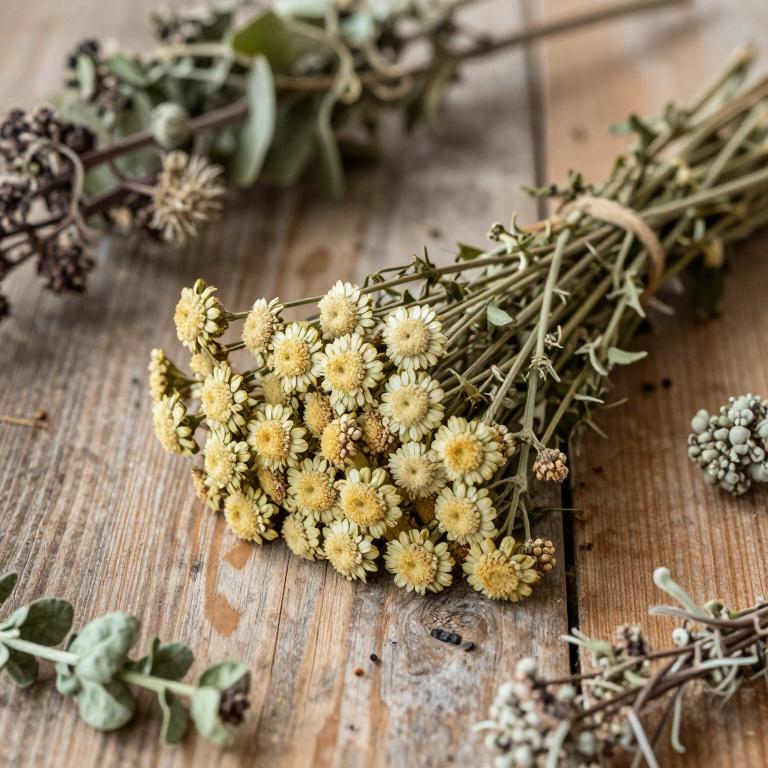
Scientifically known as Achillea micrantha, is a resilient perennial herb belonging to the Asteraceae family. Often found in rocky or mountainous terrains, this plant is valued in traditional medicine for its diverse therapeutic properties, including anti-inflammatory and antimicrobial effects, making it a significant subject for botanical research.
- Family
- Asteraceae
- Native range
- Europe
- Parts used
- Not available
- Common names
- Not available
- Scientific synonyms
- Achillea Micrantha Var. Reverdattoi · Achillea Birjuczensis · 3 more
Names and Synonyms
Scientific Names
Accepted name
Achillea micranthaSynonyms
- Achillea micrantha var. reverdattoi
- Achillea birjuczensis
- Achillea fruticulosa
- Achillea gerberi var. angustifolia
- Chamaemelum gerberi
Sources: Wikidata, Catalogue of Life
Taxonomical Classification
This plant belongs to the kingdom Plantae and the phylum Streptophyta, falling under the class Equisetopsida and subclass Magnoliidae. It is classified within the order Asterales and the family Asteraceae. Specifically, it is identified by its genus, Achillea.
| Rank | Classification |
|---|---|
| Kingdom | Plantae |
| Phylum | Streptophyta |
| Class | Equisetopsida |
| Subclass | Magnoliidae |
| Order | Asterales |
| Family | Asteraceae |
| Genus | Achillea |
Sources: The World Checklist of Vascular Plants (WCVP)
Distribution
This plant exhibits a diverse geographical presence across several key regions of the European continent. In Middle Europe, its range includes the territories of Germany and Poland. Moving toward the east, the species is also found within the borders of Belarus. Its distribution extends further north to encompass the various Baltic States. Additionally, the plant can be located in Southeastern Europe, specifically within Bulgaria.
| Region | Area |
|---|---|
| Middle Europe | Germany |
| Middle Europe | Poland |
| Southeastern Europe | Bulgaria |
| Eastern Europe | Belarus |
| Eastern Europe | Baltic States |
| Eastern Europe | Krym |
| Eastern Europe | Central European Russia |
| Eastern Europe | East European Russia |
| Eastern Europe | North European Russia |
| Eastern Europe | South European Russia |
Sources: The World Checklist of Vascular Plants (WCVP)
Botanical Identification
Ecology
The ecology of Achillea micrantha is characterized by its remarkable adaptability to diverse and often contrasting environmental conditions. This species exhibits a broad ecological amplitude, allowing it to colonize a wide variety of landscapes ranging from arid desert regions to more temperate forest ecosystems. It is frequently found inhabiting open meadows and expansive steppe environments, where it thrives in competitive herbaceous communities. Furthermore, its ability to tolerate sandy substrates indicates a resilience to nutrient-poor or unstable soil structures, enabling it to persist in transitional zones where other vegetation might struggle. This versatility across different biomes suggests a high degree of tolerance to varying moisture levels and temperature fluctuations.
- Habitat :
- desert, forest, meadows, sand, steppe
Life history
The life history of Achillea micrantha is characterized by a perennial lifecycle, allowing the plant to persist through multiple growing seasons. Structurally, it functions as a hemicryptophyte, a life form where the perennating buds are located at or just below the soil surface, typically protected by leaf litter or organic debris during unfavorable conditions. This classification as a hemicryptophyte ensures its survival and ability to regenerate annually from these protected buds.
- Life form :
- hemicryptophyte
- Lifecycle :
- perennial
Morphology
The morphology of Achillea micrantha is characterized by its growth form as a non-woody herb. This plant exhibits a versatile habitat preference, capable of existing in aquatic, semiaquatic, or terrestrial environments. In terms of stature, it is a relatively low-growing species, with a plant height that typically ranges from a minimum of 0.2 m to a maximum of 0.5 m.
- Aquatic :
- terrestrial
- Growth form :
- herb
- Plant height max:
- 0.5 m
- Plant height min:
- 0.2 m
- Woodiness :
- non-woody
Reproduction
The reproduction of Achillea micrantha is characterized by a specific seasonal flowering phenology that facilitates its pollination and seed production processes. The flowering period begins in June, marking the onset of its reproductive cycle, and continues through the mid-summer months until the flowering phase concludes in August. This seasonal window ensures that the plant's reproductive structures are active during the peak of the warm growing season, allowing for optimal interaction with pollinators.
- Flowering time :
- Jun
- Flowering time :
- Aug
Sources: Global Inventory of Floras and Traits (GIFT)
Chemicals
Achillea micrantha has 2 reported phytochemicals identified across 0 scientific publications and several other databases. The most consistently reported chemicals include 1,8-Cineole, camphor.
| Chemical | Supporting sources | Consensus |
|---|---|---|
| 1,8-Cineole | 1 supporting sources | ★☆☆☆☆ |
| camphor | 1 supporting sources | ★☆☆☆☆ |
1,8-Cineole
- Natural product research
camphor
- Natural product research
Preparations
Achillea micrantha has 1 reported preparations identified across 0 scientific publications and several other databases. The most consistently reported preparations include Essential oils from aerial parts.
| Preparation | Supporting sources | Consensus |
|---|---|---|
| Essential oils from aerial parts | 1 supporting sources | ★☆☆☆☆ |
Essential oils from aerial parts
- Natural product research