Cottonweed
Achillea maritima · Accepted scientific name
Scientific literature: Very Sparse (8 studies) · ★☆☆☆☆
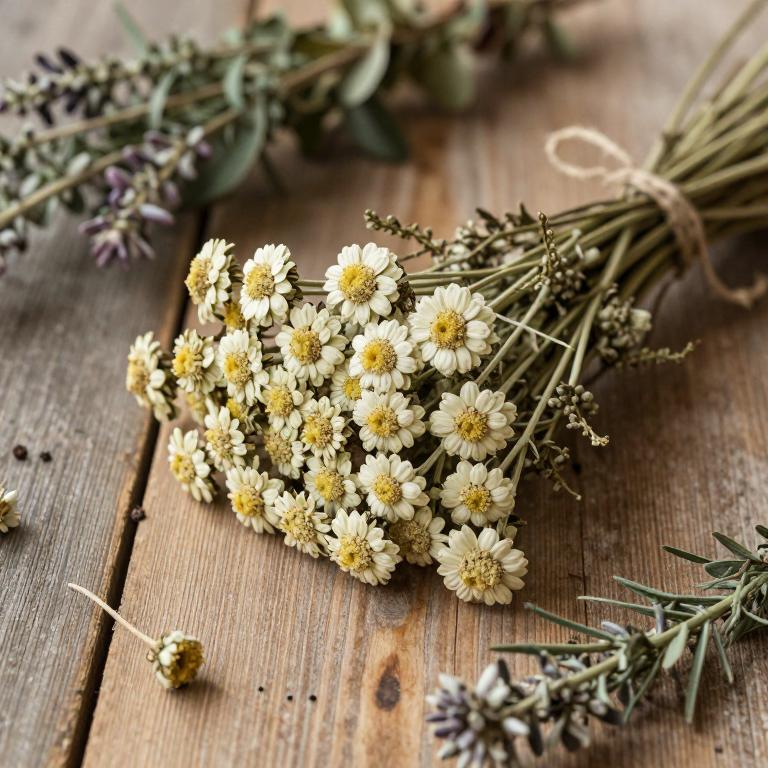
Cottonweed, scientifically known as Achillea maritima, is a resilient perennial herb native to coastal environments. Often found in sandy dunes, this plant features feathery foliage and clusters of white flowers. Traditionally valued for its medicinal properties, it contains bioactive compounds used to support skin health and digestive wellness.
- Family
- Asteraceae
- Native range
- Europe
- Parts used
- Not available
- Common names
- Cottonweed · Coastal Lavender Cotton
- Scientific synonyms
- Diotis Maritima · Filago Maritima · 5 more
Names and Synonyms
Common Names
- Cottonweed
- Coastal Lavender Cotton
Scientific Names
Accepted name
Achillea maritimaSynonyms
- Diotis maritima
- Filago maritima
- Gnaphalium maritimum
- Santolina maritima
- Athanasia maritima
- Neesia maritima
- Otanthus maritimus
Regional and Traditional Names
Spanish:
- Guata marina
German:
- Schneeweiße Strandfilzblume
- Schneeweisse Strandfilzblume
French:
- diotis blanc
- diotis cotonneux
- Achillée maritime
- Diotis blanc
Sources: Wikidata, Catalogue of Life
Taxonomical Classification
This plant belongs to the kingdom Plantae within the phylum Streptophyta and the class Equisetopsida. It is further classified under the subclass Magnoliidae and the order Asterales. Finally, it resides in the family Asteraceae and is identified by the genus Achillea.
| Rank | Classification |
|---|---|
| Kingdom | Plantae |
| Phylum | Streptophyta |
| Class | Equisetopsida |
| Subclass | Magnoliidae |
| Order | Asterales |
| Family | Asteraceae |
| Genus | Achillea |
Sources: The World Checklist of Vascular Plants (WCVP)
Distribution
This plant exhibits a diverse geographical distribution across several key regions of Europe. In Northern Europe, it can be found inhabiting the coastal areas of Great Britain and Ireland. Moving toward Middle Europe, the species is also recorded in Belgium. Its presence extends into Southwestern Europe, specifically within the Baleares islands. Additionally, the plant is documented growing on the island of Corse.
| Region | Area |
|---|---|
| Northern Europe | Great Britain |
| Northern Europe | Ireland |
| Middle Europe | Belgium |
| Southwestern Europe | Baleares |
| Southwestern Europe | Corse |
| Southwestern Europe | France |
| Southwestern Europe | Portugal |
| Southwestern Europe | Sardegna |
| Southwestern Europe | Spain |
| Southeastern Europe | Albania |
Sources: The World Checklist of Vascular Plants (WCVP)
Botanical Identification
Ecology
The ecology of Achillea maritima is characterized by its specialized adaptation to coastal environments, primarily thriving in habitats composed of sand and shores. This species occupies a very specific and low-lying altitudinal niche, with an elevational range spanning from 0 m to a maximum of only 20 m AMSL (meters above mean sea level). By occupying these seaside zones, the plant is integrated into the dynamic and often harsh conditions of maritime ecosystems, where it must contend with sandy substrates and the unique environmental pressures of shoreline landscapes.
- Elevational range max:
- 20 m AMSL
- Elevational range min:
- 0 m AMSL
- Habitat :
- sand, shores
Life history
The life history of Achillea maritima is characterized by a perennial lifecycle, allowing the plant to persist across multiple growing seasons. In terms of its structural growth and survival strategy, it is classified as a chamaephyte, a life form where the terminal buds are located close to the soil surface, often protected by leaf litter or substrate. This chamaephyte growth habit, consistent across its life form classifications, enables the species to thrive in its specific ecological niches by maintaining a low-growing profile that can withstand environmental stressors.
- Life form :
- chamaephyte
- Lifecycle :
- perennial
Morphology
The morphology of Achillea maritima is characterized by a low-growing growth form, functioning primarily as a herb or subshrub. It is a non-woody, self-supporting plant that does not exhibit climbing behavior, such as a vine or liana, and operates as an independent organism rather than a parasite. In terms of its ecological positioning, it is a terrestrial species, lacking epiphytic or aquatic tendencies. The plant maintains a compact stature, with a height ranging from a minimum of 0.1 m to a maximum of 0.5 m.
- Aquatic :
- terrestrial
- Climber :
- self-supporting
- Epiphyte :
- terrestrial
- Growth form :
- herb
- Growth form :
- subshrub
- Parasite :
- independent
- Plant height max:
- 0.5 m
- Plant height min:
- 0.1 m
- Woodiness :
- non-woody
Physiology
The physiology of Achillea maritima is characterized by a C3 photosynthetic pathway, which dictates its carbon fixation processes and metabolic efficiency. The morphology of its foliage is defined by elliptic leaf forms, which serve as the primary site for gas exchange and light absorption. These leaves exhibit specific dimensional constraints, with a leaf length ranging from a minimum of 1 cm to a maximum of 1.5 cm. Correspondingly, the leaf width is maintained within a narrow physiological range, measuring between a minimum of 0.6 cm and a maximum of 0.8 cm, factors that collectively influence the plant's surface-area-to-volume ratio and its overall transpiration and photosynthetic capacity.
- Leaf form :
- elliptic
- Leaf length max:
- 1.5 cm
- Leaf length min:
- 1 cm
- Leaf width max:
- 0.8 cm
- Leaf width min:
- 0.6 cm
- Photosynthetic pathway :
- C3
Reproduction
The reproduction of Achillea maritima is characterized by a specific flowering phenology and distinct morphological structures. The plant typically enters its flowering stage in July and concludes this period in August. During this time, it produces yellow flowers that range in length from 0.3 cm to 0.4 cm and maintain a width between 0.8 cm and 1 cm. The reproductive output results in the development of yellow fruits, specifically categorized as achenes, which measure between 0.2 cm and 0.3 cm in length. These fruits are indehiscent, meaning they do not split open at maturity to release seeds. The seeds themselves exhibit a mean mass of 0.00802 g, with individual seed weights ranging from a minimum of 0.00092 g to a maximum of 0.015 g.
- Dehiscence :
- indehiscent
- Flower colour :
- yellow
- Flower length max:
- 0.4 cm
- Flower length min:
- 0.3 cm
- Flower width max:
- 1 cm
- Flower width min:
- 0.8 cm
- Flowering time :
- Jul
- Flowering time :
- Aug
- Fruit colour :
- yellow
- Fruit length max:
- 0.3 cm
- Fruit length min:
- 0.2 cm
- Fruit type :
- achene
- Seed mass max:
- 0.015 g
- Seed mass mean:
- 0.00802 g
- Seed mass min:
- 0.00092 g
Sources: Global Inventory of Floras and Traits (GIFT)
Chemicals
Achillea maritima has 4 reported phytochemicals identified across 0 scientific publications and several other databases. The most consistently reported chemicals include Flavonoids, Monoterpenes, Vicenin, apigenin.
| Chemical | Supporting sources | Consensus |
|---|---|---|
| Flavonoids | 1 supporting sources | ★☆☆☆☆ |
| Monoterpenes | 1 supporting sources | ★☆☆☆☆ |
| Vicenin | 1 supporting sources | ★☆☆☆☆ |
| apigenin | 1 supporting sources | ★☆☆☆☆ |
Flavonoids
- Plant foods for human nutrition (Dordrecht, Netherlands)
Monoterpenes
- Journal of ethnopharmacology
Vicenin
- Plant foods for human nutrition (Dordrecht, Netherlands)
apigenin
- Plant foods for human nutrition (Dordrecht, Netherlands)
Activities
Achillea maritima has 4 reported activities identified across 0 scientific publications and several other databases. The most consistently reported activities include Antidiabetic, Antioxidant, Cytotoxic, Neuroprotective.
| Activity | Supporting sources | Consensus |
|---|---|---|
| Antidiabetic | 1 supporting sources | ★☆☆☆☆ |
| Antioxidant | 1 supporting sources | ★☆☆☆☆ |
| Cytotoxic | 1 supporting sources | ★☆☆☆☆ |
| Neuroprotective | 1 supporting sources | ★☆☆☆☆ |
Antidiabetic
- Plant foods for human nutrition (Dordrecht, Netherlands)
Antioxidant
- Plant foods for human nutrition (Dordrecht, Netherlands)
Cytotoxic
- Plant foods for human nutrition (Dordrecht, Netherlands)
Neuroprotective
- Plant foods for human nutrition (Dordrecht, Netherlands)
Preparations
Achillea maritima has 5 reported preparations identified across 0 scientific publications and several other databases. The most consistently reported preparations include ethanol extract, ethanol/water, ethyl acetate extract, hexane extract, water extract.
| Preparation | Supporting sources | Consensus |
|---|---|---|
| Ethanol extract | 1 supporting sources | ★☆☆☆☆ |
| Ethanol/water | 1 supporting sources | ★☆☆☆☆ |
| Ethyl acetate extract | 1 supporting sources | ★☆☆☆☆ |
| Hexane extract | 1 supporting sources | ★☆☆☆☆ |
| Water extract | 1 supporting sources | ★☆☆☆☆ |
Ethanol extract
- Plant foods for human nutrition (Dordrecht, Netherlands)
Ethanol/water
- Plant foods for human nutrition (Dordrecht, Netherlands)
Ethyl acetate extract
- Plant foods for human nutrition (Dordrecht, Netherlands)
Hexane extract
- Plant foods for human nutrition (Dordrecht, Netherlands)
Water extract
- Plant foods for human nutrition (Dordrecht, Netherlands)