Achillea fragrantissima
Achillea fragrantissima · Accepted scientific name
Scientific literature: Very Sparse (43 studies) · ★☆☆☆☆
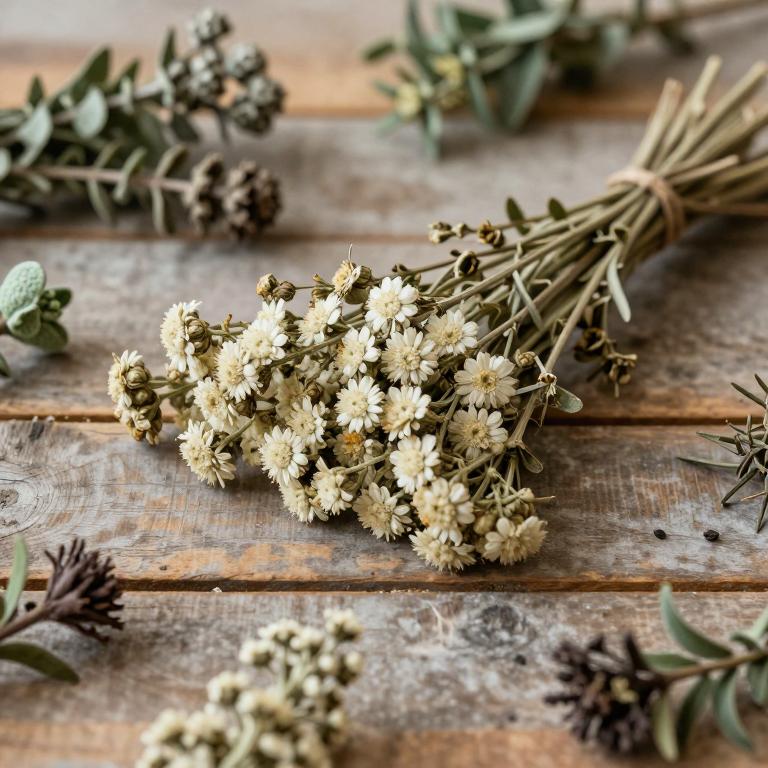
Scientifically known as Achillea fragrantissima, is a fragrant perennial herb native to the arid regions of Central Asia. Characterized by its aromatic, feathery foliage and bright yellow flower clusters, this hardy plant is valued in traditional medicine for its soothing properties and its ability to thrive in rocky soils.
- Family
- Asteraceae
- Native range
- Africa
- Parts used
- Leaf
- Common names
- Not available
- Scientific synonyms
- Santolina Fragrantissima · Santolina Simplicifolia · 2 more
Names and Synonyms
Scientific Names
Accepted name
Achillea fragrantissimaSynonyms
- Santolina fragrantissima
- Santolina simplicifolia
- Pyrethrum musilii
- Tanacetum musilii
Sources: Wikidata, Catalogue of Life
Taxonomical Classification
This plant belongs to the kingdom Plantae and is classified under the phylum Streptophyta and the class Equisetopsida. Within the subclass Magnoliidae, it is organized under the order Asterales and the family Asteraceae. Ultimately, its taxonomic identity is defined by its membership in the genus Achillea.
| Rank | Classification |
|---|---|
| Kingdom | Plantae |
| Phylum | Streptophyta |
| Class | Equisetopsida |
| Subclass | Magnoliidae |
| Order | Asterales |
| Family | Asteraceae |
| Genus | Achillea |
Sources: The World Checklist of Vascular Plants (WCVP)
Distribution
This plant exhibits a specific geographical range concentrated within the Middle East and North Africa. In Northern Africa, its presence is documented in Egypt. The species also extends into Western Asia, where it can be found throughout Iraq. Its distribution continues through the Levant, specifically covering the regions of Lebanon-Syria and Palestine. Finally, it inhabits the Sinai Peninsula, completing its regional footprint.
| Region | Area |
|---|---|
| Northern Africa | Egypt |
| Western Asia | Iraq |
| Western Asia | Lebanon-Syria |
| Western Asia | Palestine |
| Western Asia | Sinai |
| Arabian Peninsula | Kuwait |
| Arabian Peninsula | Saudi Arabia |
Sources: The World Checklist of Vascular Plants (WCVP)
Botanical Identification
Life history
The life history of Achillea fragrantissima is characterized by its nature as a perennial plant, allowing it to establish long-term presence within its ecosystem. As a perennial species, it undergoes a recurring seasonal cycle, regenerating its foliage and flowering structures year after year rather than completing its life cycle in a single season. This lifecycle enables the plant to develop robust root systems that store energy, facilitating survival through dormant periods and supporting vigorous growth during favorable environmental conditions. Through its perennial habit, it maintains stability in its habitat, contributing to the continuous biological processes of its native landscape.
- Lifecycle :
- perennial
Morphology
The morphology of Achillea fragrantissima is characterized by its growth form as a non-woody herb and a forb. This plant is strictly terrestrial in its habitat, lacking any aquatic or semiaquatic tendencies. As a self-supporting species, it does not exhibit any climber characteristics, maintaining an upright structure through its own biological strength. Furthermore, the plant is an independent organism, showing no parasitic behavior toward other species.
- Aquatic :
- terrestrial
- Climber :
- self-supporting
- Growth form :
- herb
- Parasite :
- independent
- Woodiness :
- non-woody
Reproduction
Reproduction in Achillea fragrantissima is facilitated through the production of small seeds that play a critical role in its dispersal and establishment within its habitat. The reproductive output is characterized by highly consistent seed dimensions, with a recorded seed mass of 0.00059 g. This specific mass value is uniform across all measurements, as both the mean, maximum, and minimum seed mass values are documented at 0.00059 g. Such precision in seed weight suggests a specialized evolutionary strategy for seed production, ensuring that the progeny possess standardized physical properties for successful germination and survival.
- Seed mass mean:
- 0.00059 g
Sources: Global Inventory of Floras and Traits (GIFT)
Plant Parts
Achillea fragrantissima has 1 reported plant parts identified across 1 scientific publications and several other databases that are studied for medicinal purposes. The most consistently reported plant part include leaf.
| Plant part | Supporting sources | Consensus |
|---|---|---|
| Leaf | 1 supporting sources | ★☆☆☆☆ |
Leaf
- Frontiers in veterinary science
Chemicals
Achillea fragrantissima has 17 reported phytochemicals identified across 1 scientific publications and several other databases. The most consistently reported chemicals include Artemisia ketone, 3,5,4'-trihydroxy-6,7,3'-trimethoxyflavone, 3-Thujanone, Achillolide A, Cirsiliol.
| Chemical | Supporting sources | Consensus |
|---|---|---|
| Artemisia ketone | 3 supporting sources | ★★☆☆☆ |
| 3,5,4'-trihydroxy-6,7,3'-trimethoxyflavone | 1 supporting sources | ★☆☆☆☆ |
| 3-Thujanone | 1 supporting sources | ★☆☆☆☆ |
| Achillolide A | 1 supporting sources | ★☆☆☆☆ |
| Cirsiliol | 1 supporting sources | ★☆☆☆☆ |
| DODECANE | 1 supporting sources | ★☆☆☆☆ |
| Eucalyptol | 1 supporting sources | ★☆☆☆☆ |
| Flavonoid | 1 supporting sources | ★☆☆☆☆ |
| Germacrene D | 1 supporting sources | ★☆☆☆☆ |
| ISOLONGIFOLOL | 1 supporting sources | ★☆☆☆☆ |
Artemisia ketone
- Journal, genetic engineering & biotechnology
- Journal of ethnopharmacology
- Natural product research
3,5,4'-trihydroxy-6,7,3'-trimethoxyflavone
- Journal of molecular neuroscience : MN
3-Thujanone
- Journal of ethnopharmacology
Achillolide A
- Journal of molecular neuroscience : MN
Cirsiliol
- General pharmacology
DODECANE
- Journal, genetic engineering & biotechnology
Eucalyptol
- Journal of ethnopharmacology
Flavonoid
- Scientific reports
Germacrene D
- Journal of ethnopharmacology
ISOLONGIFOLOL
- Scientific reports
Activities
Achillea fragrantissima has 3 reported activities identified across 1 scientific publications and several other databases. The most consistently reported activities include Antibacterial, Anticancer, Inflammatory.
| Activity | Supporting sources | Consensus |
|---|---|---|
| Antibacterial | 1 supporting sources | ★☆☆☆☆ |
| Anticancer | 1 supporting sources | ★☆☆☆☆ |
| Inflammatory | 1 supporting sources | ★☆☆☆☆ |
Antibacterial
- Scientific reports
Anticancer
- Scientific reports
Inflammatory
- Scientific reports
Conditions
Achillea fragrantissima has 15 reported investigations on conditions identified across 1 scientific publications and several other databases. The most consistently reported conditions include cancer, Alzheimer's disease, Blastocystis, amyotrophic lateral sclerosis, arthritis.
| Condition | Supporting sources | Consensus |
|---|---|---|
| Cancer | 2 supporting sources | ★☆☆☆☆ |
| Alzheimer's disease | 1 supporting sources | ★☆☆☆☆ |
| Blastocystis | 1 supporting sources | ★☆☆☆☆ |
| Amyotrophic lateral sclerosis | 1 supporting sources | ★☆☆☆☆ |
| Arthritis | 1 supporting sources | ★☆☆☆☆ |
| Bacteria | 1 supporting sources | ★☆☆☆☆ |
| Gout | 1 supporting sources | ★☆☆☆☆ |
| Heat stress | 1 supporting sources | ★☆☆☆☆ |
| Hepatobiliary diseases | 1 supporting sources | ★☆☆☆☆ |
| Inflammation | 1 supporting sources | ★☆☆☆☆ |
Cancer
- Journal of ethnopharmacology
- Scientific reports
Alzheimer's disease
- Journal of molecular neuroscience : MN
Blastocystis
- International journal of environmental research and public health
Amyotrophic lateral sclerosis
- Journal of molecular neuroscience : MN
Arthritis
- Drugs under experimental and clinical research
Bacteria
- Scientific reports
Gout
- Drugs under experimental and clinical research
Heat stress
- Frontiers in veterinary science
Hepatobiliary diseases
- Scientific reports
Inflammation
- Drugs under experimental and clinical research
Preparations
Achillea fragrantissima has 7 reported preparations identified across 1 scientific publications and several other databases. The most consistently reported preparations include Hydro-alcoholic extracts, dried extract, essential oil, essential oils, extracts.
| Preparation | Supporting sources | Consensus |
|---|---|---|
| Hydro-alcoholic extracts | 1 supporting sources | ★☆☆☆☆ |
| Dried extract | 1 supporting sources | ★☆☆☆☆ |
| Essential oil | 1 supporting sources | ★☆☆☆☆ |
| Essential oils | 1 supporting sources | ★☆☆☆☆ |
| Extracts | 1 supporting sources | ★☆☆☆☆ |
| Plant extracts | 1 supporting sources | ★☆☆☆☆ |
| Water-based aerial parts | 1 supporting sources | ★☆☆☆☆ |
Hydro-alcoholic extracts
- Journal of ethnopharmacology
Dried extract
- Drugs under experimental and clinical research
Essential oil
- Journal of ethnopharmacology
Essential oils
- Natural product communications
Extracts
- Journal of ethnopharmacology
Plant extracts
- Pakistan journal of biological sciences : PJBS
Water-based aerial parts
- Scientific reports