Achillea falcata
Achillea falcata · Accepted scientific name
Scientific literature: Very Sparse (7 studies) · ★☆☆☆☆
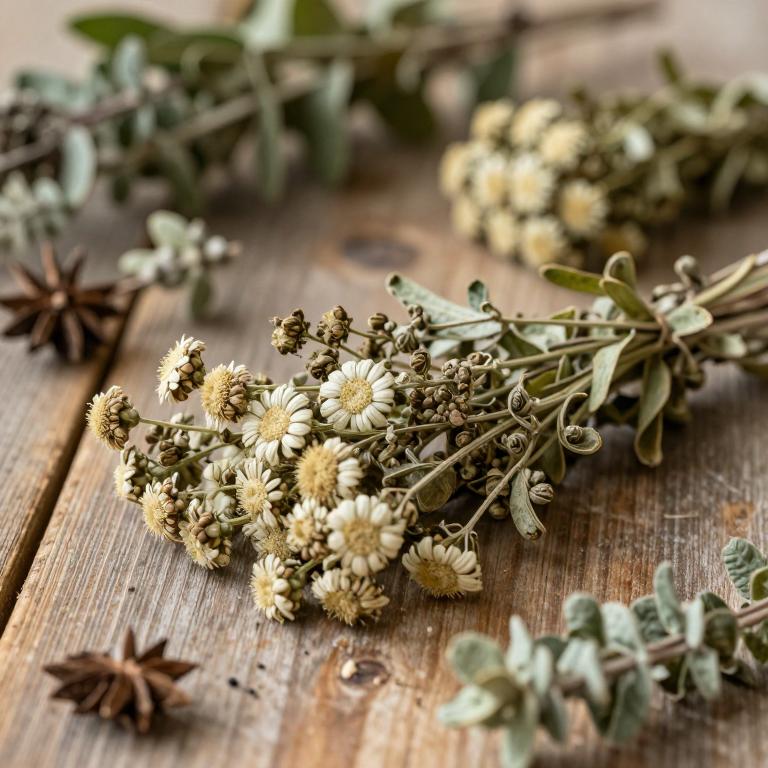
Scientifically known as Achillea falcata, is a distinctive perennial herb belonging to the Asteraceae family. Native to specific mountainous regions, this plant is characterized by its unique, sickle-shaped leaves. Often valued in traditional herbalism, it serves as a fascinating subject for botanical study and potential medicinal applications.
- Family
- Asteraceae
- Native range
- Asia-Temperate
- Parts used
- Not available
- Common names
- Not available
- Scientific synonyms
- Santolina Falcata · Achillea Sulphurea · 2 more
Names and Synonyms
Scientific Names
Accepted name
Achillea falcataSynonyms
- Santolina falcata
- Achillea sulphurea
- Ptarmica cristata
- Achillea damascena
Sources: Wikidata
Taxonomical Classification
This plant belongs to the kingdom Plantae and is classified under the phylum Streptophyta and class Equisetopsida. Within the subclass Magnoliidae, it is further organized into the order Asterales and the family Asteraceae. Ultimately, it is identified by the genus Achillea, specifically as the species Achillea falcata.
| Rank | Classification |
|---|---|
| Kingdom | Plantae |
| Phylum | Streptophyta |
| Class | Equisetopsida |
| Subclass | Magnoliidae |
| Order | Asterales |
| Family | Asteraceae |
| Genus | Achillea |
Sources: The World Checklist of Vascular Plants (WCVP)
Distribution
This plant, Achillea falcata, exhibits a specific geographical distribution across the Western Asian region. It is primarily found within the territories of Iraq and Türkiye. Furthermore, its natural habitat extends through the Levant, specifically covering Lebanon and Syria. The species can also be identified within the borders of Palestine. Consequently, its presence is concentrated within these distinct Mediterranean and Middle Eastern landscapes.
| Region | Area |
|---|---|
| Western Asia | Iraq |
| Western Asia | Lebanon-Syria |
| Western Asia | Palestine |
| Western Asia | Türkiye |
Sources: The World Checklist of Vascular Plants (WCVP)
Botanical Identification
Morphology
The morphology of Achillea falcata is characterized by its growth form as a subshrub and an herbaceous plant, exhibiting a non-woody structure throughout its development. It is a self-supporting species that does not function as a climber, liana, or vine, maintaining its upright posture independently. The plant is terrestrial in its ecological niche, functioning as an independent organism rather than an epiphyte or a parasite.
- Aquatic :
- terrestrial
- Climber :
- self-supporting
- Epiphyte :
- terrestrial
- Growth form :
- herb
- Growth form :
- subshrub
- Parasite :
- independent
- Woodiness :
- non-woody
Reproduction
The reproduction of Achillea falcata is characterized by the production of specialized seeds that exhibit specific quantitative variations in weight. The reproductive output of this species is defined by a seed mass that fluctuates within a relatively narrow range, with a recorded mean seed mass of 0.000302 g. Detailed measurements of individual seeds reveal a minimum seed mass of 0.00012 g and a maximum seed mass of 0.00076 g. This distribution of seed mass is a critical component of its dispersal and establishment strategy, ensuring that the progeny are equipped to navigate its specific ecological niche.
- Seed mass max:
- 0.00076 g
- Seed mass mean:
- 0.000302 g
- Seed mass min:
- 0.00012 g
Sources: Global Inventory of Floras and Traits (GIFT)
Chemicals
Achillea falcata has 4 reported phytochemicals identified across 0 scientific publications and several other databases. The most consistently reported chemicals include 8-Hydroxy-3-methoxyisosecotanapartholide, Chrysartemin B, Rupin A, isosecotanapartholide.
| Chemical | Supporting sources | Consensus |
|---|---|---|
| 8-Hydroxy-3-methoxyisosecotanapartholide | 1 supporting sources | ★☆☆☆☆ |
| Chrysartemin B | 1 supporting sources | ★☆☆☆☆ |
| Rupin A | 1 supporting sources | ★☆☆☆☆ |
| isosecotanapartholide | 1 supporting sources | ★☆☆☆☆ |
8-Hydroxy-3-methoxyisosecotanapartholide
- Molecules (Basel, Switzerland)
Chrysartemin B
- Molecules (Basel, Switzerland)
Rupin A
- Molecules (Basel, Switzerland)
isosecotanapartholide
- Molecules (Basel, Switzerland)
Conditions
Achillea falcata has 2 reported investigations on conditions identified across 0 scientific publications and several other databases. The most consistently reported conditions include colon cancer, colorectal cancer.
| Condition | Supporting sources | Consensus |
|---|---|---|
| Colon cancer | 1 supporting sources | ★☆☆☆☆ |
| Colorectal cancer | 1 supporting sources | ★☆☆☆☆ |
Colon cancer
- Journal of natural medicines
Colorectal cancer
- Molecules (Basel, Switzerland)
Preparations
Achillea falcata has 2 reported preparations identified across 0 scientific publications and several other databases. The most consistently reported preparations include Achillea falcata extracts, methanol whole plant.
| Preparation | Supporting sources | Consensus |
|---|---|---|
| Achillea falcata extracts | 1 supporting sources | ★☆☆☆☆ |
| Methanol whole plant | 1 supporting sources | ★☆☆☆☆ |
Achillea falcata extracts
- Molecules (Basel, Switzerland)
Methanol whole plant
- Journal of ethnopharmacology