Cretan yarrow
Achillea cretica · Accepted scientific name
Scientific literature: Very Sparse (9 studies) · ★☆☆☆☆
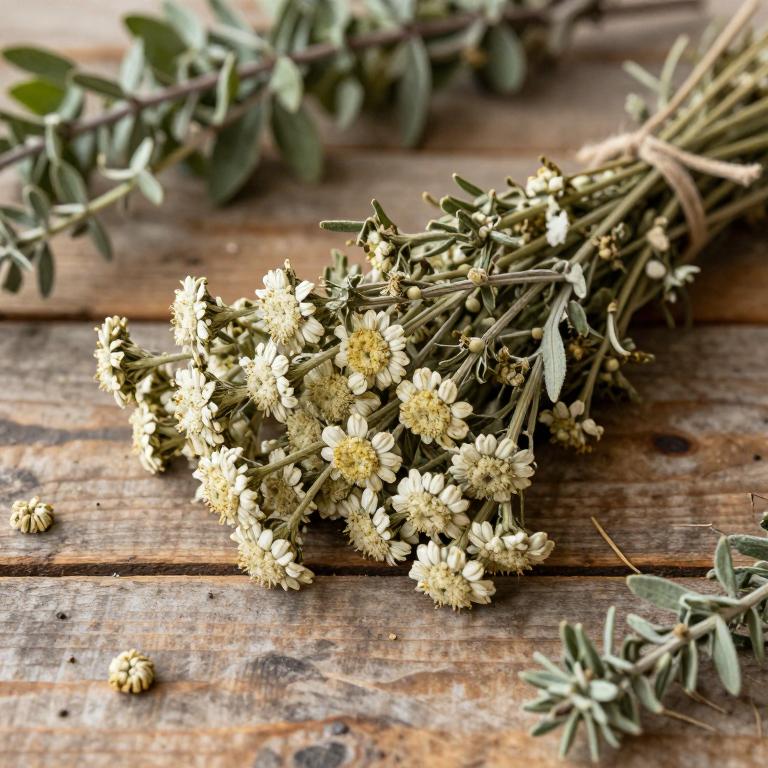
Cretan yarrow, scientifically known as Achillea cretica, is a distinctive perennial herb native to the Mediterranean region. Renowned for its delicate, feathery foliage and clusters of small flowers, this plant holds significant ethnobotanical value, traditionally utilized in various cultures for its potent antimicrobial and anti-inflammatory medicinal properties.
- Family
- Asteraceae
- Native range
- Europe
- Parts used
- Not available
- Common names
- Chamomile-Leaved Lavender-Cotton
- Scientific synonyms
- Santolina Anthemoides · Lyonnetia Anthemoides · 1 more
Names and Synonyms
Common Names
- Chamomile-leaved Lavender-cotton
Scientific Names
Accepted name
Achillea creticaSynonyms
- Santolina anthemoides
- Lyonnetia anthemoides
- Achillea erioclada
Sources: Wikidata, Catalogue of Life
Taxonomical Classification
This plant belongs to the kingdom Plantae and the phylum Streptophyta, falling under the class Equisetopsida and subclass Magnoliidae. Within the order Asterales, it is classified in the family Asteraceae under the genus Achillea.
| Rank | Classification |
|---|---|
| Kingdom | Plantae |
| Phylum | Streptophyta |
| Class | Equisetopsida |
| Subclass | Magnoliidae |
| Order | Asterales |
| Family | Asteraceae |
| Genus | Achillea |
Sources: The World Checklist of Vascular Plants (WCVP)
Distribution
This plant is primarily distributed throughout Southeastern Europe and Western Asia. In Southeastern Europe, it can be found growing in Greece, specifically on the island of Kriti. Moving into Western Asia, the species is also present in Cyprus and across Türkiye. Additionally, its range extends to the East Aegean Islands. Together, these regions define the specific geographical footprint of Achillea cretica.
| Region | Area |
|---|---|
| Southeastern Europe | Greece |
| Southeastern Europe | Kriti |
| Western Asia | Cyprus |
| Western Asia | East Aegean Is. |
| Western Asia | Türkiye |
Sources: The World Checklist of Vascular Plants (WCVP)
Botanical Identification
Life history
The life history of Achillea cretica is characterized by its classification as a chamaephyte, a life form where the majority of the plant's regenerative buds are located close to the soil surface, protected by the substrate or litter. This growth habit allows the species to persist in the harsh, often rocky and Mediterranean environments it inhabits, as the low-lying structure provides resilience against wind and temperature fluctuations. Its development cycle typically involves the establishment of a perennial structure that can withstand seasonal dry periods, utilizing its low profile to conserve moisture and energy. Throughout its life cycle, the plant focuses on reproductive success through the production of flowering stalks that emerge from its compact base, ensuring that while the vegetative body remains near the ground, the reproductive organs are positioned to facilitate pollination and seed dispersal within its specialized ecological niche.
- Life form :
- chamaephyte
Morphology
The morphology of Achillea cretica is characterized by its herbaceous growth habit, typically manifesting as a perennial plant that thrives in a terrestrial environment, rather than being aquatic or semiaquatic. The plant features a branched stem structure that often arises from a woody rhizome or caudex. Its leaves are typically divided into fine, pinnatifid segments, giving them a feathery or lace-like appearance, which is a common trait among the Asteraceae family. The inflorescence is composed of numerous small, discoid flower heads arranged in dense, corymb-like terminal clusters. These flower heads are characterized by their yellowish to cream-colored florets, which are held upon small involucral bracts. The root system is adapted for stability in well-drained, rocky, or mountainous soils, supporting its classification as a terrestrial species.
- Aquatic :
- terrestrial
Sources: Global Inventory of Floras and Traits (GIFT)
Chemicals
Achillea cretica has 3 reported phytochemicals identified across 0 scientific publications and several other databases. The most consistently reported chemicals include Epicatechin, Flavonoids, camphor.
| Chemical | Supporting sources | Consensus |
|---|---|---|
| Epicatechin | 1 supporting sources | ★☆☆☆☆ |
| Flavonoids | 1 supporting sources | ★☆☆☆☆ |
| camphor | 1 supporting sources | ★☆☆☆☆ |
Epicatechin
- Chemistry & biodiversity
Flavonoids
- Journal of ethnopharmacology
camphor
- Chemistry & biodiversity
Activities
Achillea cretica has 3 reported activities identified across 0 scientific publications and several other databases. The most consistently reported activities include Antibacterial, Antimicrobial, Neuroprotective.
| Activity | Supporting sources | Consensus |
|---|---|---|
| Antibacterial | 1 supporting sources | ★☆☆☆☆ |
| Antimicrobial | 1 supporting sources | ★☆☆☆☆ |
| Neuroprotective | 1 supporting sources | ★☆☆☆☆ |
Antibacterial
- Chemistry & biodiversity
Antimicrobial
- Chemistry & biodiversity
Neuroprotective
- Scientific reports
Conditions
Achillea cretica has 1 reported investigations on conditions identified across 0 scientific publications and several other databases. The most consistently reported conditions include endometriosis.
| Condition | Supporting sources | Consensus |
|---|---|---|
| Endometriosis | 1 supporting sources | ★☆☆☆☆ |
Endometriosis
- Journal of ethnopharmacology
Preparations
Achillea cretica has 9 reported preparations identified across 0 scientific publications and several other databases. The most consistently reported preparations include 80% ethanol extracts, ASE, Defatted extract, hydro-methanolic extract, hydroethanolic extract.
| Preparation | Supporting sources | Consensus |
|---|---|---|
| 80% ethanol extracts | 1 supporting sources | ★☆☆☆☆ |
| Ase | 1 supporting sources | ★☆☆☆☆ |
| Defatted extract | 1 supporting sources | ★☆☆☆☆ |
| Hydro-methanolic extract | 1 supporting sources | ★☆☆☆☆ |
| Hydroethanolic extract | 1 supporting sources | ★☆☆☆☆ |
| Methanolic and defatted extracts | 1 supporting sources | ★☆☆☆☆ |
| Methanolic extract | 1 supporting sources | ★☆☆☆☆ |
| Petroleum ether and hydro-methanolic extracts | 1 supporting sources | ★☆☆☆☆ |
| Petroleum ether extract | 1 supporting sources | ★☆☆☆☆ |
80% ethanol extracts
- Journal of ethnopharmacology
Ase
- Journal of ethnopharmacology
Defatted extract
- Zhong xi yi jie he xue bao = Journal of Chinese integrative medicine
Hydro-methanolic extract
- Chemistry & biodiversity
Hydroethanolic extract
- Journal of ethnopharmacology
Methanolic and defatted extracts
- Zhong xi yi jie he xue bao = Journal of Chinese integrative medicine
Methanolic extract
- Zhong xi yi jie he xue bao = Journal of Chinese integrative medicine
Petroleum ether and hydro-methanolic extracts
- Chemistry & biodiversity
Petroleum ether extract
- Chemistry & biodiversity