Achillea collina
Achillea collina · Accepted scientific name
Scientific literature: Very Sparse (4 studies) · ★☆☆☆☆
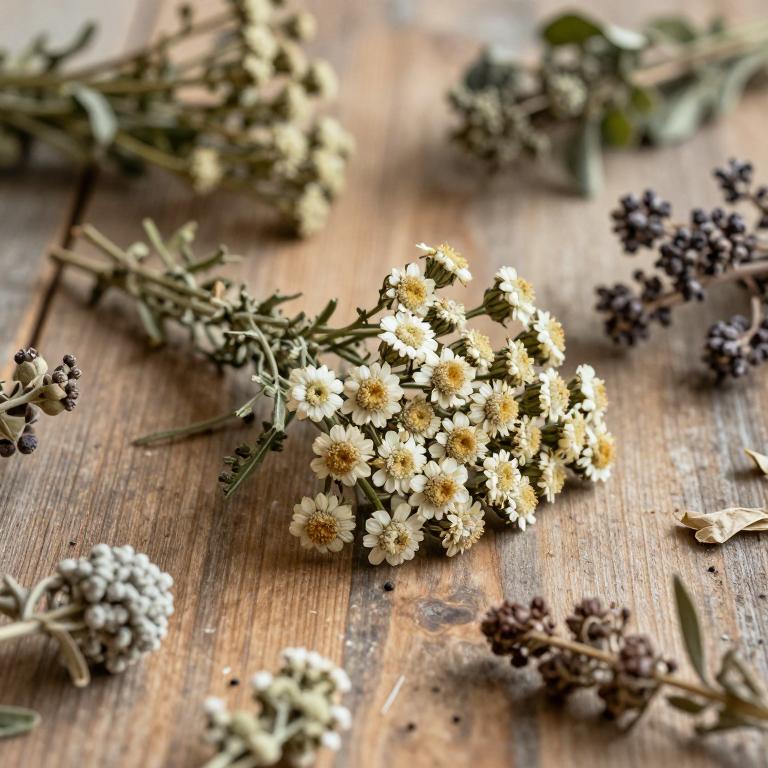
, scientifically known as Achillea collina, is a resilient perennial herb belonging to the Asteraceae family. Native to specific Mediterranean regions, this plant is distinguished by its delicate white flower clusters and aromatic foliage. It holds significant interest in ethnobotany for its potential therapeutic properties and unique chemical composition.
- Family
- Asteraceae
- Native range
- Europe
- Parts used
- Not available
- Common names
- Not available
- Scientific synonyms
- Achillea Millefolium Subsp. Collina · Achillea Millefolium Var. Collina · 1 more
Names and Synonyms
Scientific Names
Accepted name
Achillea collinaSynonyms
- Achillea millefolium subsp. collina
- Achillea millefolium var. collina
- Achillea collina var. tubuliflora
Regional and Traditional Names
German:
- Gemeine Schafgarbe
- Hügel-Schafgarbe
- Hügel-Wiesen-Schafgarbe
- Hügel-Wiesenschafgarbe
French:
- Achillée millefeuille
Sources: Wikidata, Catalogue of Life
Taxonomical Classification
This plant belongs to the kingdom Plantae and is classified within the phylum Streptophyta and the class Equisetopsida. Under the subclass Magnoliidae, it falls into the order Asterales and the family Asteraceae. Specifically, it is identified by the genus Achillea, which includes the species Achillea collina.
| Rank | Classification |
|---|---|
| Kingdom | Plantae |
| Phylum | Streptophyta |
| Class | Equisetopsida |
| Subclass | Magnoliidae |
| Order | Asterales |
| Family | Asteraceae |
| Genus | Achillea |
Sources: The World Checklist of Vascular Plants (WCVP)
Distribution
This plant is primarily distributed across several regions within Middle Europe. It can be found growing in the natural landscapes of Austria. Additionally, its range extends through the territories of Czechia and Slovakia. The species is also documented throughout Germany and Hungary. Finally, its geographical presence includes parts of Poland.
| Region | Area |
|---|---|
| Middle Europe | Austria |
| Middle Europe | Czechia-Slovakia |
| Middle Europe | Germany |
| Middle Europe | Hungary |
| Middle Europe | Poland |
| Middle Europe | Switzerland |
| Southwestern Europe | France |
| Southeastern Europe | Albania |
| Southeastern Europe | Bulgaria |
| Southeastern Europe | Greece |
Sources: The World Checklist of Vascular Plants (WCVP)
Botanical Identification
Life history
The life history of Achillea collina is characterized by its existence as a perennial species, allowing it to persist through multiple growing seasons. Structurally, the plant functions as a hemicryptophyte, meaning its perennable buds are located at or just below the soil surface, protected by leaf litter or soil during unfavorable conditions. This life form facilitates its resilience in its natural habitat. Furthermore, the plant exhibits a deciduous nature, shedding its foliage during dormant periods to conserve energy and resources.
- Deciduousness :
- deciduous
- Life form :
- hemicryptophyte
- Lifecycle :
- perennial
Morphology
The morphology of Achillea collina is characterized by its growth form as a non-woody herb. This species is a self-supporting, terrestrial plant that functions independently, lacking any parasitic or epiphytic behavior. In terms of stature, it exhibits a relatively low growth habit with a plant height that varies between a minimum of 0.25 m and a maximum of 0.6 m, maintaining an average height of approximately 0.55 m.
- Climber :
- self-supporting
- Epiphyte :
- terrestrial
- Growth form :
- herb
- Parasite :
- independent
- Plant height max:
- 0.6 m
- Plant height mean:
- 0.55 m
- Plant height min:
- 0.25 m
- Woodiness :
- non-woody
Physiology
The physiology of Achillea collina is characterized by a C3 photosynthetic pathway, a common metabolic strategy for plants in this genus that optimizes carbon fixation under moderate environmental conditions. Morphologically, the plant exhibits a mean leaf size of approximately 10.3749 cm², reflecting its structural adaptation to light interception and gas exchange. This leaf morphology is further quantified by a mean Specific Leaf Area (SLA) of 174 cm²/g, a value that provides insight into the plant's leaf thickness and resource allocation strategies, balancing the efficiency of light capture with the metabolic costs of leaf tissue maintenance.
- Leaf size mean:
- 10.3749 cm²
- Photosynthetic pathway :
- C3
- Specific Leaf Area (SLA) mean:
- 174 cm²/g
Reproduction
The reproduction of Achillea collina is characterized by a specific seasonal flowering period and specialized pollination and dispersal mechanisms. The plant enters its flowering phase in July and continues until November. During this time, it utilizes a biotic pollination syndrome, specifically relying on insects to facilitate the reproductive process; notably, self-fertilization is absent, indicating a reliance on cross-pollination. The resulting seeds are extremely lightweight, with a mean mass of 0.00014325 g, ranging from a minimum of 0.000117 g to a maximum of 0.00016 g. For the spread of its offspring, the species employs an anemochorous dispersal syndrome, meaning the seeds are dispersed by the wind.
- Dispersal syndrome :
- anemochorous
- Flowering time :
- Jul
- Flowering time :
- Nov
- Pollination syndrome :
- insect
- Pollination syndrome :
- biotic
- Seed mass max:
- 0.00016 g
- Seed mass mean:
- 0.00014325 g
- Seed mass min:
- 0.000117 g
- Self fertilization :
- absent
Sources: Global Inventory of Floras and Traits (GIFT)
Chemicals
Achillea collina has 3 reported phytochemicals identified across 0 scientific publications and several other databases. The most consistently reported chemicals include Achillicin, Arglanin, Santamarin.
| Chemical | Supporting sources | Consensus |
|---|---|---|
| Achillicin | 1 supporting sources | ★☆☆☆☆ |
| Arglanin | 1 supporting sources | ★☆☆☆☆ |
| Santamarin | 1 supporting sources | ★☆☆☆☆ |
Achillicin
- Journal of chromatography. B, Biomedical sciences and applications
Arglanin
- Journal of chromatography. B, Biomedical sciences and applications
Santamarin
- Journal of chromatography. B, Biomedical sciences and applications
Activities
Achillea collina has 1 reported activities identified across 0 scientific publications and several other databases. The most consistently reported activities include Antiphlogistic.
| Activity | Supporting sources | Consensus |
|---|---|---|
| Antiphlogistic | 1 supporting sources | ★☆☆☆☆ |
Antiphlogistic
- Journal of chromatography. B, Biomedical sciences and applications