moonshine yarrow
Achillea clypeolata · Accepted scientific name
Scientific literature: Very Sparse (3 studies) · ★☆☆☆☆
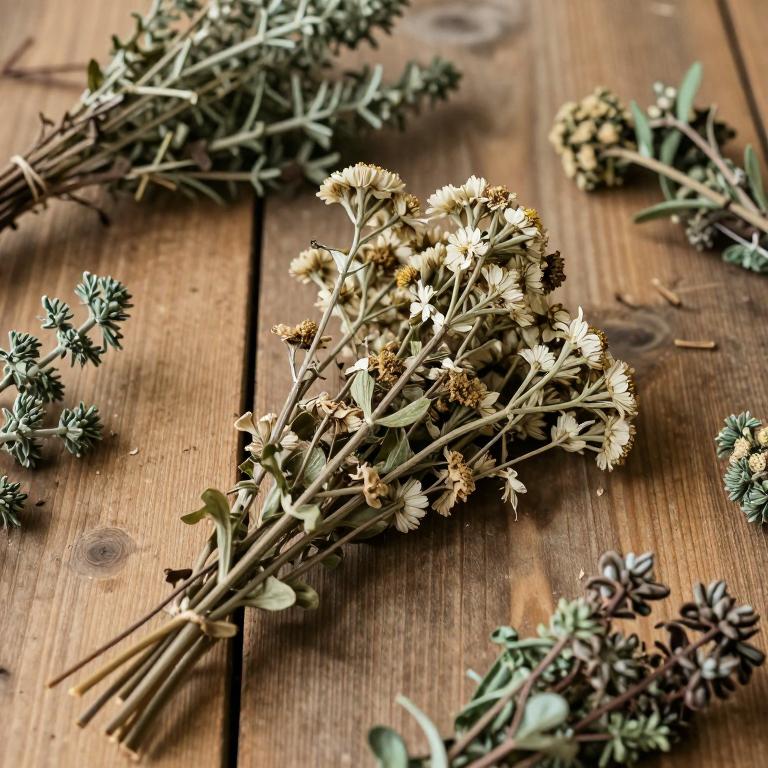
Moonshine yarrow, scientifically known as Achillea clypeolata, is a resilient perennial herb native to specific regions of Asia. Characterized by its distinctive yellow flowering heads, this botanical species belongs to the Asteraceae family. It is valued in traditional herbalism for its unique phytochemical properties and potential therapeutic applications.
- Family
- Asteraceae
- Native range
- Europe
- Parts used
- Not available
- Common names
- Moonshine Yarrow · Balkan Yarrow
- Scientific synonyms
- Achillea Alexandri-Borzae · Achillea Borzana · 1 more
Names and Synonyms
Common Names
- moonshine yarrow
- Balkan Yarrow
Scientific Names
Accepted name
Achillea clypeolataSynonyms
- Achillea alexandri-borzae
- Achillea borzana
- Achillea serbanii
Regional and Traditional Names
German:
- Goldquirl-Garbe
Sources: Wikidata, Catalogue of Life
Taxonomical Classification
This plant belongs to the kingdom Plantae and the phylum Streptophyta, specifically falling under the class Equisetopsida and subclass Magnoliidae. It is further classified within the order Asterales and the family Asteraceae. Finally, it is identified under the genus Achillea.
| Rank | Classification |
|---|---|
| Kingdom | Plantae |
| Phylum | Streptophyta |
| Class | Equisetopsida |
| Subclass | Magnoliidae |
| Order | Asterales |
| Family | Asteraceae |
| Genus | Achillea |
Sources: The World Checklist of Vascular Plants (WCVP)
Distribution
This plant exhibits a diverse geographical range spanning several distinct regions of the European continent. In Middle Europe, its presence can be documented within the borders of Germany. Moving toward the southern regions, it is also found throughout Southwestern Europe, specifically in France. The species extends further into Southeastern Europe, where it inhabits the landscape of Albania. Finally, its distribution continues through the Balkan Peninsula to include Bulgaria and Greece.
| Region | Area |
|---|---|
| Middle Europe | Germany |
| Southwestern Europe | France |
| Southeastern Europe | Albania |
| Southeastern Europe | Bulgaria |
| Southeastern Europe | Greece |
| Southeastern Europe | Romania |
| Southeastern Europe | Türkiye-in-Europe |
| Southeastern Europe | NW. Balkan Pen. |
Sources: The World Checklist of Vascular Plants (WCVP)
Botanical Identification
Life history
The life history of Achillea clypeolata is characterized by its classification as a hemicryptophyte, a growth form where the perennating buds are located at the soil surface, protected by leaf litter or soil during unfavorable seasons. This life strategy allows the plant to persist through seasonal variations, utilizing its underground structures to regenerate annually. Within the broader spectrum of plant life forms, it specifically functions as a hemicryptophyte, distinguishing its survival mechanism from other categories such as phanerophytes, chamaephytes, cryptophytes, or therophytes. This specific positioning in its life cycle ensures its ability to occupy its ecological niche by effectively managing energy reserves at the ground level to facilitate regrowth.
- Life form :
- hemicryptophyte
Morphology
The morphology of Achillea clypeolata is characterized by its growth form as a non-woody herb, functioning as a self-supporting plant that does not require climbing structures. It is classified as an independent species, meaning it does not exhibit parasitic behavior, and it maintains a terrestrial life habit rather than being aquatic, semiaquatic, or epiphytic. As a non-climbing herb, it lacks the characteristics of a liana or vine, instead growing as a self-supporting forb that remains firmly rooted in terrestrial environments.
- Aquatic :
- terrestrial
- Climber :
- self-supporting
- Epiphyte :
- terrestrial
- Growth form :
- herb
- Parasite :
- independent
- Woodiness :
- non-woody
Reproduction
The reproduction of Achillea clypeolata is characterized by the production of specialized seeds that exhibit highly consistent physical properties. Based on available data, the seed mass for this species is extremely uniform, with a recorded mean, maximum, and minimum value all centered at 1e-04 g. This lack of variance in seed mass suggests a highly stabilized reproductive strategy, where the plant allocates a precise amount of energy to each individual propagule. Such minute and consistent seed dimensions are typical for many members of the Asteraceae family, facilitating efficient dispersal and establishment within its ecological niche.
- Seed mass mean:
- 1e-04 g
Sources: Global Inventory of Floras and Traits (GIFT)
Chemicals
Achillea clypeolata has 2 reported phytochemicals identified across 0 scientific publications and several other databases. The most consistently reported chemicals include 1,8-Cineole, camphor.
| Chemical | Supporting sources | Consensus |
|---|---|---|
| 1,8-Cineole | 1 supporting sources | ★☆☆☆☆ |
| camphor | 1 supporting sources | ★☆☆☆☆ |
1,8-Cineole
- Molecules (Basel, Switzerland)
camphor
- Molecules (Basel, Switzerland)
Preparations
Achillea clypeolata has 1 reported preparations identified across 0 scientific publications and several other databases. The most consistently reported preparations include essential oil.
| Preparation | Supporting sources | Consensus |
|---|---|---|
| Essential oil | 1 supporting sources | ★☆☆☆☆ |
Essential oil
- Molecules (Basel, Switzerland)