black yarrow
Achillea atrata · Accepted scientific name
Scientific literature: Very Sparse (7 studies) · ★☆☆☆☆
Black yarrow, scientifically known as Achillea atrata, is a perennial herb belonging to the Asteraceae family. Found in mountainous regions, this resilient plant is distinguished by its dark, dramatic foliage and unique floral structure. It holds significant ethnobotanical value, traditionally utilized in various cultures for its diverse medicinal properties.
- Family
- Asteraceae
- Native range
- Europe
- Parts used
- Not available
- Common names
- Black Yarrow · Dark Stemmed Sneezewort
- Scientific synonyms
- Chamaemelum Atratum · Ptarmica Atrata Var. Haenkeana · 14 more
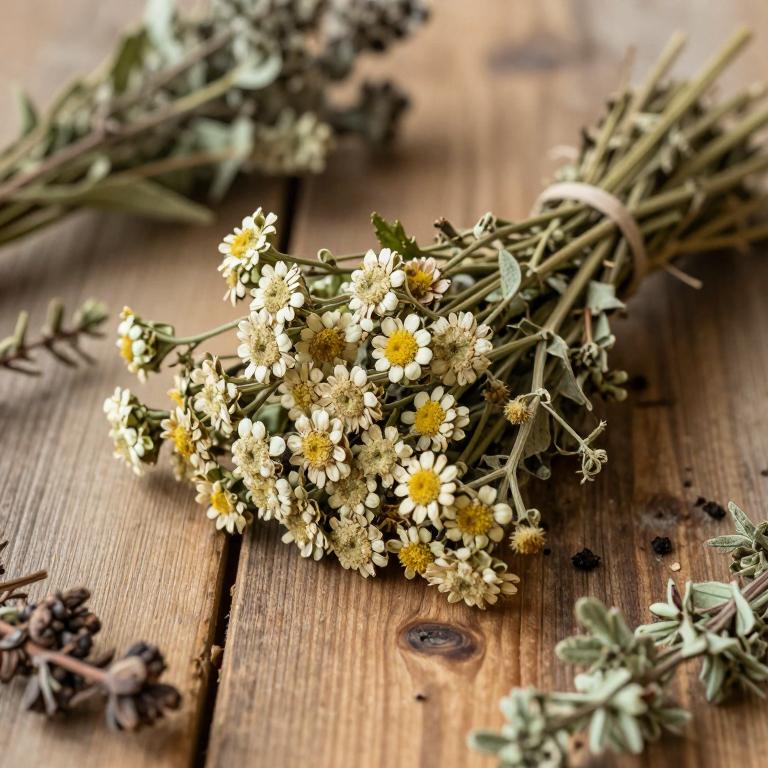
Names and Synonyms
Common Names
- Black Yarrow
- Dark Stemmed Sneezewort
Scientific Names
Accepted name
Achillea atrataSynonyms
- Chamaemelum atratum
- Ptarmica atrata var. haenkeana
- Ptarmica atrata
- Ptarmica atrata var. vulgaris
- Ptarmica clusiana
- Achillea atrata var. vulgaris
- Achillea atrata subsp. halleri
- Achillea atrata var. intermedia
- Achillea halleri
- Achillea atrata var. monocephala
- Ptarmica scardica
- Achillea atrata var. beckiana
- Santolina atrata
- Achillea atrata var. multiflora
- Achillea atrata var. oligocephala
- Anthemis corymbosa
Regional and Traditional Names
German:
- Schwarzrandige Schafgarbe
- Schwarze Schafgarbe
- Schwarzrandige Schafgarbe
- Hallers Schafgarbe
- Schwarze Schafgarbe
- Schwarzrand-Schafgarbe
French:
- Achillée noirâtre
- Achillee noiratre
- Achillée noirâtre
Sources: Wikidata, Catalogue of Life
Taxonomical Classification
This plant belongs to the kingdom Plantae and is classified under the phylum Streptophyta and the class Equisetopsida. Within the subclass Magnoliidae and order Asterales, it is a member of the family Asteraceae. Its taxonomic identity is further specified under the genus Achillea, known as Achillea atrata.
| Rank | Classification |
|---|---|
| Kingdom | Plantae |
| Phylum | Streptophyta |
| Class | Equisetopsida |
| Subclass | Magnoliidae |
| Order | Asterales |
| Family | Asteraceae |
| Genus | Achillea |
Sources: The World Checklist of Vascular Plants (WCVP)
Distribution
This plant exhibits a distinct distribution across several regions of the European continent. In Middle Europe, it can be found growing within the borders of Austria, Germany, and Switzerland. Its range extends further west into Southwestern Europe, specifically inhabiting parts of France. Additionally, the species is present in Southeastern Europe within the country of Italy. Together, these locations highlight the specific mountainous and temperate habitats where the species thrives.
| Region | Area |
|---|---|
| Middle Europe | Austria |
| Middle Europe | Germany |
| Middle Europe | Switzerland |
| Southwestern Europe | France |
| Southeastern Europe | Italy |
| Southeastern Europe | NW. Balkan Pen. |
Sources: The World Checklist of Vascular Plants (WCVP)
Botanical Identification
Life history
The life history of Achillea atrata is characterized by its status as a perennial plant, allowing it to persist through multiple growing seasons. Structurally, it follows a hemicryptophyte life form, meaning its perennating buds are located at or just below the soil surface, protected by leaf litter or soil during unfavorable periods. This specific growth strategy enables the species to withstand seasonal environmental changes while maintaining a stable presence within its habitat.
- Life form :
- hemicryptophyte
- Lifecycle :
- perennial
Morphology
The morphology of Achillea atrata is characterized by a non-woody growth form, specifically classified as a herb. This plant exhibits a relatively low stature, with a height that typically ranges from a minimum of 0.08 m to a maximum of 0.25 m, resulting in an average plant height of approximately 0.115 m.
- Growth form :
- herb
- Plant height max:
- 0.25 m
- Plant height mean:
- 0.115 m
- Plant height min:
- 0.08 m
- Woodiness :
- non-woody
Physiology
The physiology of Achillea atrata is characterized by a metabolic framework governed by a C3 photosynthetic pathway, a mechanism typical of many temperate herbaceous perennials that involves the direct fixation of atmospheric carbon dioxide through the enzyme RuBisCO. This C3 process facilitates the production of three-carbon sugar phosphates during the Calvin cycle, which serves as the foundational energy source for the plant's growth and secondary metabolite synthesis. Beyond its carbon fixation strategy, the plant's physiological vitality is supported by a robust vascular system designed to transport water and nutrients from its root architecture to the foliage, facilitating transpiration and thermoregulation. The metabolic processes within its tissues are further influenced by environmental stimuli, where the integration of light interception and enzymatic activity drives the development of its bioactive compounds, ensuring efficient resource utilization within its specific ecological niche.
- Photosynthetic pathway :
- C3
Reproduction
The reproduction of Achillea atrata is characterized by a specific seasonal flowering window and specialized seed dispersal mechanisms. The flowering period typically begins in July and extends through September, marking the peak time for sexual reproduction. Following pollination, the plant produces seeds with a mean mass of approximately 0.00032 g. The dispersal of these seeds follows an autochorous syndrome, meaning the plant utilizes internal mechanisms to shed its seeds, rather than relying primarily on external agents like wind or animals for the initial release.
- Dispersal syndrome :
- autochorous
- Flowering time :
- Jul
- Flowering time :
- Sep
- Seed mass mean:
- 0.00032 g
Sources: Global Inventory of Floras and Traits (GIFT)
Chemicals
Achillea atrata has 4 reported phytochemicals identified across 0 scientific publications and several other databases. The most consistently reported chemicals include Centaureidin, Nevadensin, apigenin, syringetin-3-o-glucoside.
| Chemical | Supporting sources | Consensus |
|---|---|---|
| Centaureidin | 1 supporting sources | ★☆☆☆☆ |
| Nevadensin | 1 supporting sources | ★☆☆☆☆ |
| apigenin | 1 supporting sources | ★☆☆☆☆ |
| syringetin-3-o-glucoside | 1 supporting sources | ★☆☆☆☆ |
Centaureidin
- Zeitschrift fur Naturforschung. C, Journal of biosciences
Nevadensin
- Zeitschrift fur Naturforschung. C, Journal of biosciences
apigenin
- Zeitschrift fur Naturforschung. C, Journal of biosciences
syringetin-3-o-glucoside
- Zeitschrift fur Naturforschung. C, Journal of biosciences
Conditions
Achillea atrata has 3 reported investigations on conditions identified across 0 scientific publications and several other databases. The most consistently reported conditions include Propionibacterium acnes, Staphylococcus epidermidis, acne vulgaris.
| Condition | Supporting sources | Consensus |
|---|---|---|
| Propionibacterium acnes | 1 supporting sources | ★☆☆☆☆ |
| Staphylococcus epidermidis | 1 supporting sources | ★☆☆☆☆ |
| Acne vulgaris | 1 supporting sources | ★☆☆☆☆ |
Propionibacterium acnes
- Zeitschrift fur Naturforschung. C, Journal of biosciences
Staphylococcus epidermidis
- Zeitschrift fur Naturforschung. C, Journal of biosciences
Acne vulgaris
- Zeitschrift fur Naturforschung. C, Journal of biosciences