Arabian Milfoil
Achillea arabica · Accepted scientific name
Scientific literature: Very Sparse (11 studies) · ★☆☆☆☆
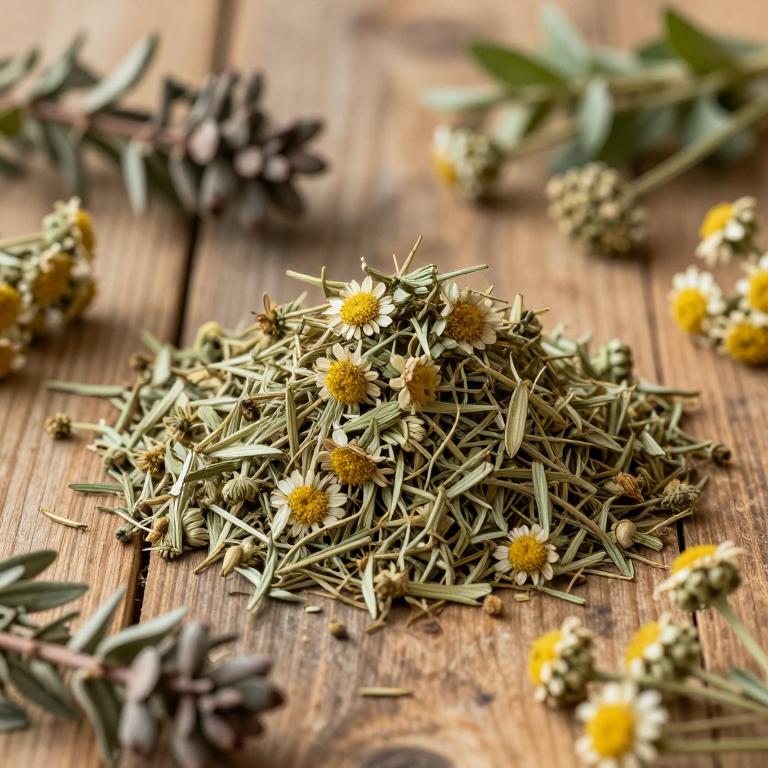
Arabian Milfoil, scientifically known as Achillea arabica, is a resilient perennial herb native to the arid landscapes of the Middle East. Renowned for its delicate, feathery foliage and clusters of small flowers, this medicinal plant is traditionally valued in folk medicine for its potent anti-inflammatory and antimicrobial properties.
- Family
- Asteraceae
- Native range
- Europe
- Parts used
- Flower · Leaf
- Common names
- Not available
- Scientific synonyms
- Achillea Micrantha F. Tenuisecta · Achillea Biebersteinii
Names and Synonyms
Scientific Names
Accepted name
Achillea arabicaSynonyms
- Achillea micrantha f. tenuisecta
- Achillea biebersteinii
Sources: Wikidata, Catalogue of Life
Taxonomical Classification
This plant belongs to the kingdom Plantae and the phylum Streptophyta, falling under the class Equisetopsida and subclass Magnoliidae. It is further classified within the order Asterales and the family Asteraceae. Finally, it is categorized under the genus Achillea as the species Achillea arabica.
| Rank | Classification |
|---|---|
| Kingdom | Plantae |
| Phylum | Streptophyta |
| Class | Equisetopsida |
| Subclass | Magnoliidae |
| Order | Asterales |
| Family | Asteraceae |
| Genus | Achillea |
Sources: The World Checklist of Vascular Plants (WCVP)
Distribution
This plant exhibits a broad distribution across various regions of the European continent. In Middle Europe, its presence can be identified within Germany. It also extends into Southwestern Europe, where it is found in both France and Spain. Moving toward the Balkans, the species is documented in Southeastern Europe, specifically in Bulgaria. Finally, its range reaches into Eastern Europe, encompassing parts of South European Russia.
| Region | Area |
|---|---|
| Middle Europe | Germany |
| Southwestern Europe | France |
| Southwestern Europe | Spain |
| Southeastern Europe | Bulgaria |
| Eastern Europe | South European Russia |
| Central Asia | Kirgizstan |
| Central Asia | Turkmenistan |
| Central Asia | Tadzhikistan |
| Central Asia | Uzbekistan |
| Caucasus | North Caucasus |
Sources: The World Checklist of Vascular Plants (WCVP)
Botanical Identification
Ecology
The ecology of Achillea arabica is characterized by its ability to thrive across a diverse range of topographical and geological landscapes, spanning elevations from 600 m to a maximum of 3000 m AMSL. This species demonstrates significant ecological plasticity, colonizing varied environments including hills, mountains, and the banks of rivers. It is particularly well-adapted to disturbed or specialized substrates, frequently found growing in sandy areas as well as stony places, which allows it to occupy distinct niches within its mountainous and undulating habitats.
- Elevational range max:
- 3000 m AMSL
- Elevational range min:
- 600 m AMSL
- Habitat :
- hills, mountains, rivers, sand, stony places
Life history
The life history of Achillea arabica is characterized by its classification as a perennial plant, allowing it to persist through multiple growing seasons. Structurally, the species exhibits a hemicryptophyte life form, meaning its perennial buds are located at or just below the soil surface, protected by leaf litter or the ground layer during unfavorable conditions. This specific growth habit, categorized under both hemicryptophyte life form descriptors, enables the plant to maintain its presence in its natural habitat by regenerating from these protected subterranean or surface-level buds after periods of dormancy.
- Life form :
- hemicryptophyte
- Lifecycle :
- perennial
Morphology
The morphology of Achillea arabica is characterized by its growth form as a non-woody herb, presenting a primarily terrestrial existence rather than an aquatic or epiphytic lifestyle. This self-supporting plant does not function as a climber, liana, or vine, maintaining its structure independently. It reaches a relatively modest stature, with a plant height ranging from a minimum of 0.12 m to a maximum of 0.6 m. As an independent organism, it does not exhibit parasitic behavior, growing autonomously in its natural habitat.
- Aquatic :
- terrestrial
- Climber :
- self-supporting
- Epiphyte :
- terrestrial
- Growth form :
- herb
- Parasite :
- independent
- Plant height max:
- 0.6 m
- Plant height min:
- 0.12 m
- Woodiness :
- non-woody
Reproduction
The reproduction of Achillea arabica is characterized by a distinct flowering period and specific seed morphology. The plant's flowering cycle typically commences in May and extends through August, although the timing can be variable depending on environmental conditions. During this reproductive phase, it produces seeds that exhibit a wide range of mass values, reflecting significant variability in seed size. The seed mass can be as low as 0.00001 g (1e-05 g) and reaches a maximum of 0.00034 g, with an overall mean seed mass calculated at 0.0001275 g.
- Flowering time :
- May
- Flowering time :
- Aug
- Seed mass max:
- 0.00034 g
- Seed mass mean:
- 0.0001275 g
- Seed mass min:
- 1e-05 g
Sources: Global Inventory of Floras and Traits (GIFT)
Plant Parts
Achillea arabica has 4 reported plant parts identified across 5 scientific publications and several other databases that are studied for medicinal purposes. The most consistently reported plant part include flower, leaf, root, stem.
| Plant part | Supporting sources | Consensus |
|---|---|---|
| Flower | 2 supporting sources | ★☆☆☆☆ |
| Leaf | 1 supporting sources | ★☆☆☆☆ |
| Root | 1 supporting sources | ★☆☆☆☆ |
| Stem | 1 supporting sources | ★☆☆☆☆ |
Flower
- Acta biologica Hungarica
- BioMed research international
Leaf
- Acta biologica Hungarica
Root
- Acta biologica Hungarica
Stem
- Acta biologica Hungarica
Chemicals
Achillea arabica has 2 reported phytochemicals identified across 5 scientific publications and several other databases. The most consistently reported chemicals include P-CYMENE, dimethoate.
| Chemical | Supporting sources | Consensus |
|---|---|---|
| P-CYMENE | 1 supporting sources | ★☆☆☆☆ |
| dimethoate | 1 supporting sources | ★☆☆☆☆ |
P-CYMENE
- Evidence-based complementary and alternative medicine : eCAM
dimethoate
- Pakistan journal of biological sciences : PJBS
Activities
Achillea arabica has 3 reported activities identified across 5 scientific publications and several other databases. The most consistently reported activities include Antioxidant, Fungicide, Hepatoprotective.
| Activity | Supporting sources | Consensus |
|---|---|---|
| Antioxidant | 1 supporting sources | ★☆☆☆☆ |
| Fungicide | 1 supporting sources | ★☆☆☆☆ |
| Hepatoprotective | 1 supporting sources | ★☆☆☆☆ |
Antioxidant
- Evidence-based complementary and alternative medicine : eCAM
Fungicide
- Journal of intercultural ethnopharmacology
Hepatoprotective
- Evidence-based complementary and alternative medicine : eCAM
Preparations
Achillea arabica has 2 reported preparations identified across 5 scientific publications and several other databases. The most consistently reported preparations include essential oil, extracts.
| Preparation | Supporting sources | Consensus |
|---|---|---|
| Essential oil | 1 supporting sources | ★☆☆☆☆ |
| Extracts | 1 supporting sources | ★☆☆☆☆ |
Essential oil
- Evidence-based complementary and alternative medicine : eCAM
Extracts
- Avicenna journal of phytomedicine