Aleppo Milfoil
Achillea aleppica · Accepted scientific name
Scientific literature: Very Sparse (5 studies) · ★☆☆☆☆
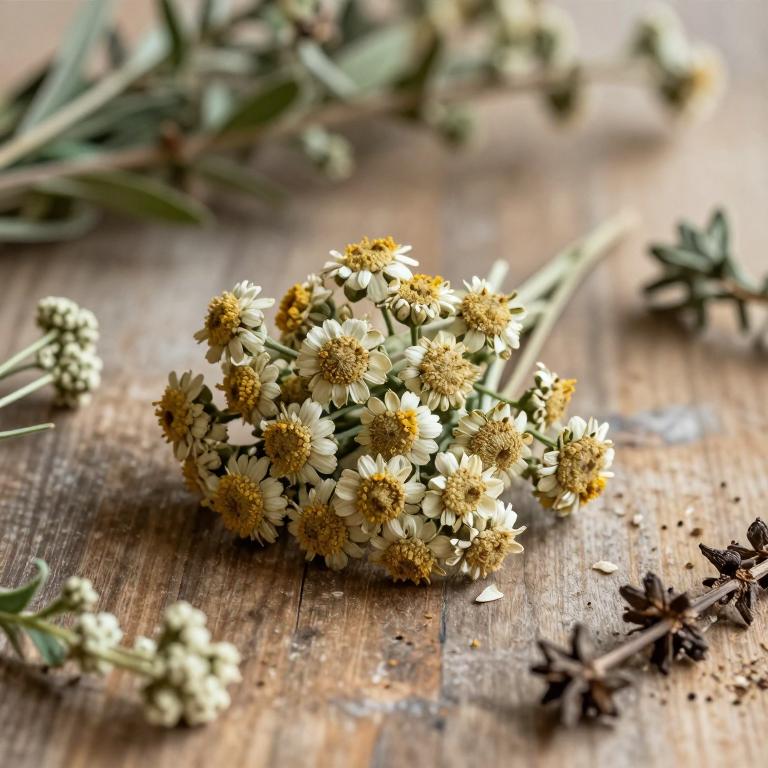
Aleppo Milfoil, scientifically known as Achillea aleppica, is a perennial herb native to the Mediterranean and Middle Eastern regions. Belonging to the Asteraceae family, it is characterized by delicate white flower clusters. Traditionally, this plant has been utilized in folk medicine for its potential anti-inflammatory and antimicrobial properties.
- Family
- Asteraceae
- Native range
- Europe
- Parts used
- Root
- Common names
- Not available
- Scientific synonyms
- Not available
Names and Synonyms
Scientific Names
Accepted name
Achillea aleppicaSources: Wikidata, Catalogue of Life
Taxonomical Classification
This plant belongs to the kingdom Plantae and is classified under the phylum Streptophyta and class Equisetopsida. Within the subclass Magnoliidae and order Asterales, it is a member of the family Asteraceae. It is specifically identified by the genus Achillea, where its species name is aleprica.
| Rank | Classification |
|---|---|
| Kingdom | Plantae |
| Phylum | Streptophyta |
| Class | Equisetopsida |
| Subclass | Magnoliidae |
| Order | Asterales |
| Family | Asteraceae |
| Genus | Achillea |
Sources: The World Checklist of Vascular Plants (WCVP)
Distribution
This plant exhibits a diverse geographical range that spans across multiple regions. In Middle Europe, its presence is noted specifically in Germany. Moving toward Western Asia, it can be found growing within the borders of Iran. The distribution extends further through Iraq and the Levant region, covering Lebanon and Syria. Finally, its habitat includes the territory of Palestine, completing its spread across these areas.
| Region | Area |
|---|---|
| Middle Europe | Germany |
| Western Asia | Iran |
| Western Asia | Iraq |
| Western Asia | Lebanon-Syria |
| Western Asia | Palestine |
| Western Asia | Türkiye |
Sources: The World Checklist of Vascular Plants (WCVP)
Botanical Identification
Life history
The life history of Achillea aleppica is characterized by its nature as a perennial plant, allowing it to persist through multiple growing seasons. As a perennial species, it establishes a stable presence in its habitat, often utilizing robust root systems to survive periods of dormancy and re-emerge annually. This life cycle enables the plant to invest energy into long-term survival and vegetative spread, rather than focusing solely on a single reproductive event. Throughout its lifespan, it undergoes seasonal cycles of growth, flowering, and seed production, contributing to its ability to colonize and maintain its ecological niche over many years.
- Lifecycle :
- perennial
Morphology
The morphology of Achillea aleppica is characterized by a perennial herbaceous growth habit, typically reaching heights of 20 to 50 cm. The plant exhibits a terrestrial life form, meaning it grows in soil rather than being aquatic or semiaquatic, and it functions as an independent organism, lacking any parasitic relationship with other plants. Its stems are erect, often branched, and possess a slightly pubescent texture. The leaves are pinnatisect or deeply lobed, displaying a characteristic feathery appearance with finely divided segments that are arranged alternately along the stem. The inflorescence consists of dense, corymb-like clusters of small, discoid flower heads. Each individual flower head is surrounded by involucral bracts and contains numerous small, tubular florets that are typically white or pale pink in color. The root system is composed of a sturdy rhizomatous structure, which allows the plant to spread and persist in its natural Mediterranean and temperate habitats.
- Aquatic :
- terrestrial
- Parasite :
- independent
Sources: Global Inventory of Floras and Traits (GIFT)
Plant Parts
Achillea aleppica has 1 reported plant parts identified across 1 scientific publications and several other databases that are studied for medicinal purposes. The most consistently reported plant part include root.
| Plant part | Supporting sources | Consensus |
|---|---|---|
| Root | 1 supporting sources | ★☆☆☆☆ |
Root
- Antioxidants (Basel, Switzerland)
Chemicals
Achillea aleppica has 1 reported phytochemicals identified across 1 scientific publications and several other databases. The most consistently reported chemicals include Flavonoid.
| Chemical | Supporting sources | Consensus |
|---|---|---|
| Flavonoid | 1 supporting sources | ★☆☆☆☆ |
Flavonoid
- Antioxidants (Basel, Switzerland)
Conditions
Achillea aleppica has 2 reported investigations on conditions identified across 1 scientific publications and several other databases. The most consistently reported conditions include Alzheimer's disease, redroot pigweed.
| Condition | Supporting sources | Consensus |
|---|---|---|
| Alzheimer's disease | 1 supporting sources | ★☆☆☆☆ |
| Redroot pigweed | 1 supporting sources | ★☆☆☆☆ |
Alzheimer's disease
- Antioxidants (Basel, Switzerland)
Redroot pigweed
- Heliyon
Preparations
Achillea aleppica has 3 reported preparations identified across 1 scientific publications and several other databases. The most consistently reported preparations include ethyl acetate, methanol, water.
| Preparation | Supporting sources | Consensus |
|---|---|---|
| Ethyl acetate | 1 supporting sources | ★☆☆☆☆ |
| Methanol | 1 supporting sources | ★☆☆☆☆ |
| Water | 1 supporting sources | ★☆☆☆☆ |
Ethyl acetate
- Antioxidants (Basel, Switzerland)
Methanol
- Antioxidants (Basel, Switzerland)
Water
- Antioxidants (Basel, Switzerland)