red maple
Acer rubrum · Accepted scientific name
Scientific literature: Very Sparse (6 studies) · ★☆☆☆☆
Red maple, scientifically known as Acer rubrum, is a versatile deciduous tree valued in traditional medicine. Its bark and sap contain bioactive compounds, including tannins and flavonoids, which exhibit antioxidant and anti-inflammatory properties. While primarily ornamental, it offers significant ethnobotanical potential for treating various ailments and supporting wellness.
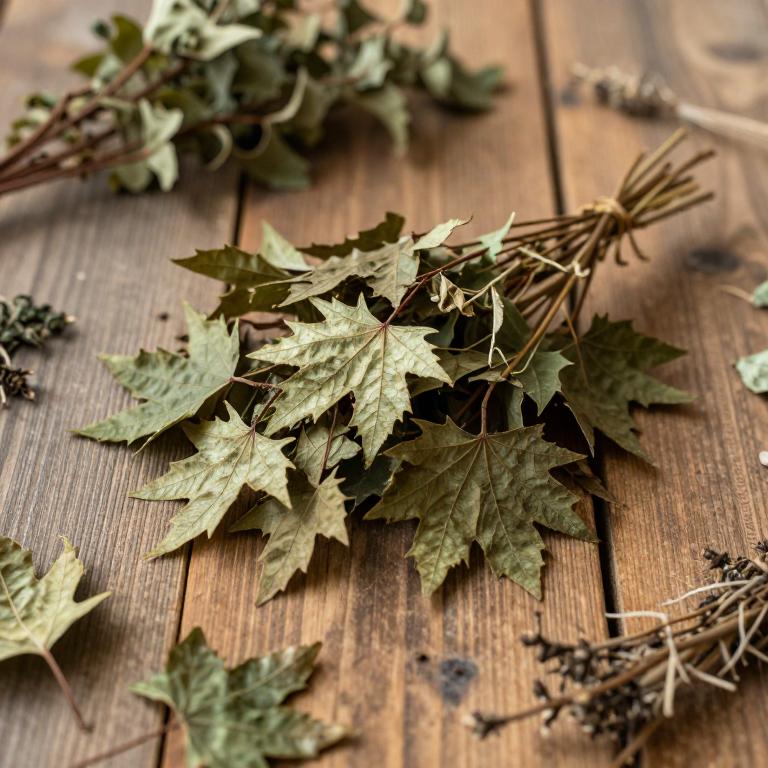
Names and Synonyms
Common Names
- maple
- red maple
- scarlet maple
- soft maple
- swamp maple
Scientific Names
Accepted name
Acer rubrumSynonyms
- Rufacer rubrum
- Acer rubrum subsp. semiorbiculatum
- Acer rubrum var. stenocarpum
- Acer rubrum f. viride
- Acer rubrum subsp. tomentosum
- Acer rubrum f. tomentosum
- Acer rubrum var. tomentosum
- Acer rubrum subsp. microphyllum
- Acer rubrum var. sanguineum
- Acer rubrum f. columnare
- Acer rubrum f. pallidiflorum
- Acer rubrum f. clausum
- Acer rubrum f. globosum
- Acer rubrum var. virginianum
- Acer fulgens
- Acer glaucum
- Acer hypoleucum
- Acer splendens
- Acer coccineum
- Acer wagneri
- Acer rubrum f. rotundata
- Acer rubrum var. intermedium
- Acer rubrum var. pallidum
- Acer rubrum f. sanguineum
- Acer rubrum f. semiorbiculatum
- Acer rubrum var. pendulum
- Acer rubrum f. breviramusculum
- Acer rubrum f. palmatum
- Acer rubrum var. clausum
- Acer rubrum f. microphyllum
- Acer rubrum var. coccineum
- Acer rubrum var. latifolium
- Acer rubrum var. columnare
- Acer rubrum f. pendulum
- Acer rubrum f. wagneri
- Acer rubrum var. viride
- Acer rubrum var. globosum
- Acer rubrum var. pallidiflorum
- Acer rubrum var. rubrocarpum
- Acer rubrum f. schlesingeri
- Acer semiorbiculatum
Regional and Traditional Names
Spanish:
- Arce rojo
- Acer palliderubrum
- Arce rojo americano
- Acer palmifolium
- Acer glaucum
- Acer eriocarpum
- Acer collinsonia
- Maple Rojo
- arce rojo
German:
- Rot-Ahorn
- Rotahorn
- Rotahorn
- Rot-Ahorn
French:
- érable rouge
- érable du Canada
- plaine rouge
- érable de Virginie
- plaine
- plaine
- plaine rouge
- érable rouge
Sources: Wikidata, Catalogue of Life
Taxonomical Classification
This plant belongs to the kingdom Plantae within the phylum Streptophyta and the class Equisetopsida. Following the subclass Magnoliidae, it is classified under the order Sapindales and the family Sapindaceae. Ultimately, it is identified by the genus Acer.
| Rank | Classification |
|---|---|
| Kingdom | Plantae |
| Phylum | Streptophyta |
| Class | Equisetopsida |
| Subclass | Magnoliidae |
| Order | Sapindales |
| Family | Sapindaceae |
| Genus | Acer |
Sources: The World Checklist of Vascular Plants (WCVP)
Distribution
This plant exhibits a wide-ranging geographical distribution that spans across several continents and diverse climates. In Northern Europe, its presence can be observed within the landscapes of Great Britain. Moving into Middle Europe, the species is commonly found throughout Germany and Poland. Its range continues eastward into the territories of Central European Russia. Finally, the distribution extends across the Atlantic to include Western Canada, specifically within British Columbia.
| Region | Area |
|---|---|
| Northern Europe | Great Britain |
| Middle Europe | Germany |
| Middle Europe | Poland |
| Eastern Europe | Central European Russia |
| Western Canada | British Columbia |
| Eastern Canada | New Brunswick |
| Eastern Canada | Newfoundland |
| Eastern Canada | Nova Scotia |
| Eastern Canada | Ontario |
| Eastern Canada | Prince Edward I. |
Sources: The World Checklist of Vascular Plants (WCVP)
Botanical Identification
Ecology
The ecology of Acer rubrum is characterized by its broad adaptability and preference for specific moisture-rich environments. Native to the Atlantic coast of North America, this species naturally thrives in hydric habitats, frequently colonizing marshes and growing along the edges of riverbanks where soil moisture is consistently high. Beyond its native range, the plant has been successfully introduced and cultivated within the European Part of the USSR, demonstrating a capacity to adapt to diverse geographic regions provided its fundamental ecological requirements are met.
- Habitat :
- cultivated in the European Part of the USSR, native to the Atlantic coast of N. America where it grows in marshes and at riverbanks
Life history
The life history of Acer rubrum is characterized by its status as a perennial species, allowing it to persist in forest ecosystems for many decades through continuous seasonal growth cycles. The lifecycle begins with the germination of seeds, typically dispersed by wind, which then undergo a period of establishment where they develop a robust root system to support long-term survival. As a perennial, the plant undergoes annual patterns of bud development, leaf expansion, and flowering, often responding to environmental cues such as temperature and moisture availability to regulate its growth stages. Throughout its extended lifespan, it transitions from a sapling into a mature canopy tree, contributing to the structural complexity of its habitat through repeated cycles of vegetative growth and reproductive efforts.
- Lifecycle :
- perennial
Morphology
The morphology of Acer rubrum is characterized by its growth form as a woody tree, which functions as a self-supporting structure rather than a climber or liana. This species is strictly terrestrial in its habitat, exhibiting neither aquatic nor epiphytic tendencies, and it exists as an independent organism without parasitic behavior. In terms of stature, the plant reaches a maximum height of 25 m, with a mean plant height of approximately 24.52 m.
- Aquatic :
- terrestrial
- Climber :
- self-supporting
- Epiphyte :
- terrestrial
- Growth form :
- tree
- Parasite :
- independent
- Plant height max:
- 25 m
- Plant height mean:
- 24.52 m
- Woodiness :
- woody
Physiology
The physiology of Acer rubrum is defined by its specialized metabolic and structural adaptations to diverse temperate environments. As a plant utilizing the C3 photosynthetic pathway, its carbon fixation process relies on the enzyme RuBisCO to incorporate atmospheric carbon dioxide directly into a three-carbon molecule within the mesophyll cells. This metabolic strategy necessitates a high degree of stomatal regulation to balance the intake of CO2 with the prevention of excessive transpiration, a critical factor given the species' high water requirements. Its physiological efficiency is closely tied to its ability to manage light interception and gas exchange across varying canopy densities. Furthermore, the plant exhibits significant physiological plasticity in response to seasonal shifts, managing nutrient cycling and osmotic adjustments to endure fluctuations in temperature and moisture availability, which supports its wide ecological distribution.
- Photosynthetic pathway :
- C3
Reproduction
The reproduction of Acer rubrum is characterized by a specific phenological cycle and specialized seed dispersal mechanisms. The flowering period is relatively concentrated, with the flowering time typically starting and ending in April. Once the reproductive cycle progresses to seed production, the resulting seeds exhibit a specific mass profile; the mean seed mass is approximately 0.0199320625 g, with individual seeds ranging from a minimum of 0.01393 g to a maximum of 0.0768 g. To facilitate the spread of the next generation, the plant utilizes an anemochorous dispersal syndrome, relying on wind currents to transport its lightweight seeds away from the parent plant.
- Dispersal syndrome :
- anemochorous
- Flowering time :
- Apr
- Seed mass max:
- 0.0768 g
- Seed mass mean:
- 0.0199320625 g
- Seed mass min:
- 0.01393 g
Sources: Global Inventory of Floras and Traits (GIFT)
Chemicals
Acer rubrum has 1 reported phytochemicals identified across 0 scientific publications and several other databases. The most consistently reported chemicals include GINNALIN A.
| Chemical | Supporting sources | Consensus |
|---|---|---|
| GINNALIN A | 1 supporting sources | ★☆☆☆☆ |
GINNALIN A
- Food & function
Activities
Acer rubrum has 2 reported activities identified across 0 scientific publications and several other databases. The most consistently reported activities include Antidiabetic, Antioxidant.
| Activity | Supporting sources | Consensus |
|---|---|---|
| Antidiabetic | 1 supporting sources | ★☆☆☆☆ |
| Antioxidant | 1 supporting sources | ★☆☆☆☆ |
Antidiabetic
- Food & function
Antioxidant
- Food & function
Conditions
Acer rubrum has 3 reported investigations on conditions identified across 0 scientific publications and several other databases. The most consistently reported conditions include advanced glycation end-products, antidiabetic, colon cancer.
| Condition | Supporting sources | Consensus |
|---|---|---|
| Advanced glycation end-products | 1 supporting sources | ★☆☆☆☆ |
| Antidiabetic | 1 supporting sources | ★☆☆☆☆ |
| Colon cancer | 1 supporting sources | ★☆☆☆☆ |
Advanced glycation end-products
- Food & function
Antidiabetic
- Food & function
Colon cancer
- Phytotherapy research : PTR