great-maple
Acer pseudoplatanus · Accepted scientific name
Scientific literature: Very Sparse (3 studies) · ★☆☆☆☆
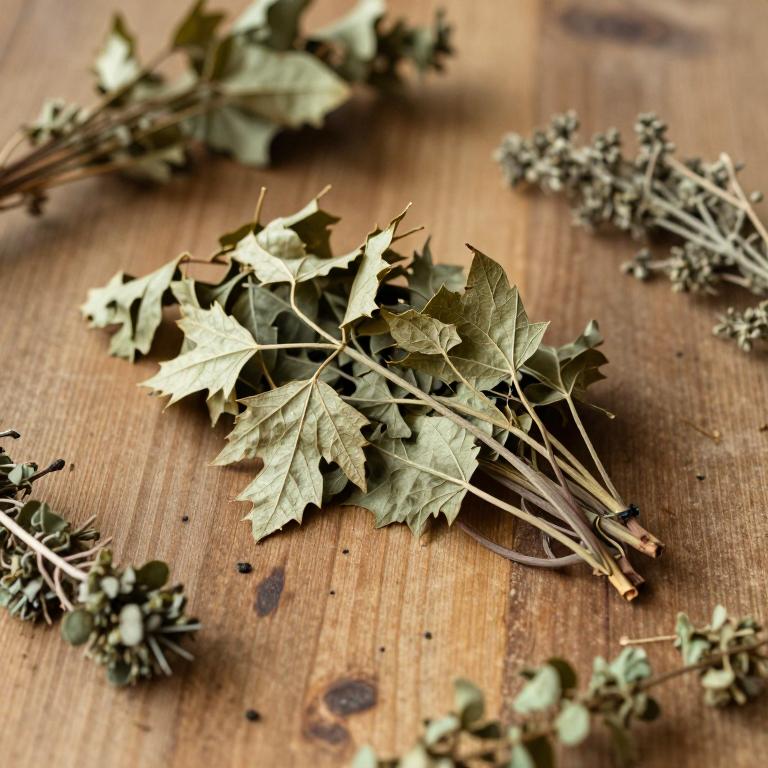
Great-maple, scientifically known as Acer pseudoplatanus, is a distinguished deciduous tree valued for its therapeutic potential. Renowned in traditional medicine, its bark and leaves possess antioxidant and anti-inflammatory properties. This versatile botanical species offers significant bioactive compounds, making it a subject of growing interest in modern ethnopharmacology.
Names and Synonyms
Common Names
- great-maple
- mock-plane-tree
- sycamore maple
- Sycamore
- Scottish maple
- false planetree
- great maple
- mock plane
Scientific Names
Accepted name
Acer pseudoplatanusSynonyms
- Acer pseudoplatanus var. fieberi
- Acer pseudoplatanus f. purpurascens
- Acer pseudoplatanus var. dittrichii
- Acer pseudoplatanus var. subobtusum
- Acer pseudoplatanus f. dittrichii
- Acer pseudoplatanus var. latialatum
- Acer pseudoplatanus subsp. villosum
- Acer pseudoplatanus var. villosum
- Acer opalus var. villosum
- Acer pseudoplatanus f. vitifolium
- Acer pseudoplatanus f. euchlorum
- Acer pseudoplatanus var. microcarpum
- Acer pseudoplatanus var. davuricum
- Acer pseudoplatanus f. jaspideum
- Acer pseudoplatanus var. insigne
- Acer pseudoplatanus f. distans
- Acer pseudoplatanus var. variegatum
- Acer pseudoplatanus f. grandicorne
- Acer pseudoplatanus f. obtusangulatum
- Acer pseudoplatanus var. acuminatum
- Acer pseudoplatanus var. vitifolium
- Acer pseudoplatanus var. medium
- Acer pseudoplatanus var. longifolium
- Acer pseudoplatanus var. flavovariegatum
- Acer pseudoplatanus f. serratum
- Acer pseudoplatanus f. cruciatum
- Acer pseudoplatanus var. triangulare
- Acer pseudoplatanus f. opizii
- Acer euchlorum
- Acer abchasicum
- Acer atropurpureum
- Acer dittrichii
- Acer wondracekii
- Acer worleei
- Acer melliodorum
- Acer pseudoplatanus var. nebrodense
- Acer opizii
- Acer pseudoplatanus var. macrocarpum
- Acer purpureum
- Acer rafinesquianum
- Acer pseudoplatanus var. rubropurpureum
- Acer pseudoplatanus var. siculum
- Acer pseudoplatanus var. leopoldii
- Acer leopoldii
- Acer pseudoplatanus f. siculum
- Acer pseudoplatanus f. subparallelum
- Acer pseudoplatanus var. quinquelobum
- Acer procerum
- Acer pseudoplatanus f. clausum
- Acer pseudoplatanus f. serotinum
- Acer pseudoplatanus f. erythrocarpum
- Acer pseudoplatanus var. handjeryi
- Acer pseudoplatanus f. palmatifidum
- Acer pseudoplatanus var. erythrocarpum
- Acer pseudoplatanus var. microcarpum
- Acer pseudoplatanus f. neglectum
- Acer pseudoplatanus f. purpureum
- Acer pseudoplatanus var. subtrilobum
- Acer pseudoplatanus var. tomentosum
- Acer pseudoplatanus f. variegatum
- Acer pseudoplatanus f. trilobatum
- Acer pseudoplatanus f. argutum
- Acer pseudoplatanus var. crispum
- Acer pseudoplatanus var. ternatum
- Acer pseudoplatanus subvar. splendens
- Acer pseudoplatanus f. sanguineum
- Acer pseudoplatanus f. cupreum
- Acer pseudoplatanus f. metallicum
- Acer pseudoplatanus subvar. lutescens
- Acer pseudoplatanus f. worleei
- Acer pseudoplatanus f. flavescens
- Acer pseudoplatanus f. luteoconcavum
- Acer pseudoplatanus f. albertsii
- Acer pseudoplatanus f. flavovariegatum
- Acer pseudoplatanus f. costorphinense
- Acer pseudoplatanus var. aureovariegatum
- Acer pseudoplatanus subvar. auratum
- Acer pseudoplatanus atropurpureum
- Acer pseudoplatanus f. aureovariegatum
- Acer pseudoplatanus euchlorum
- Acer pseudoplatanus f. aucubifolium
- Acer pseudoplatanus subvar. pallidum
- Acer pseudoplatanus var. pindicum
- Acer pseudoplatanus f. albovariegatum
- Acer pseudoplatanus f. leopoldii
- Acer pseudoplatanus var. camboi
- Acer pseudoplatanus f. tricolor
- Acer pseudoplatanus var. dodei
- Acer pseudoplatanus subvar. argenteum
- Acer pseudoplatanus var. mariae
- Acer pseudoplatanus f. quadricolor
- Acer pseudoplatanus f. annae
- Acer pseudoplatanus purpurascens
- Acer pseudoplatanus f. insigne
- Acer pseudoplatanus f. discolor
- Acer pseudoplatanus var. tricuspidatum
- Acer pseudoplatanus subvar. smaragdinum
- Acer pseudoplatanus f. laetum
- Acer pseudoplatanus f. spaethii
- Acer pseudoplatanus f. luteovirescens
- Acer pseudoplatanus f. bicolor
- Acer pseudoplatanus subvar. rubrum
- Acer pseudoplatanus f. pseudonizetii
- Acer pseudoplatanus f. handjeryi
- Acer pseudoplatanus f. nervosum
- Acer pseudoplatanus f. atropurpureum
- Acer pseudoplatanus f. nizetii
- Acer pseudoplatanus var. anomalum
- Acer pseudoplatanus f. complicatum
- Acer pseudoplatanus f. brevialatum
- Acer pseudoplatanus var. subtruncatum
- Acer pseudoplatanus var. subintegrilobum
- Acer pseudoplatanus var. coloratum
- Acer pseudoplatanus f. lutescens
- Acer pseudoplatanus f. albomarmoratum
- Acer pseudoplatanus f. rubromaculatum
- Acer pseudoplatanus var. complicatum
- Acer pseudoplatanus f. latialatum
- Acer pseudoplatanus var. laciniatum
- Acer pseudoplatanus var. albovariegatum
- Acer pseudoplatanus var. purpureum
- Acer pseudoplatanus f. pyramidale
- Acer pseudoplatanus f. latifolium
- Acer pseudoplatanus f. laxum
- Acer pseudoplatanus f. heterophyllum
- Acer pseudoplatanus f. concavum
- Acer pseudoplatanus f. opulifolium
- Acer pseudoplatanus f. pulverulentum
- Acer majus var. glaucum
Regional and Traditional Names
Spanish:
- Planago
- Arce sicomoro
- Pladano
- Arce plátano falso
- Platano silvestre
- Pradano
- Falso-platano
- Arce-sicomoro
- Falso sicómoro
- Plátano silvestre
- Plagano
- Arce platano falso
- Falso sicomoro
- Arce blanco
- arce plátano falso
- arce sicómoro
- Arce blanco
German:
- Bergahorn
- Berg-Ahorn
- Blutahorn
- Sykomore
- Weißahorn
- Weiß-Ahorn
- Weiss-Ahorn
- Weissahorn
- Bergahorn
- Berg-Ahorn
French:
- érable sycomore
- Érable de montagne
- Faux Platane
- Erable sycomore
- Érable sycomore
- érable sycomore
- Erable des montagnes
- Erable sycomore
Sources: Wikidata, Catalogue of Life
Taxonomical Classification
This plant belongs to the kingdom Plantae and is classified within the phylum Streptophyta and the class Equisetopsida. As a member of the subclass Magnoliidae and the order Sapindales, it falls under the family Sapindaceae. Finally, its taxonomic identity is defined by the genus Acer.
| Rank | Classification |
|---|---|
| Kingdom | Plantae |
| Phylum | Streptophyta |
| Class | Equisetopsida |
| Subclass | Magnoliidae |
| Order | Sapindales |
| Family | Sapindaceae |
| Genus | Acer |
Sources: The World Checklist of Vascular Plants (WCVP)
Distribution
This plant exhibits a wide geographical presence across several key regions of the European continent. In Northern Europe, its range extends through the coastal landscapes of Denmark and the islands of Great Britain and Ireland. The species can also be found growing within the territories of Sweden. Moving toward the center of the continent, its distribution reaches into Middle Europe. Specifically, this medicinal plant is documented to inhabit the mountainous and temperate regions of Austria.
| Region | Area |
|---|---|
| Northern Europe | Denmark |
| Northern Europe | Great Britain |
| Northern Europe | Ireland |
| Northern Europe | Sweden |
| Middle Europe | Austria |
| Middle Europe | Belgium |
| Middle Europe | Czechia-Slovakia |
| Middle Europe | Germany |
| Middle Europe | Hungary |
| Middle Europe | Netherlands |
Sources: The World Checklist of Vascular Plants (WCVP)
Botanical Identification
Ecology
The ecology of Acer pseudoplatanus is characterized by its wide adaptability to diverse geographical and topographical settings, allowing it to thrive in environments ranging from dense forests and mountainous regions to open plains. It is frequently found in riparian zones near rivers, as well as in more disturbed or transitional areas such as roadsides and stony places. In terms of its symbiotic relationships with soil fungi, this species does not form mycorrhizae, distinguishing its nutrient acquisition strategy from many other woody plants.
- Habitat :
- forest, mountains, plains, rivers, roadsides, stony places
- Mycorrhiza :
- no
Life history
The life history of Acer pseudoplatanus is characterized by its nature as a perennial organism with a remarkably long lifespan, capable of enduring for up to 400 years. As a phanerophyte, its reproductive buds are elevated on woody stems well above the ground, a structural adaptation that defines its primary life form. The plant follows a deciduous growth pattern, shedding its foliage annually as part of its seasonal cycle. This life strategy allows it to persist through various environmental shifts over several centuries, maintaining its status as a long-lived woody species within its ecosystem.
- Deciduousness :
- deciduous
- Life form :
- phanerophyte
- Lifecycle :
- perennial
- Lifespan :
- 400
Morphology
The morphology of Acer pseudoplatanus is characterized by its growth form as a woody tree that functions as a self-supporting organism. As a terrestrial species, it grows independently without the need for parasitic or epiphytic associations. The plant exhibits significant variation in stature, with heights ranging from a minimum of 8 meters to a maximum of 40 meters, maintaining an average plant height of approximately 21.93 meters.
- Aquatic :
- terrestrial
- Climber :
- self-supporting
- Epiphyte :
- terrestrial
- Growth form :
- tree
- Parasite :
- independent
- Plant height max:
- 40 m
- Plant height mean:
- 21.9333333333333 m
- Plant height min:
- 8 m
- Woodiness :
- woody
Physiology
The physiology of Acer pseudoplatanus is characterized by a C3 photosynthetic pathway and a non-carnivorous nutritional strategy, functioning without the ability to fix nitrogen. Its foliage displays a lobed leaf form with significant morphological variability, featuring a leaf length that ranges from a minimum of 10 cm to a maximum of 30 cm, and a mean leaf width of 15 cm, which fluctuates between a minimum of 8 cm and a maximum of 22 cm. These dimensions contribute to a mean leaf size of approximately 83.65175 cm² and a mean Specific Leaf Area (SLA) of 166.8 cm²/g, reflecting its metabolic investment in leaf tissue. Structurally, the plant exhibits a stem specific density (SSD) with a mean value of 620 mg/cm³, providing the necessary mechanical support for its growth habit.
- Carnivory :
- non-carnivorous
- Leaf form :
- lobed
- Leaf length max:
- 30 cm
- Leaf length min:
- 10 cm
- Leaf size mean:
- 83.65175 cm²
- Leaf width max:
- 22 cm
- Leaf width mean:
- 15 cm
- Leaf width min:
- 8 cm
- Nitrogen fixer :
- no
- Photosynthetic pathway :
- C3
- Specific Leaf Area (SLA) mean:
- 166.8 cm²/g
- Stem specific density (SSD) mean:
- 620 mg/cm³
Reproduction
The reproduction of Acer pseudoplatanus is characterized by a sexual process through a monoecious reproductive system, as asexual reproduction is notably absent. The flowering period typically commences in April and concludes in June, featuring green flowers that are organized into panicle inflorescences ranging from a minimum length of 0.05 m to a maximum of 0.15 m. Each individual flower is relatively small, with a length measuring between 0.4 cm and 0.5 cm. The pollination syndrome is biotic, specifically relying on insects for the transfer of pollen, while self-fertilization is absent. Following successful pollination, the plant produces a high volume of seeds, with more than 1000 seeds per fruit. These seeds have a mean mass of approximately 0.0946594776 g (ranging from 0.05986 g to 0.1335 g) and consistent dimensions, with a mean length and width of 6.4 mm and 5 mm, respectively. The dispersal of these seeds is anemochorous, meaning they are dispersed by the wind.
- Dispersal syndrome :
- anemochorous
- Flower colour :
- green
- Flower length max:
- 0.5 cm
- Flower length min:
- 0.4 cm
- Flowering time :
- Apr
- Flowering time :
- Jun
- Inflorescence :
- panicle
- Inflorescence length max:
- 0.15 m
- Inflorescence length min:
- 0.05 m
- Pollination syndrome :
- insect
- Pollination syndrome :
- biotic
- Reproduction asexual :
- absent
- Reproduction sexual :
- monoecious
- Seed length mean:
- 6.4 mm
- Seed mass max:
- 0.1335 g
- Seed mass mean:
- 0.0946594776 g
- Seed mass min:
- 0.05986 g
- Seed width mean:
- 5 mm
- Seeds_per_fruit :
- >1000
- Self fertilization :
- absent
Sources: Global Inventory of Floras and Traits (GIFT)
Plant Parts
Acer pseudoplatanus has 1 reported plant parts identified across 1 scientific publications and several other databases that are studied for medicinal purposes. The most consistently reported plant part include leaf.
| Plant part | Supporting sources | Consensus |
|---|---|---|
| Leaf | 1 supporting sources | ★☆☆☆☆ |
Leaf
- Antioxidants (Basel, Switzerland)
Chemicals
Acer pseudoplatanus has 2 reported phytochemicals identified across 1 scientific publications and several other databases. The most consistently reported chemicals include ADPglucose, polyphenols.
| Chemical | Supporting sources | Consensus |
|---|---|---|
| ADPglucose | 1 supporting sources | ★☆☆☆☆ |
| polyphenols | 1 supporting sources | ★☆☆☆☆ |
ADPglucose
- Proceedings of the National Academy of Sciences of the United States of America
polyphenols
- Antioxidants (Basel, Switzerland)