coojong or cujong
Acacia saligna · Accepted scientific name
Scientific literature: Very Sparse (17 studies) · ★☆☆☆☆
Coojong or cujong, scientifically known as Acacia saliigna, is a versatile medicinal shrub native to various African regions. Renowned for its therapeutic properties, it is traditionally utilized to treat ailments ranging from skin infections to gastrointestinal issues. Its bark and leaves offer potent bioactive compounds essential in herbal medicine.
- Family
- Fabaceae
- Native range
- Europe
- Parts used
- Flower · Leaf
- Common names
- Not available
- Scientific synonyms
- Mimosa Saligna · Racosperma Salignum · 3 more
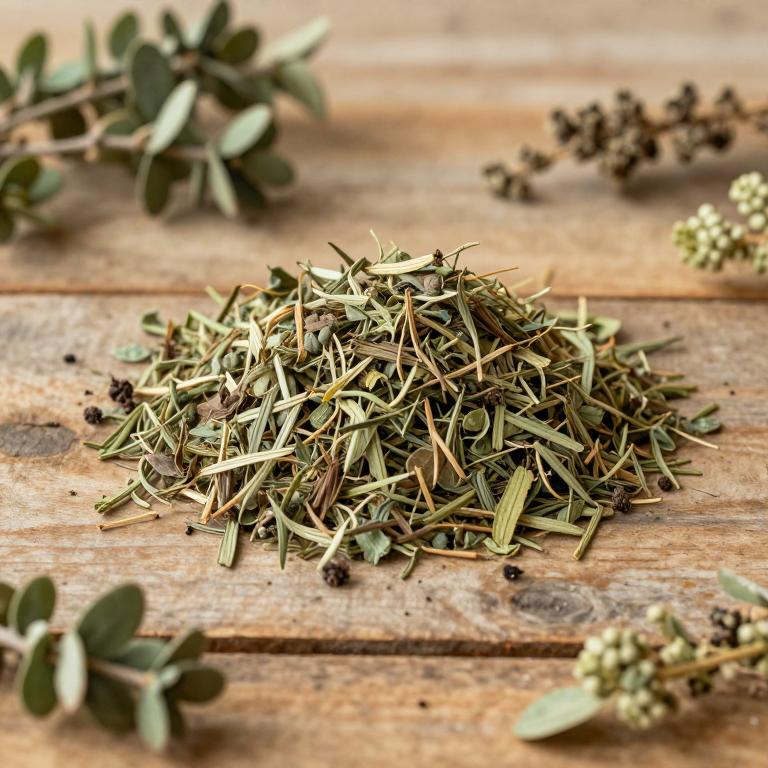
Names and Synonyms
Scientific Names
Accepted name
Acacia salignaSynonyms
- Mimosa saligna
- Racosperma salignum
- Acacia lindleyi
- Acacia cyanophylla
- Acacia bracteata
Regional and Traditional Names
Spanish:
- Acacia Azul
- Acacia cyanophylla
- Viuda de Port Jackson
German:
- Weidenblatt-Akazie
Sources: Wikidata
Taxonomical Classification
This plant belongs to the kingdom Plantae and is classified under the phylum Streptophyta and class Equisetopsida. Within the subclass Magnoliidae, it is ordered under Fabales and categorized under the family Fabaceae. Finally, it is identified by its genus, Acacia.
| Rank | Classification |
|---|---|
| Kingdom | Plantae |
| Phylum | Streptophyta |
| Class | Equisetopsida |
| Subclass | Magnoliidae |
| Order | Fabales |
| Family | Fabaceae |
| Genus | Acacia |
Sources: The World Checklist of Vascular Plants (WCVP)
Distribution
This plant, known as Acacia saligna, exhibits a specific geographical distribution across several regions of Southwestern Europe. It can be found growing within the Baleares islands as part of its Mediterranean range. Additionally, its presence extends to the island of Corse and the coastal areas of France. The species is also documented in the territory of Portugal. Finally, its distribution reaches the island of Sardegna, completing its documented footprint in these European locations.
| Region | Area |
|---|---|
| Southwestern Europe | Baleares |
| Southwestern Europe | Corse |
| Southwestern Europe | France |
| Southwestern Europe | Portugal |
| Southwestern Europe | Sardegna |
| Southwestern Europe | Spain |
| Southeastern Europe | Albania |
| Southeastern Europe | Greece |
| Southeastern Europe | Italy |
| Southeastern Europe | Kriti |
Sources: The World Checklist of Vascular Plants (WCVP)
Botanical Identification
Ecology
The ecology of Acacia saligna is defined by its remarkable adaptability to diverse environmental conditions, particularly within arid and semi-arid landscapes. It thrives across a broad altitudinal spectrum, occupying a vertical range that extends from sea level (0 m AMSL) up to a maximum elevation of 700 m AMSL. This species is frequently found in coastal regions, sand dunes, and alluvial plains, where it plays a crucial role in soil stabilization and nitrogen fixation. Its ability to colonize nutrient-poor, sandy soils allows it to establish itself in habitats where other vegetation may struggle, often forming dense thickets that influence local microclimates and soil moisture retention. The plant is highly resilient to varying moisture levels, ranging from well-drained slopes to riparian margins, making it a dominant component of various scrublands and woodland ecosystems within its specific elevational niche.
- Elevational range max:
- 700 m AMSL
- Elevational range min:
- 0 m AMSL
Life history
The life history of Acacia saligna is characterized by its status as a perennial plant, allowing it to persist through multiple growing seasons. As a phanerophyte, it maintains its photosynthetic organs on elevated branches above the ground, a structural strategy that defines its life form. Throughout its existence, the species exhibits evergreen deciduousness, ensuring that it retains its foliage and maintains metabolic activity across various environmental conditions rather than shedding leaves seasonally.
- Deciduousness :
- evergreen
- Life form :
- phanerophyte
- Lifecycle :
- perennial
Morphology
The morphology of Acacia saligna is characterized by a woody growth form that can manifest as either a shrub or a tree. It is a self-supporting, terrestrial plant that grows independently, rather than acting as a parasite or an epiphyte. In terms of stature, the plant exhibits significant vertical variation, with a minimum height of 0.5 m, a mean height of approximately 5 m, and a maximum height reaching up to 10 m.
- Aquatic :
- terrestrial
- Climber :
- self-supporting
- Epiphyte :
- terrestrial
- Growth form :
- tree
- Growth form :
- shrub
- Parasite :
- independent
- Plant height max:
- 10 m
- Plant height mean:
- 5 m
- Plant height min:
- 0.5 m
- Woodiness :
- woody
Physiology
The physiology of Acacia saligna is characterized by a highly efficient metabolic and morphological structure adapted for varied environments. As a nitrogen-fixing species, the plant engages in a symbiotic relationship with soil bacteria to convert atmospheric nitrogen into a usable form, enhancing soil fertility and its own nutrient uptake. Its photosynthetic process follows the C3 pathway, which dictates its carbon fixation mechanisms and water-use efficiency. Morphologically, the leaves are linear in form, exhibiting significant dimensional variability; they typically measure between 7 cm and 30 cm in length, with a width ranging from a minimum of 0.5 cm to a maximum of 5 cm.
- Leaf form :
- linear
- Leaf length max:
- 30 cm
- Leaf length min:
- 7 cm
- Leaf width max:
- 5 cm
- Leaf width min:
- 0.5 cm
- Nitrogen fixer :
- yes
- Photosynthetic pathway :
- C3
Reproduction
The reproduction of Acacia saligna is characterized by a complex flowering and fruiting cycle that relies heavily on biotic interactions. The plant produces yellow flowers arranged in a raceme inflorescence, which serves as a primary attractant for pollinators. The pollination syndrome is categorized as biotic, specifically utilizing insects to facilitate the transfer of pollen. Notably, self-fertilization is absent in this species, necessitating these insect visitors for successful reproduction. The flowering period is extensive and variable, beginning in January and continuing through to December. Following successful pollination, the plant develops dry fruit in the form of a pod. These pods vary in size, with lengths ranging from 5 cm to a maximum of 14 cm and widths between 0.5 cm and 0.6 cm. The fruit is dehiscent, meaning it splits open to release its seeds. The seeds themselves are relatively small, with a mean mass of approximately 0.015695926 g (ranging from a minimum of 0.00838 g to a maximum of 0.02076 g), a length between 5 mm and 6 mm, and a consistent volume of 16 mm³. Dispersal is achieved through a zoochorous syndrome, where animals play a key role in spreading the seeds to new locations.
- Dehiscence :
- dehiscent
- Dispersal syndrome :
- zoochorous
- Flower colour :
- yellow
- Flowering time :
- Jan
- Flowering time :
- Dec
- Fruit dryness :
- dry
- Fruit length max:
- 14 cm
- Fruit length min:
- 5 cm
- Fruit type :
- pod
- Fruit width max:
- 0.6 cm
- Fruit width min:
- 0.5 cm
- Inflorescence :
- raceme
- Pollination syndrome :
- insect
- Pollination syndrome :
- biotic
- Seed length max:
- 6 mm
- Seed length min:
- 5 mm
- Seed mass max:
- 0.02076 g
- Seed mass mean:
- 0.015695926 g
- Seed mass min:
- 0.00838 g
- Seed volume max:
- 16 mm³
- Self fertilization :
- absent
Sources: Global Inventory of Floras and Traits (GIFT)
Plant Parts
Acacia saligna has 2 reported plant parts identified across 2 scientific publications and several other databases that are studied for medicinal purposes. The most consistently reported plant part include flower, leaf.
| Plant part | Supporting sources | Consensus |
|---|---|---|
| Flower | 1 supporting sources | ★☆☆☆☆ |
| Leaf | 1 supporting sources | ★☆☆☆☆ |
Flower
- Heliyon
Leaf
- Fitoterapia
Chemicals
Acacia saligna has 7 reported phytochemicals identified across 2 scientific publications and several other databases. The most consistently reported chemicals include Flavonoids, Antioxidants, Procyanidins, Tannin, Tannins.
| Chemical | Supporting sources | Consensus |
|---|---|---|
| Flavonoids | 2 supporting sources | ★☆☆☆☆ |
| Antioxidants | 1 supporting sources | ★☆☆☆☆ |
| Procyanidins | 1 supporting sources | ★☆☆☆☆ |
| Tannin | 1 supporting sources | ★☆☆☆☆ |
| Tannins | 1 supporting sources | ★☆☆☆☆ |
| Unsaturated Fatty Acids | 1 supporting sources | ★☆☆☆☆ |
| polyphenols | 1 supporting sources | ★☆☆☆☆ |
Flavonoids
- Heliyon
- Fitoterapia
Antioxidants
- Heliyon
Procyanidins
- Fitoterapia
Tannin
- The British journal of nutrition
Tannins
- Heliyon
Unsaturated Fatty Acids
- Heliyon
polyphenols
- Fitoterapia
Conditions
Acacia saligna has 7 reported investigations on conditions identified across 2 scientific publications and several other databases. The most consistently reported conditions include Colitis, Ulcerative Colitis, cough, diarrhea, headaches.
| Condition | Supporting sources | Consensus |
|---|---|---|
| Colitis | 1 supporting sources | ★☆☆☆☆ |
| Ulcerative colitis | 1 supporting sources | ★☆☆☆☆ |
| Cough | 1 supporting sources | ★☆☆☆☆ |
| Diarrhea | 1 supporting sources | ★☆☆☆☆ |
| Headaches | 1 supporting sources | ★☆☆☆☆ |
| Testosterone | 1 supporting sources | ★☆☆☆☆ |
| Wounds | 1 supporting sources | ★☆☆☆☆ |
Colitis
- Biology
Ulcerative colitis
- Biology
Cough
- Fitoterapia
Diarrhea
- Fitoterapia
Headaches
- Fitoterapia
Testosterone
- Heliyon
Wounds
- Fitoterapia
Preparations
Acacia saligna has 8 reported preparations identified across 2 scientific publications and several other databases. The most consistently reported preparations include butanol extract, dry leachates, flower extract, leaf extract (LE), leaf methanolic extracts.
| Preparation | Supporting sources | Consensus |
|---|---|---|
| Butanol extract | 1 supporting sources | ★☆☆☆☆ |
| Dry leachates | 1 supporting sources | ★☆☆☆☆ |
| Flower extract | 1 supporting sources | ★☆☆☆☆ |
| Leaf extract (le) | 1 supporting sources | ★☆☆☆☆ |
| Leaf methanolic extracts | 1 supporting sources | ★☆☆☆☆ |
| Nano extract | 1 supporting sources | ★☆☆☆☆ |
| Nano-formula-tions | 1 supporting sources | ★☆☆☆☆ |
| Stem extract (se) | 1 supporting sources | ★☆☆☆☆ |
Butanol extract
- Biology
Dry leachates
- PeerJ
Flower extract
- Heliyon
Leaf extract (le)
- PeerJ
Leaf methanolic extracts
- Fitoterapia
Nano extract
- Biology
Nano-formula-tions
- Biology
Stem extract (se)
- PeerJ